



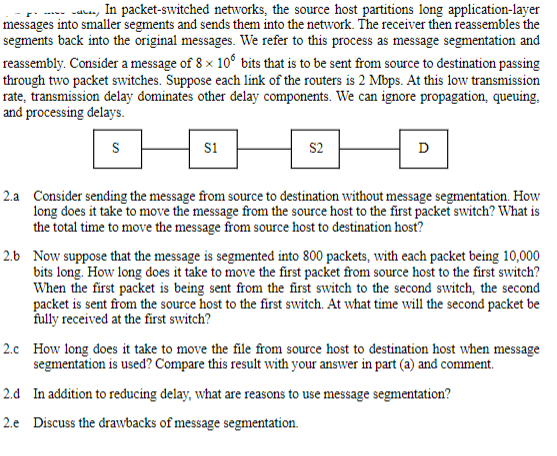
Question: In packet - switched networks, the source host partitions long application - layer messages into smaller segments and sends them into the network. The receiver
In packetswitched networks, the source host partitions long applicationlayer
messages into smaller segments and sends them into the network. The receiver then reassembles the
segments back into the original messages. We refer to this process as message segmentation and
reassembly. Consider a message of bits that is to be sent from source to destination passing
through two packet switches. Suppose each link of the routers is At this low transmission
rate, transmission delay dominates other delay components. We can ignore propagation, queuing,
and processino delave
a Consider sending the message from source to destination without message segmentation. How
long does it take to move the message from the source host to the first packet switch? What is
the total time to move the message from source host to destination host?
b Now suppose that the message is segmented into packets, with each packet being
bits long. How long does it take to move the first packet from source host to the first switch?
When the first packet is being sent from the first switch to the second switch, the second
packet is sent from the source host to the first switch. At what time will the second packet be
fully received at the first switch?
c How long does it take to move the file from source host to destination host when message
segmentation is used? Compare this result with your answer in part a and comment.
d In addition to reducing delay, what are reasons to use message segmentation?
e Discuss the drawbacks of message segmentation.
Step by Step Solution
There are 3 Steps involved in it
1 Expert Approved Answer
Step: 1 Unlock

Question Has Been Solved by an Expert!
Get step-by-step solutions from verified subject matter experts
Step: 2 Unlock
Step: 3 Unlock