







Question: In packet-switched network, two applications in the network running at Host A and Host B, respectively, are both sending data to Host C The link
In packet-switched network, two applications in the network running at Host A and Host B, respectively, are both sending data to Host C
The link capacity between router R1 and router R2 is L bits per time slot and the link capacity between router R2 and Host C is M bits per time slot. We have L Each application lasts for T time slots: as shown in figure below, one application transmits a packet of N bits at the speed of Z1 bits per time slot at the beginning of each time slot, and the other application transmits a packet of N bits at the speed of Z2 bits per time slot immediately following that. Suppose N>L/2 (bits), Z1>L (bits per time slot), Z2>L (bits per time slot), and N/Z1+N/Z2=1. Ignore nodal processing delay and propagation delay in this network. Q1-1 Find the queueing delay experienced by the last packet from application 2 at router R1 Q1-2 Find average throughput of receiving data from both applications at host C, over the span from the start of the first time slot (t0) to the time when the last packet from application 2 is entirely received by host C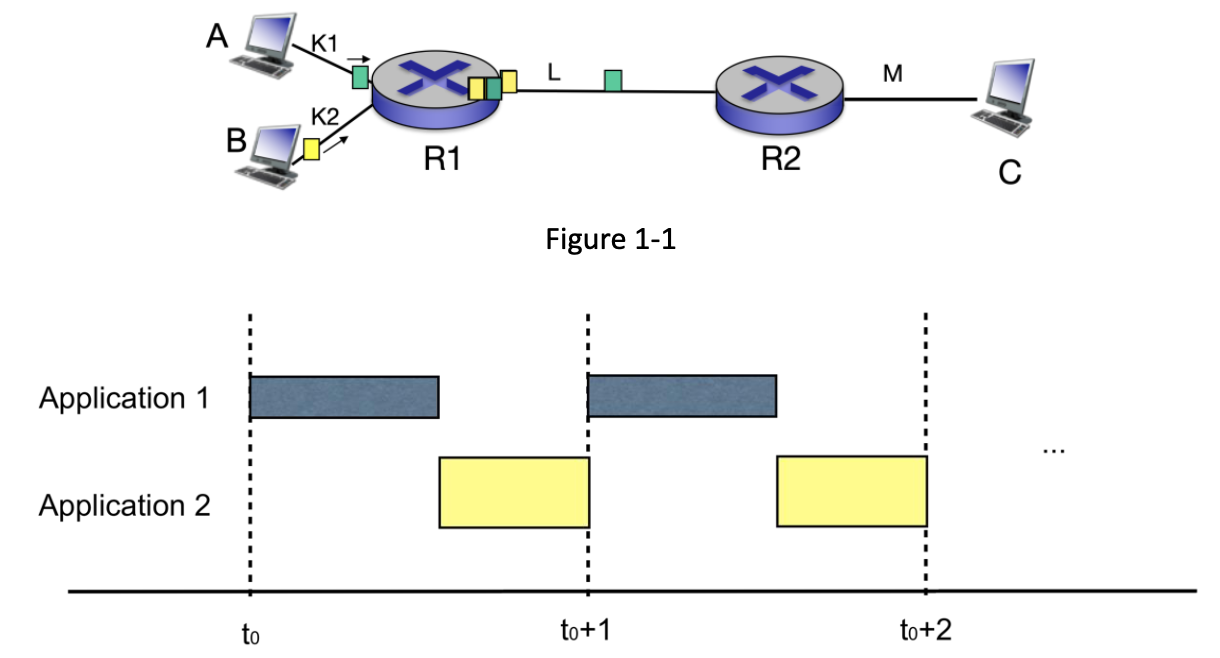
Step by Step Solution
There are 3 Steps involved in it

Get step-by-step solutions from verified subject matter experts
 Study Help