







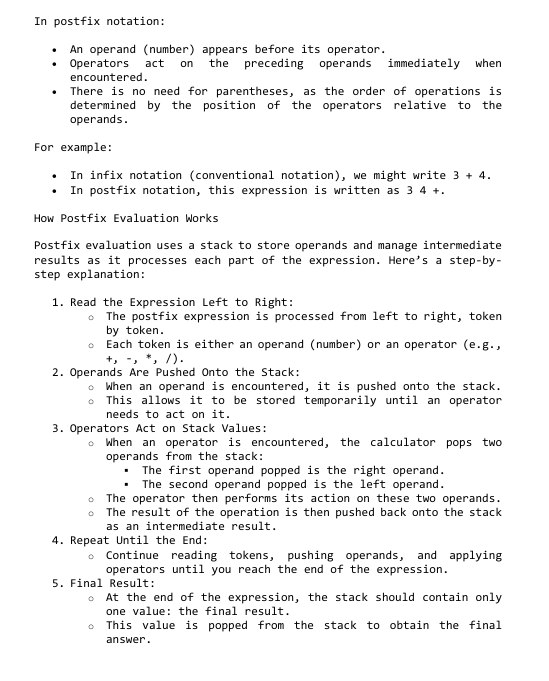
Question: In postfix notation: An operand ( number ) appears before its operator. Operators act on the preceding operands immediately when encountered. There is no need
In postfix notation:
An operand number appears before its operator.
Operators act on the preceding operands immediately when
encountered.
There is no need for parentheses, as the order of operations is
determined by the position of the operators relative to the
operands.
For example:
In infix notation conventional notation we might write
In postfix notation, this expression is written as
How Postfix Evaluation Works
Postfix evaluation uses a stack to store operands and manage intermediate
results as it processes each part of the expression. Here's a stepby
step explanation:
Read the Expression Left to Right:
The postfix expression is processed from left to right, token
by token.
Each token is either an operand number or an operator eg
Operands Are Pushed Onto the Stack:
When an operand is encountered, it is pushed onto the stack.
This allows it to be stored temporarily until an operator
needs to act on it
Operators Act on Stack Values:
When an operator is encountered, the calculator pops two
operands from the stack:
The first operand popped is the right operand.
The second operand popped is the left operand.
The operator then performs its action on these two operands.
The result of the operation is then pushed back onto the stack
as an intermediate result.
Repeat Until the End:
Continue reading tokens, pushing operands, and applying
operators until you reach the end of the expression.
Final Result:
At the end of the expression, the stack should contain only
one value: the final result.
This value is popped from the stack to obtain the final
answer.
Example of Postfix Evaluation
Consider the postfix expression:
Let's evaluate it step by step:
Token : It's an operand, so push onto the stack.
Stack:
Token : It's an operand, so push onto the stack.
Stack:
Token : It's an operator, so pop the top two values from the stack
and
Operation:
Push the result back onto the stack.
Stack:
Token : It's an operand, so push onto the stack.
Stack:
Token : It's an operator, so pop the top two values from the stack
and
Operation:
Push the result back onto the stack.
Stack:
End of Expression: The stack contains a single value, which is
the final result.
Advantages of Postfix Notation
No Parentheses Needed: Postfix notation does not require
parentheses, making expressions simpler to write and evaluate.
Simplified Computation with a Stack: The LIFO structure of a stack
naturally handles the order of operations without needing to
consider precedence rules or parentheses.
Q Write an assembly code using floating point unit to compute the value
expression
Y
You must convert the above expression to postfix notation using pencil
and paper and then use that expression, store the same in a data structure
and use FPU and write an assembly program. You don't have to write a
tokenizer.
Points
Q Trace this program and showing the contents of FPU stack after
execution of each Instruction of your code.
Points
please help, Im having trouble with this, if you could answer the questions that would be extremely helpful, masm is preferred please
Step by Step Solution
There are 3 Steps involved in it
1 Expert Approved Answer
Step: 1 Unlock

Question Has Been Solved by an Expert!
Get step-by-step solutions from verified subject matter experts
Step: 2 Unlock
Step: 3 Unlock
 Study Help