





Question: In practice, when doing CDS valuations, we need to estimate the default probability and the recovery rate, just as we need to estimate the volatility
In practice, when doing CDS valuations, we need
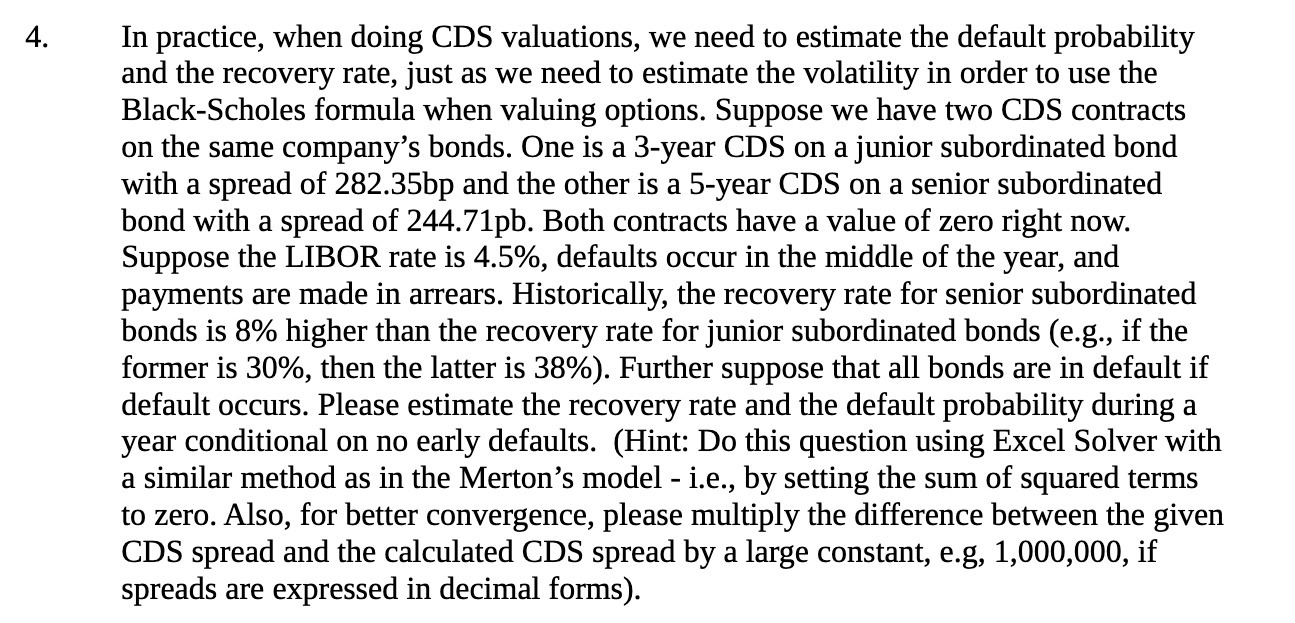
In practice, when doing CDS valuations, we need to estimate the default probability and the recovery rate, just as we need to estimate the volatility in order to use the Black-Scholes formula when valuing options. Suppose we have two CDS contracts on the same company's bonds. One is a 3-year CDS on a junior subordinated bond with a spread of 282.35bp and the other is a 5-year CDS on a senior subordinated bond with a spread of 244.71pb. Both contracts have a value of zero right now. Suppose the LIBOR rate is 4.5%, defaults occur in the middle of the year, and payments are made in arrears. Historically, the recovery rate for senior subordinated bonds is 8% higher than the recovery rate for junior subordinated bonds (e.g., if the former is 30%, then the latter is 38%). Further suppose that all bonds are in default if default occurs. Please estimate the recovery rate and the default probability during a year conditional on no early defaults. (Hint: Do this question using Excel Solver with a similar method as in the Merton's model - i.e., by setting the sum of squared terms to zero. Also, for better convergence, please multiply the difference between the given CDS spread and the calculated CDS spread by a large constant, e.g, 1,000,000, if spreads are expressed in decimal forms)

Step by Step Solution

There are 3 Steps involved in it

1 Expert Approved Answer
Step: 1 Unlock blur-text-image

Question Has Been Solved by an Expert!

Get step-by-step solutions from verified subject matter experts

Step: 2 Unlock
Step: 3 Unlock

Students Have Also Explored These Related Mathematics Questions!