







Question: In problem 2, you will illustrate the Central Limit Theorem using a uniform distribution. The uniform distribution is one of the simplest probability distributions.
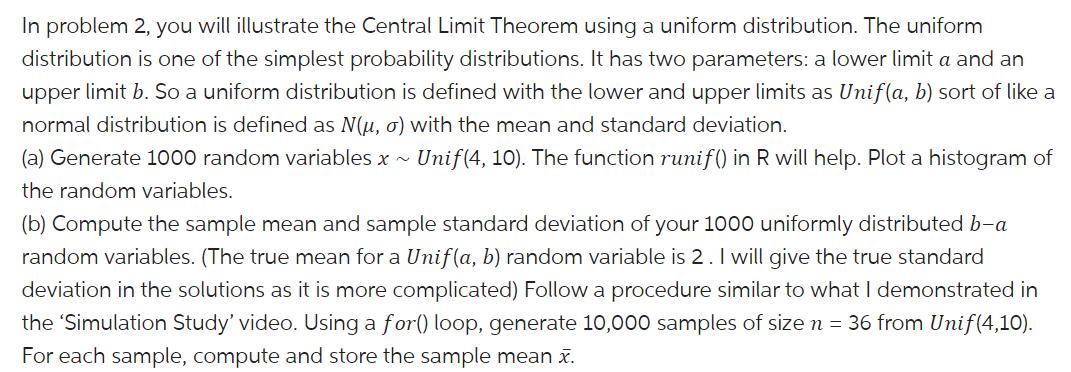
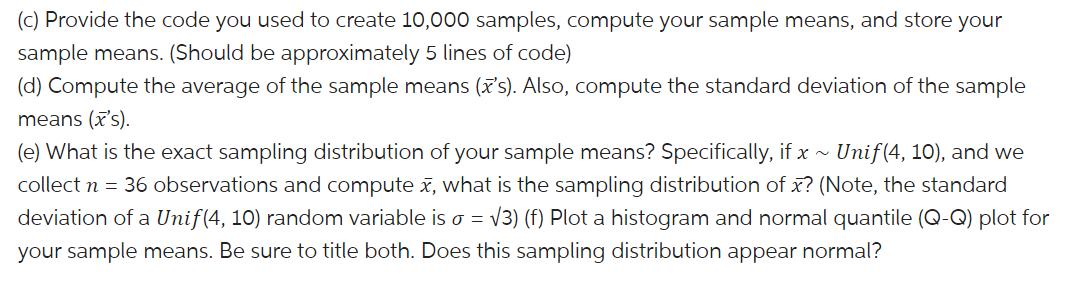
In problem 2, you will illustrate the Central Limit Theorem using a uniform distribution. The uniform distribution is one of the simplest probability distributions. It has two parameters: a lower limit a and an upper limit b. So a uniform distribution is defined with the lower and upper limits as Unif(a, b) sort of like a normal distribution is defined as N(u, o) with the mean and standard deviation. (a) Generate 1000 random variables x~ Unif(4, 10). The function runif() in R will help. Plot a histogram of the random variables. (b) Compute the sample mean and sample standard deviation of your 1000 uniformly distributed b-a random variables. (The true mean for a Unif(a, b) random variable is 2. I will give the true standard deviation in the solutions as it is more complicated) Follow a procedure similar to what I demonstrated in the 'Simulation Study' video. Using a for() loop, generate 10,000 samples of size n = 36 from Unif(4,10). For each sample, compute and store the sample mean x. (c) Provide the code you used to create 10,000 samples, compute your sample means, and store your sample means. (Should be approximately 5 lines of code) (d) Compute the average of the sample means (x's). Also, compute the standard deviation of the sample means (x's). (e) What is the exact sampling distribution of your sample means? Specifically, if x ~ Unif(4, 10), and we collect n = 36 observations and compute x, what is the sampling distribution of x? (Note, the standard deviation of a Unif(4, 10) random variable is o = 3) (f) Plot a histogram and normal quantile (Q-Q) plot for your sample means. Be sure to title both. Does this sampling distribution appear normal?
Step by Step Solution
3.44 Rating (160 Votes )
There are 3 Steps involved in it

Get step-by-step solutions from verified subject matter experts
 Study Help