



Question: In problem 4.5 in K&K, you calculated that the temperature of the Earth was 280K by assuming that the Earth was a spherical, isothermal blackbody
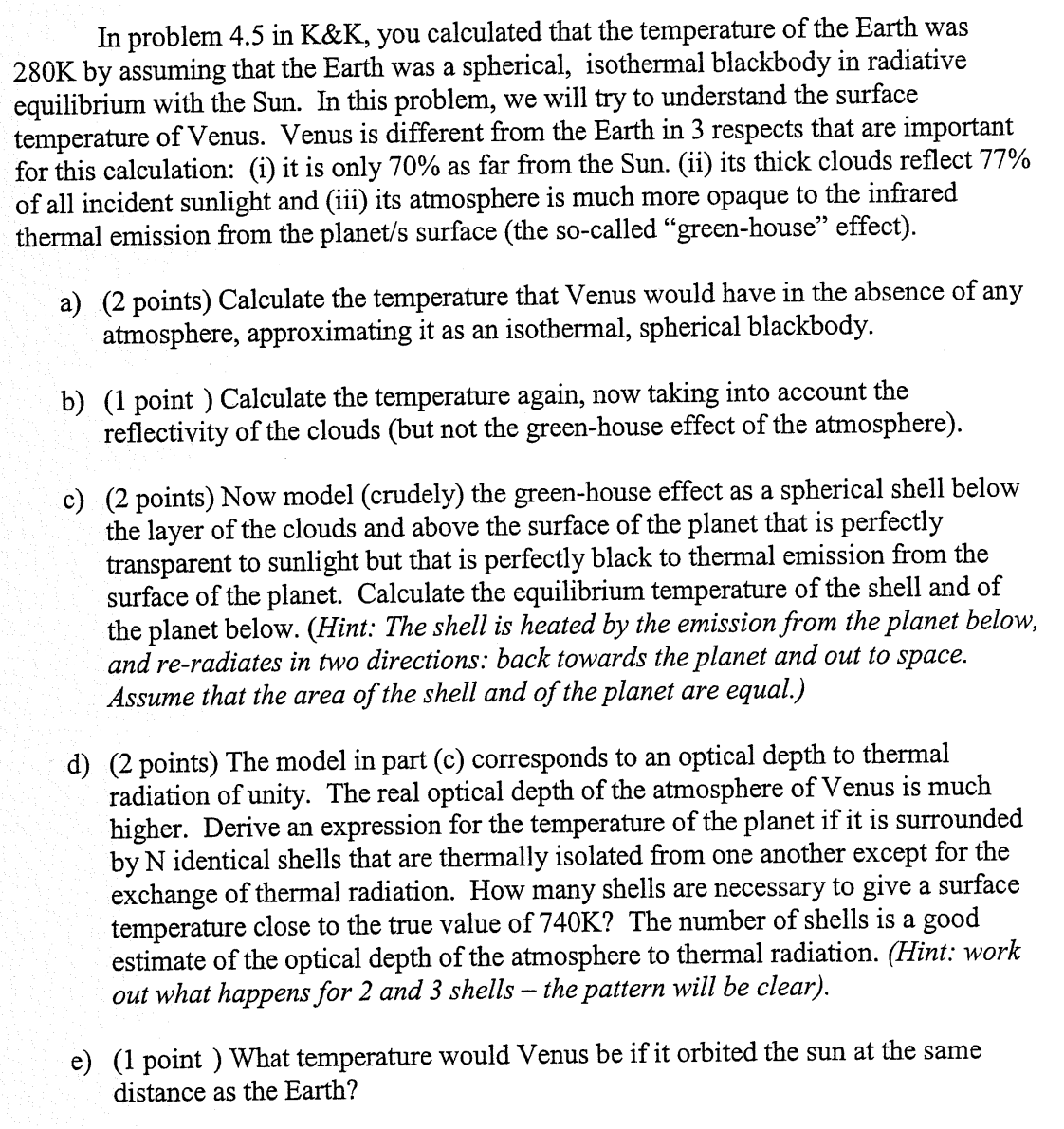
In problem 4.5 in K&K, you calculated that the temperature of the Earth was 280K by assuming that the Earth was a spherical, isothermal blackbody in radiative equilibrium with the Sun. In this problem, we will try to understand the surface temperature of Venus. Venus is different from the Earth in 3 respects that are important for this calculation: (i) it is only 70% as far from the Sun. (ii) its thick clouds reect 77% of all incident sunlight and (iii) its atmosphere is much more opaque to the infrared thermal emission from the planet/s surface (the socalled \"green-house\" effect). a) (2 points) Calculate the temperature that Venus would have in the absence of any atmosphere, approximating it as an isothermal, Spherical blackbody. b) (1 point ) Calculate the temperature again, now taking into account the reectivity of the clouds (but not the greenhouse effect of the atmosphere). 0) (2 points) Now model (crudely) the green-house effect as a spherical shell below the layer of the clouds and above the surface of the planet that is perfectly transparent to sunlight but that is perfectly black to thermal emission from the surface of the planet. Calculate the equilibrium temperature of the shell and of the planet below. (Hint: The shell is heated by the emission from the planet below, and re-radz'ares in two directions: back towards the planet and out to space. Assume that the area of the shell and ofthe planet are equal.) d) (2 points) The model in part (0) corresponds to an optical depth to thermal radiation of unity. The real optical depth of the atmosphere of Venus is much higher. Derive an expression for the temperature of the planet if it is surrounded by N identical shells that are thermally isolated from one another except for the exchange of thermal radiation. How many shells are necessary to give a surface temperature close to the true value of 740K? The number of shells is a good estimate of the optical depth of the atmosphere to thermal radiation. (Hint: work out what happens for .2 and 3 shells - the pattern will be clear). e) (1 point ) What temperature would Venus be if it orbited the sun at the same distance as the Earth
Step by Step Solution
There are 3 Steps involved in it

Get step-by-step solutions from verified subject matter experts