







Question: In problems 1-5 below, I will list a set S and a rule that defines a relation R on S as follows: (m, n) E
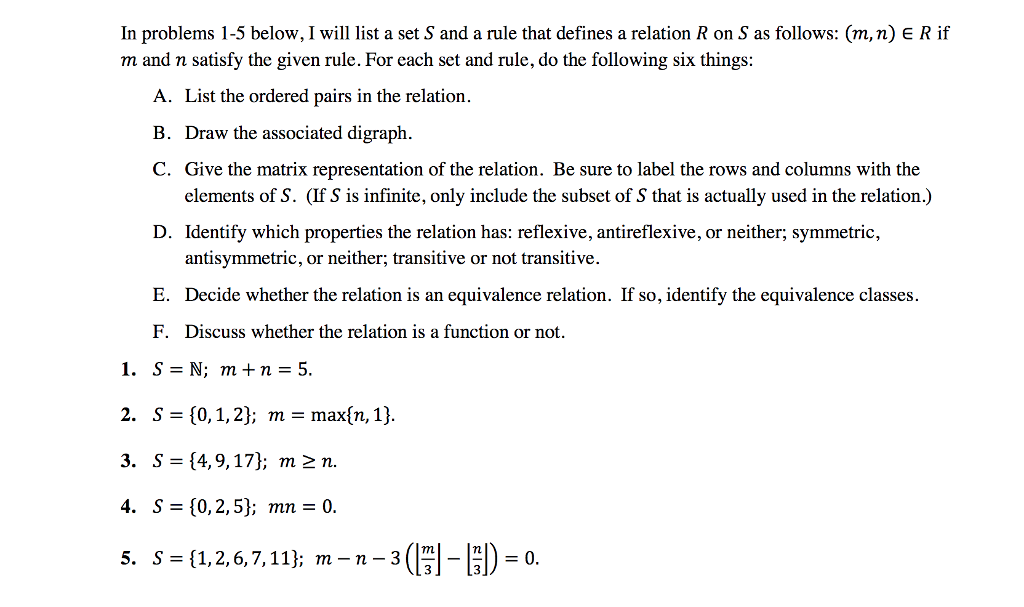
In problems 1-5 below, I will list a set S and a rule that defines a relation R on S as follows: (m, n) E R if m and n satisfy the given rule. For each set and rule, do the following six things: A. List the ordered pairs in the relation B. Draw the associated digraph. C. Give the matrix representation of the relation. Be sure to label the rows and columns with the elements of S. (If S is infinite, only include the subset of S that is actually used in the relation.) Identify which properties the relation has: reflexive, antireflexive, or neither; symmetric, antisymmetric, or neither, transitive or not transitive D. E. Decide whether the relation is an equivalence relation. If so, identify the equivalence classes F. Discuss whether the relation is a function or not. 2. S [0,1,2]; m-maxfn, 1). 3. S-[4,9,17); m zn. 4. S = {0,2,5); mn = 0. s. s-(1.26,7,.11:3(-B-o 0
Step by Step Solution
There are 3 Steps involved in it

Get step-by-step solutions from verified subject matter experts
 Study Help