







Question: In Problems 25-30, x = 0 is a regular singular point of the given dif- ferential equation. Show that the indicial roots of the singularity
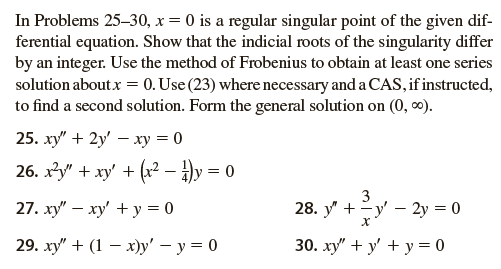
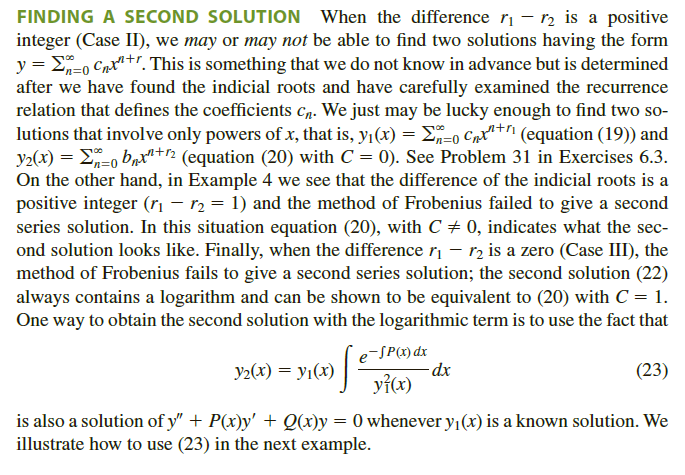
In Problems 25-30, x = 0 is a regular singular point of the given dif- ferential equation. Show that the indicial roots of the singularity differ by an integer. Use the method of Frobenius to obtain at least one series solution about x = 0. Use (23) where necessary and a CAS, if instructed, to find a second solution. Form the general solution on (0, co). 25. xy" + 2y' - xy = 0 26. xy" +xy' + (x2 - Hy = 0 3 27. xy" - xy' ty = 0 28. y +-v - 2y = 0 X 29. xy" + (1 - x)y'- y = 0 30. xy" ty ty=0FINDING A SECOND SOLUTION When the difference ry r, is a positive integer (Case II), we may or may not be able to find two solutions having the form y = X, c,x"*". This is something that we do not know in advance but is determined after we have found the indicial roots and have carefully examined the recurrence relation that defines the coefficients c,. We just may be lucky enough to find two so- lutions that involve only powers of x, that is, y;(x) = =7_, c,x"" "' (equation (19)) and ya(x) = 2, byx""" (equation (20) with C = 0). See Problem 31 in Exercises 6.3. On the other hand, in Example 4 we see that the difference of the indicial roots is a positive integer (r; r = 1) and the method of Frobenius failed to give a second series solution. In this situation equation (20), with C # 0, indicates what the sec- ond solution looks like. Finally, when the difference r; r; is a zero (Case III), the method of Frobenius fails to give a second series solution; the second solution (22) always contains a logarithm and can be shown to be equivalent to (20) with C = 1. One way to obtain the second solution with the logarithmic term is to use the fact that E_.rP Erj dx yix) is also a solution of v" + P(x)y" + Q(x)y = 0 whenever y,(x) is a known solution. We illustrate how to use (23) in the next example. ya(x) = yi(x) J (23)
Step by Step Solution
There are 3 Steps involved in it

Get step-by-step solutions from verified subject matter experts
 Study Help