







Question: In Python Please! Q10: Call expressions, such as square(2), apply functions to arguments. When executing call expressions, we create a new frame in our diagram
In Python Please!
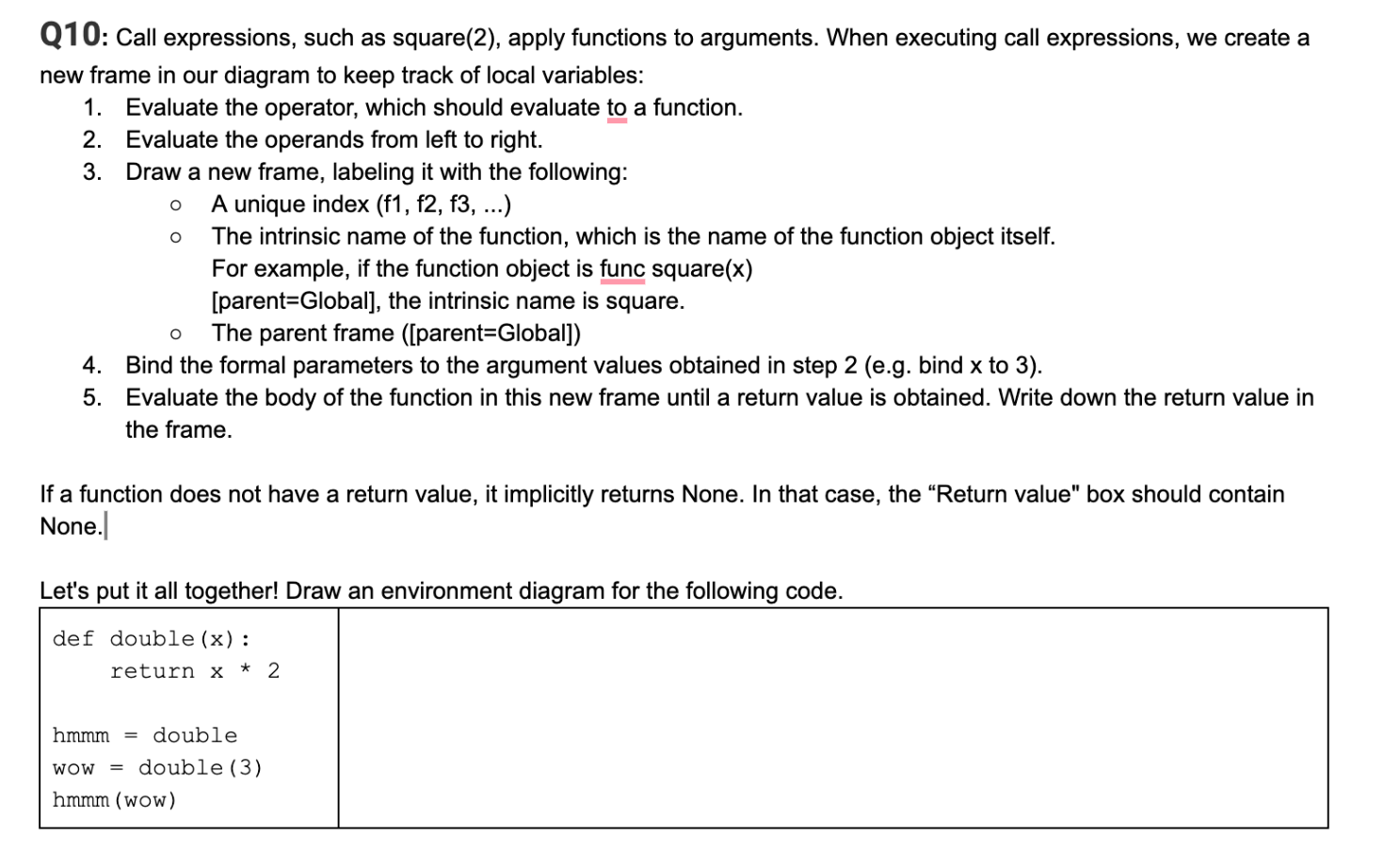
Q10: Call expressions, such as square(2), apply functions to arguments. When executing call expressions, we create a new frame in our diagram to keep track of local variables: 1. Evaluate the operator, which should evaluate to a function. 2. Evaluate the operands from left to right. 3. Draw a new frame, labeling it with the following: - A unique index (f1,f2,f3,) - The intrinsic name of the function, which is the name of the function object itself. For example, if the function object is func square (x) [parent=Global], the intrinsic name is square. - The parent frame ([parent=Global]) 4. Bind the formal parameters to the argument values obtained in step 2 (e.g. bind x to 3 ). 5. Evaluate the body of the function in this new frame until a return value is obtained. Write down the return value in the frame. If a function does not have a return value, it implicitly returns None. In that case, the "Return value" box should contain
Step by Step Solution
There are 3 Steps involved in it

Get step-by-step solutions from verified subject matter experts
 Study Help