







Question: in python pls 12.1 DNA Sequence DNA, the carrier of genetic information in living things, has been used in criminal justice for decades. But how,
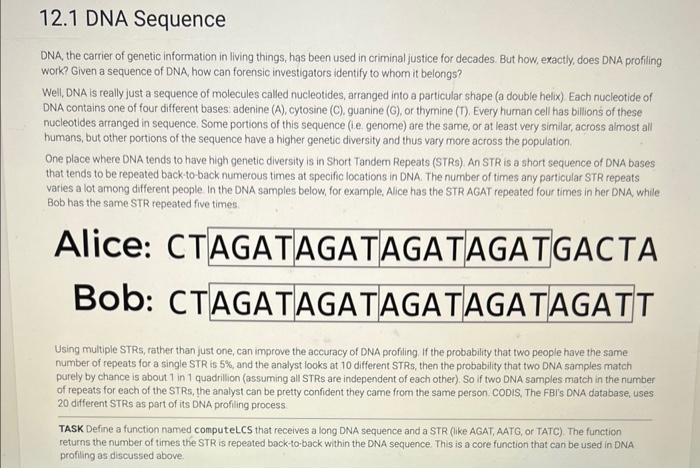
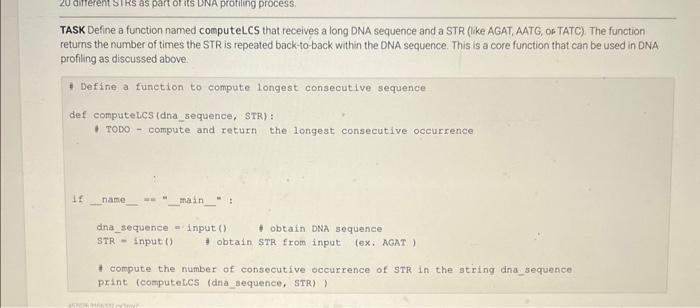
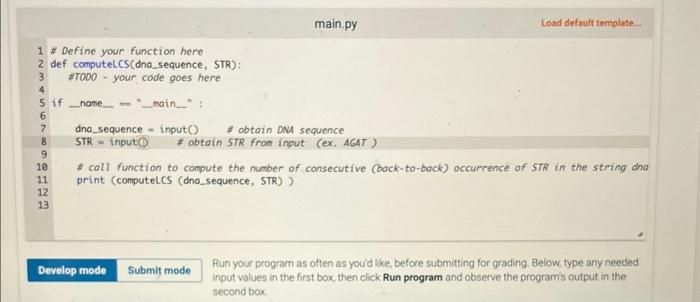
12.1 DNA Sequence DNA, the carrier of genetic information in living things, has been used in criminal justice for decades. But how, exactly, does DNA profilin work? Given a sequence of DNA, how can forensic investigators identify to whom it belongs? Well Alice: CTAGATAGATAGATAGATGACTA Bob: CTAGATAGATAGATAGATAGATT TASK Define a function named computeLCS that receives a long DNA sequence and a STR (like AGAT, AATG, OF TATC) The function returns the number of times the STR is repeated back-to-back within the DNA sequence. This is a core function that can be used in DNA profiling as discussed above. Define a function to compute longest consecutive sequence def computelcs (dna_sequence, STR): - TODO - compute and return the longest consecutive occurrence if name =- "main_" : dna_sequence = input () obtain DNA sequence STR - input ( obtain STR from input (ex. AGAT) t compute the number of consecutive occurrence of STR in the string dna sequence print (corputelcs (dina_sequence, STR) ) \# call function to compute the number of consecutive (back-to-back) occurrence of STR in the string dna print (computelCS (dna sequence, STR)) Run your program as often as you'd like, before submitting for grading. Below, type any needed input values in the first box, then click Run program and observe the program's output in the second box
Step by Step Solution
There are 3 Steps involved in it

Get step-by-step solutions from verified subject matter experts
 Study Help