







Question: In Python (The Account class) Design a class named Account that contains: A private int data field named id for the account. A private float
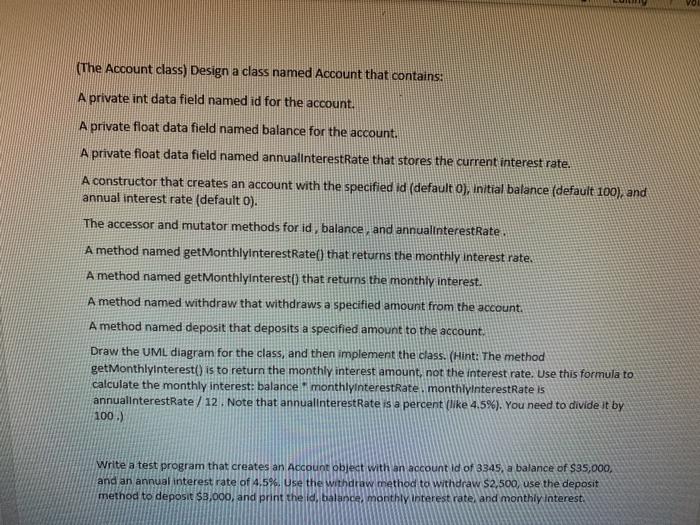
(The Account class) Design a class named Account that contains: A private int data field named id for the account. A private float data field named balance for the account. A private float data field named annualinterestRate that stores the current interest rate. A constructor that creates an account with the specified id (default 0), Initial balance (default 100), and annual interest rate (default o). The accessor and mutator methods for id, balance, and annualnterestRate. A method named getMonthlyinterestRate() that returns the monthly interest rate. A method named getMonthlyinterest() that returns the monthly interest. A method named withdraw that withdraws a specified amount from the account. A method named deposit that deposits a specified amount to the account. Draw the UML diagram for the class, and then implement the class. (Hint: The method get MonthlyInterest() is to return the monthly interest amount, not the interest rate. Use this formula to calculate the monthly interest: balance 1 monthlyInterestRate, monthlyInterestRate is annualinterest Rate / 12. Note that annualinterest Rate is a percent (like 4.5%). You need to divide it by 100.) Write a test program that creates an Account object with an account id of 3345, a balance of $35,000, and an annual interest rate of 4,5%. Use the withdraw method to withdraw $2,500, use the deposit method to deposit $3,000, and print the id, balance, monthly interest rate, and monthly interest
Step by Step Solution
There are 3 Steps involved in it

Get step-by-step solutions from verified subject matter experts
 Study Help