







Question: In Question 1 2 , if we write new data to a newly - allocated data block data [ 0 ] , you need to
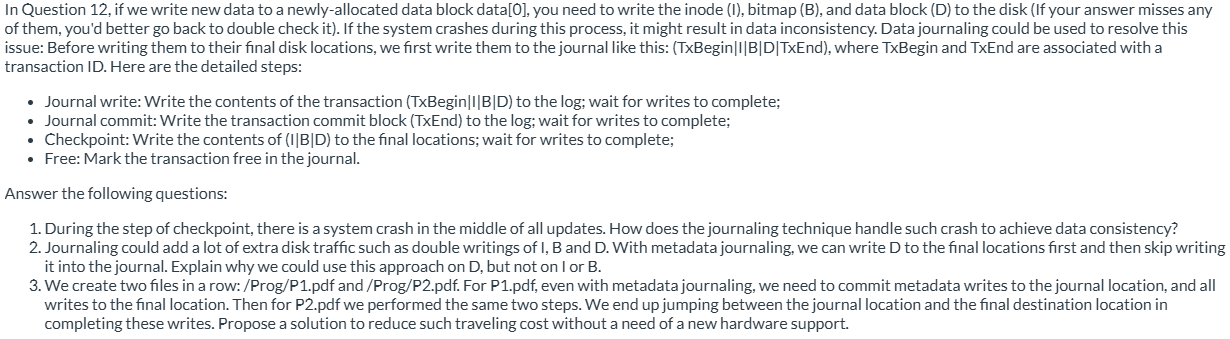
In Question if we write new data to a newlyallocated data block data you need to write the inode I bitmap B and data block D to the disk If your answer misses any of them, you'd better go back to double check it If the system crashes during this process, it might result in data inconsistency. Data journaling could be used to resolve this issue: Before writing them to their final disk locations, we first write them to the journal like this: TxBeginIBDTxEnd where TxBegin and TxEnd are associated with a transaction ID Here are the detailed steps:
Journal write: Write the contents of the transaction TxBeginIBD to the log; wait for writes to complete;
Journal commit: Write the transaction commit block TxEnd to the log; wait for writes to complete;
Checkpoint: Write the contents of IBD to the final locations; wait for writes to complete;
Free: Mark the transaction free in the journal.
Answer the following questions:
During the step of checkpoint, there is a system crash in the middle of all updates. How does the journaling technique handle such crash to achieve data consistency?
Journaling could add a lot of extra disk traffic such as double writings of I, B and D With metadata journaling, we can write D to the final locations first and then skip writing it into the journal. Explain why we could use this approach on D but not on I or B
We create two files in a row: ProgPpdf and ProgPpdf For Ppdf even with metadata journaling, we need to commit metadata writes to the journal location, and all writes to the final location. Then for Ppdf we performed the same two steps. We end up jumping between the journal location and the final destination location in completing these writes. Propose a solution to reduce such traveling cost without a need of a new hardware support.
Step by Step Solution
There are 3 Steps involved in it
1 Expert Approved Answer
Step: 1 Unlock

Question Has Been Solved by an Expert!
Get step-by-step solutions from verified subject matter experts
Step: 2 Unlock
Step: 3 Unlock
 Study Help