







Question: In reading the case study regarding the Buffalo Bisons Baseball Club at the conclusion of Chapter 14 - Compensation of Special Groups, please answer the
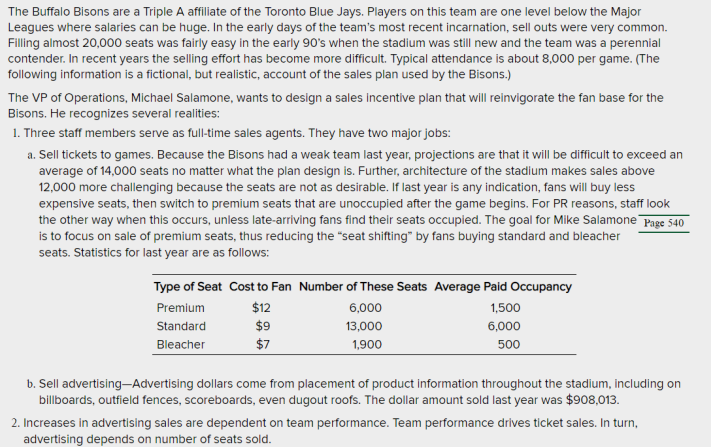

In reading the case study regarding the Buffalo Bisons Baseball Club at the conclusion of Chapter 14 - Compensation of Special Groups, please answer the following questions for your case study:
1) Based on the information in the case study, what is the most important information your design of a sales incentive plan for the three (3) person sales staff?
2) The chapter talks about unit rate plans. Which of these types of plan would you use for sales of tickets? Which plan might be appropriate for the sales of advertising? Why?
3) What factors influence the dollar amount you can pay for increases in ticket sales?
Your assignment submission should be in APA format and 2-3 pages in length not including title and reference pages. Include at least two (2) sources excluding your textbook.
The Buffalo Bisons are a Triple A affiliate of the Toronto Blue Jays. Players on this team are one level below the Major Leagues where salaries can be huge. In the early days of the team's most recent incarnation, sell outs were very common. Filling almost 20,000 seats was fairly easy in the early 90 's when the stadium was still new and the team was a perennial contender. In recent years the selling effort has become more difficult. Typical attendance is about 8,000 per game. (The following information is a fictional, but realistic, account of the sales plan used by the Bisons.) The VP of Operations, Michael Salamone, wants to design a sales incentive plan that will reinvigorate the fan base for the Bisons. He recognizes several realities: 1. Three staff members serve as full-time sales agents. They have two major jobs: a. Sell tickets to games. Because the Bisons had a weak team last year, projections are that it will be difficult to exceed an average of 14,000 seats no matter what the plan design is. Further, architecture of the stadium makes sales above 12,000 more challenging because the seats are not as desirable. If last year is any indication, fans will buy less expensive seats, then switch to premium seats that are unoccupied after the game begins. For PR reasons, staff look the other way when this occurs, unless late-arriving fans find their seats occupled. The goal for Mike Salamone Page 540 is to focus on sale of premium seats, thus reducing the "seat shifting" by fans buying standard and bleacher seats. Statistics for last year are as follows: b. Sell advertising-Advertising dollars come from placement of product information throughout the stadium, including on billboards, outfield fences, scoreboards, even dugout roofs. The dollar amount sold last year was $908,013. 2. Increases in advertising sales are dependent on team performance. Team performance drives ticket sales. In turn, advertising depends on number of seats sold. 3. The three staff members are heavily dependent on the total administrative team ( 7 other individuals) for ancillary activities in the selling event (e.g., they send out brochures, answer phone queries, provide follow-up information after the initial sales contact, etc.). Mike Salamone wants to have a simple plan for advertising sales that rewards the total group yet still motivates the three sales staff. The Buffalo Bisons are a Triple A affiliate of the Toronto Blue Jays. Players on this team are one level below the Major Leagues where salaries can be huge. In the early days of the team's most recent incarnation, sell outs were very common. Filling almost 20,000 seats was fairly easy in the early 90 's when the stadium was still new and the team was a perennial contender. In recent years the selling effort has become more difficult. Typical attendance is about 8,000 per game. (The following information is a fictional, but realistic, account of the sales plan used by the Bisons.) The VP of Operations, Michael Salamone, wants to design a sales incentive plan that will reinvigorate the fan base for the Bisons. He recognizes several realities: 1. Three staff members serve as full-time sales agents. They have two major jobs: a. Sell tickets to games. Because the Bisons had a weak team last year, projections are that it will be difficult to exceed an average of 14,000 seats no matter what the plan design is. Further, architecture of the stadium makes sales above 12,000 more challenging because the seats are not as desirable. If last year is any indication, fans will buy less expensive seats, then switch to premium seats that are unoccupied after the game begins. For PR reasons, staff look the other way when this occurs, unless late-arriving fans find their seats occupled. The goal for Mike Salamone Page 540 is to focus on sale of premium seats, thus reducing the "seat shifting" by fans buying standard and bleacher seats. Statistics for last year are as follows: b. Sell advertising-Advertising dollars come from placement of product information throughout the stadium, including on billboards, outfield fences, scoreboards, even dugout roofs. The dollar amount sold last year was $908,013. 2. Increases in advertising sales are dependent on team performance. Team performance drives ticket sales. In turn, advertising depends on number of seats sold. 3. The three staff members are heavily dependent on the total administrative team ( 7 other individuals) for ancillary activities in the selling event (e.g., they send out brochures, answer phone queries, provide follow-up information after the initial sales contact, etc.). Mike Salamone wants to have a simple plan for advertising sales that rewards the total group yet still motivates the three sales staff
Step by Step Solution
There are 3 Steps involved in it

Get step-by-step solutions from verified subject matter experts
 Study Help