







Question: In sample steps please For the questions below the following doss definition Which of the following could be used to instantiate a new Student s_1?
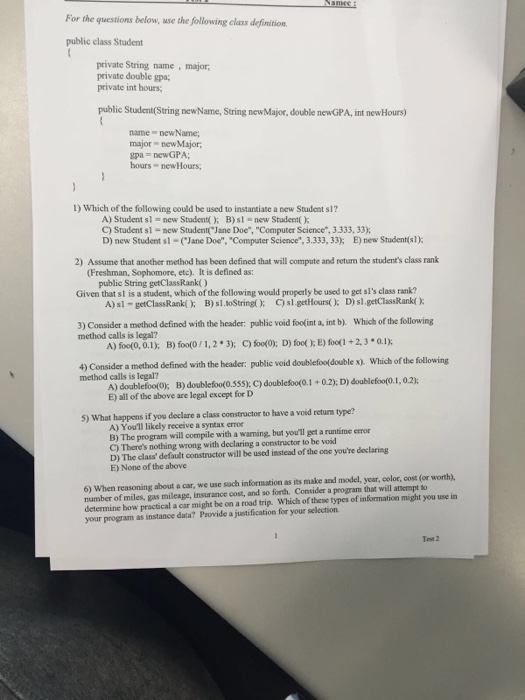
For the questions below the following doss definition Which of the following could be used to instantiate a new Student s_1? Student s1 = new Student(); s_1 = new Student(); Student s1 = new Student("Janc Doe", "Computer Science. 3.333.33); new Student (s1) Assume that another method has been defined that will compute and return the student's class rank (Freshman. Sophomore, etc). It is defined as: pubic Stnng gctClassRank() Given that s1 is a student, which of the following would properly be used to get s1's class rank? s1 = getClassRank(); s1.toString(); s1 get Hours(): s1 getClassRank(); Consider a method defined with the header: public void foo(tit a. int b). Which of the following method calls is legal? Consider a method defined with the header: public void doubkfoo(double x) Which of the following method calls is legal? What happens if you declare a class constructor to have a void return type? You'll likely receive a syntax cm The program will compile with a warning, but you'll per a runtime cm There's nothing wrong with declaring a constructor lo be void The class' default constructor will be used instead of the one you're declaring None of the above When reasoning about a car. we use such information as its make and model year, color, cost (as worth) number of miles, gas mileage, insurance cost and so forth. consider a program that will attempt to determine how practical a car might be on a road trip. which of these types of information might you use in your program as instance data? Provide a justfication for your selection
Step by Step Solution
There are 3 Steps involved in it

Get step-by-step solutions from verified subject matter experts
 Study Help