







Question: In Section 1.2, engineering risk management was described as a program management process and one that, at its best, is indistinguishable from program management. Discuss
In Section 1.2, engineering risk management was described as a program management process and one that, at its best, is indistinguishable from program management.
- Discuss how one might institute protocols to ensure risk management and program management are inseparable disciplines in the design and engineering of systems.
- What leadership qualities are needed in the management environment to accomplish (a) above?
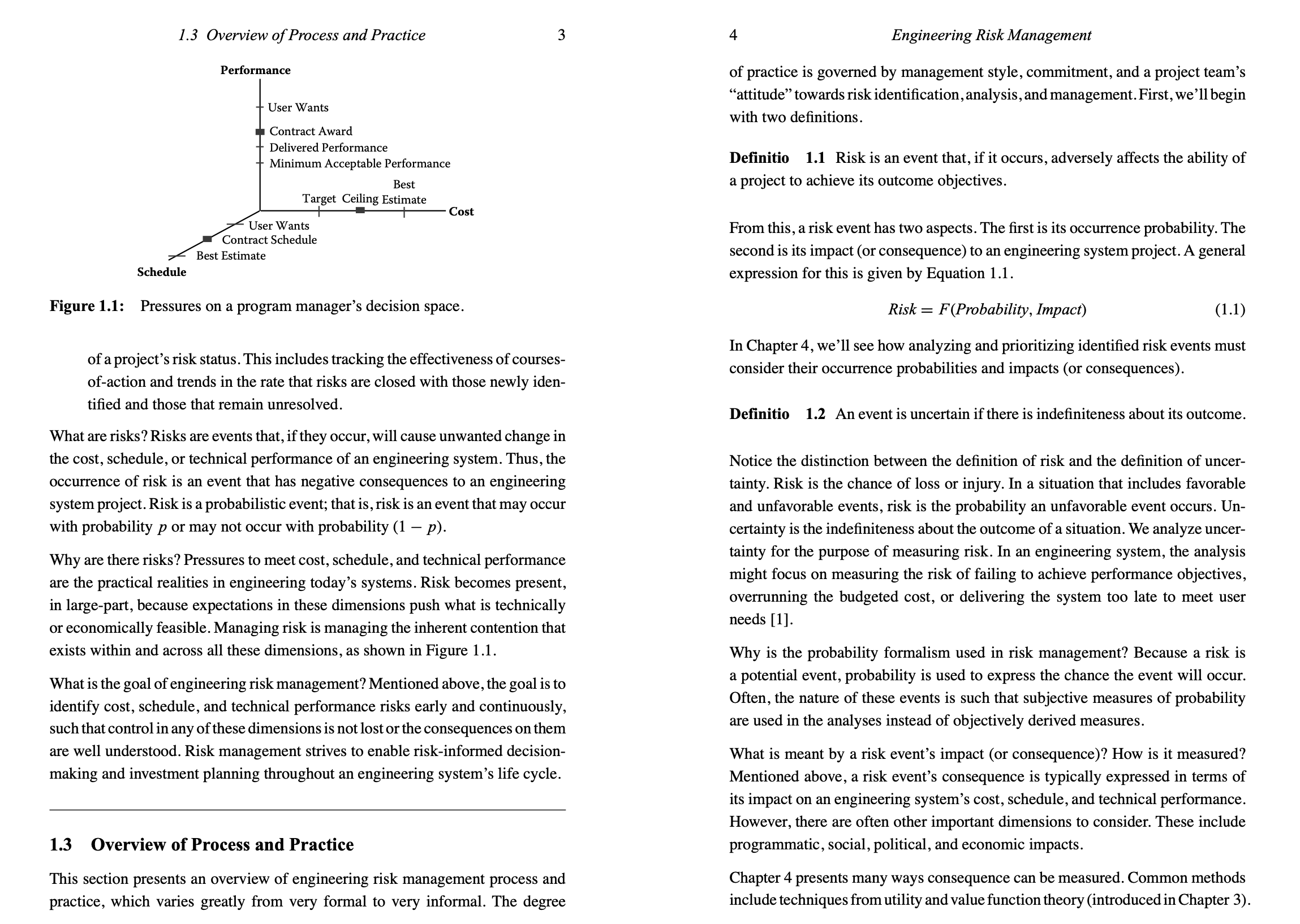
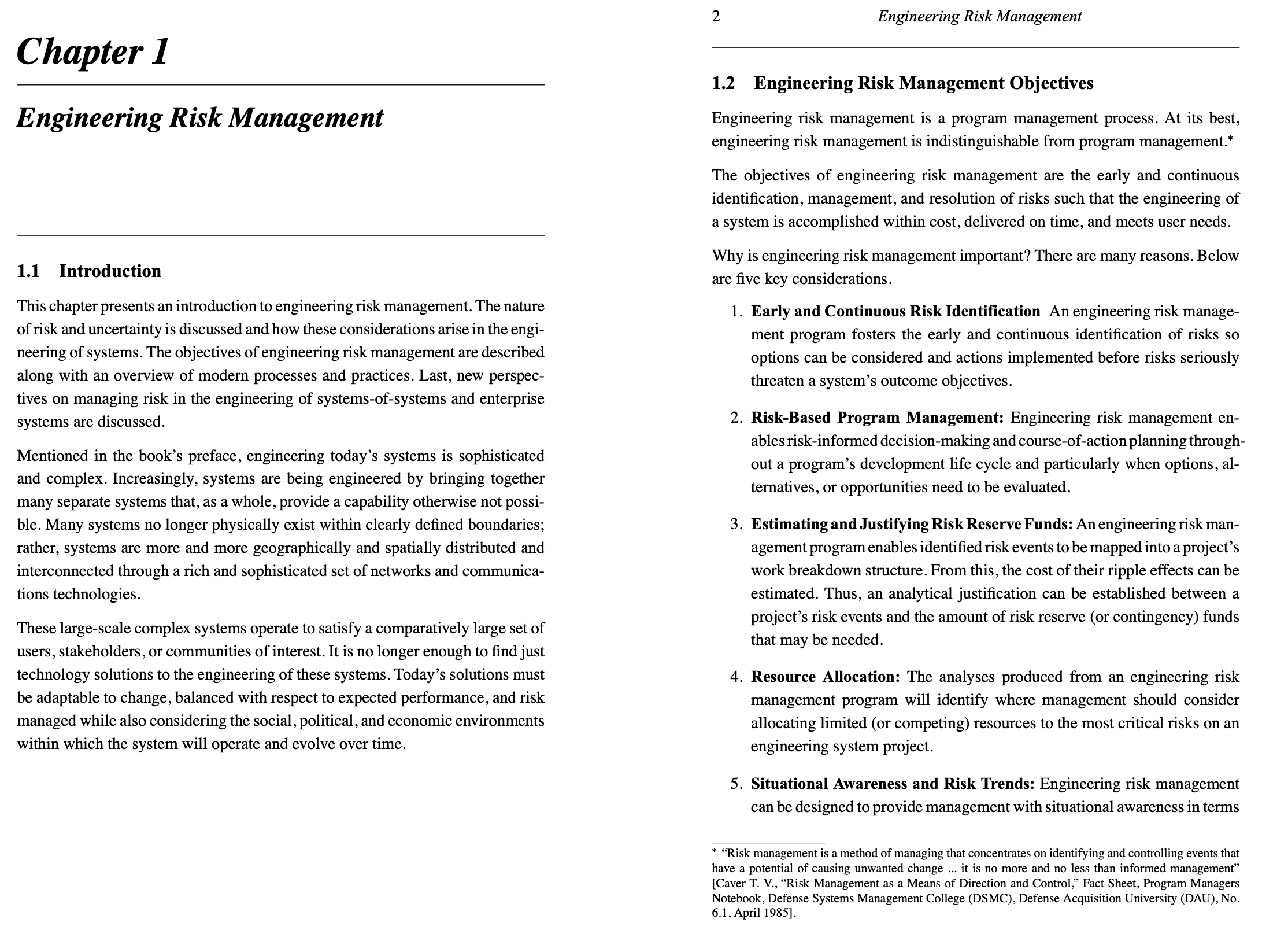
1.3 Overview of Process and Practice 3 4 Engineering Risk Management of practice is governed by management style, commitment, and a project team's "attitude" towards risk identification, analysis, and management. First, we'll begin with two definitions. Definitio 1.1 Risk is an event that, if it occurs, adversely affects the ability of a project to achieve its outcome objectives. From this, a risk event has two aspects. The first is its occurrence probability. The second is its impact (or consequence) to an engineering system project. A general expression for this is given by Equation 1.1. Risk=F(Probability,Impact) In Chapter 4, we'll see how analyzing and prioritizing identified risk events must consider their occurrence probabilities and impacts (or consequences). Definitio 1.2 An event is uncertain if there is indefiniteness about its outcome. Notice the distinction between the definition of risk and the definition of uncertainty. Risk is the chance of loss or injury. In a situation that includes favorable and unfavorable events, risk is the probability an unfavorable event occurs. Uncertainty is the indefiniteness about the outcome of a situation. We analyze uncertainty for the purpose of measuring risk. In an engineering system, the analysis might focus on measuring the risk of failing to achieve performance objectives, overrunning the budgeted cost, or delivering the system too late to meet user needs [1]. Why is the probability formalism used in risk management? Because a risk is a potential event, probability is used to express the chance the event will occur. Often, the nature of these events is such that subjective measures of probability are used in the analyses instead of objectively derived measures. What is meant by a risk event's impact (or consequence)? How is it measured? Mentioned above, a risk event's consequence is typically expressed in terms of its impact on an engineering system's cost, schedule, and technical performance. However, there are often other important dimensions to consider. These include programmatic, social, political, and economic impacts. Chapter 4 presents many ways consequence can be measured. Common methods include techniques from utility and value function theory (introduced in Chapter 3). Cnapter I Engineering Risk Management 1.2 Engineering Risk Management Objectives Engineering risk management is a program management process. At its best, engineering risk management is indistinguishable from program management.* The objectives of engineering risk management are the early and continuous identification, management, and resolution of risks such that the engineering of a system is accomplished within cost, delivered on time, and meets user needs. 1.1 Introduction This chapter presents an introduction to engineering risk management. The nature of risk and uncertainty is discussed and how these considerations arise in the engineering of systems. The objectives of engineering risk management are described along with an overview of modern processes and practices. Last, new perspectives on managing risk in the engineering of systems-of-systems and enterprise systems are discussed. Mentioned in the book's preface, engineering today's systems is sophisticated and complex. Increasingly, systems are being engineered by bringing together many separate systems that, as a whole, provide a capability otherwise not possible. Many systems no longer physically exist within clearly defined boundaries; rather, systems are more and more geographically and spatially distributed and interconnected through a rich and sophisticated set of networks and communications technologies. These large-scale complex systems operate to satisfy a comparatively large set of users, stakeholders, or communities of interest. It is no longer enough to find just technology solutions to the engineering of these systems. Today's solutions must be adaptable to change, balanced with respect to expected performance, and risk managed while also considering the social, political, and economic environments within which the system will operate and evolve over time. Why is engineering risk management important? There are many reasons. Below are five key considerations. 1. Early and Continuous Risk Identification An engineering risk management program fosters the early and continuous identification of risks so options can be considered and actions implemented before risks seriously threaten a system's outcome objectives. 2. Risk-Based Program Management: Engineering risk management enables risk-informed decision-making and course-of-action planning throughout a program's development life cycle and particularly when options, alternatives, or opportunities need to be evaluated. 3. Estimating and Justifying Risk Reserve Funds: An engineering risk management program enables identified risk events to be mapped into a project's work breakdown structure. From this, the cost of their ripple effects can be estimated. Thus, an analytical justification can be established between a project's risk events and the amount of risk reserve (or contingency) funds that may be needed. 4. Resource Allocation: The analyses produced from an engineering risk management program will identify where management should consider allocating limited (or competing) resources to the most critical risks on an engineering system project. 5. Situational Awareness and Risk Trends: Engineering risk management can be designed to provide management with situational awareness in terms * "Risk management is a method of managing that concentrates on identifying and controlling events that have a potential of causing unwanted change ... it is no more and no less than informed management" [Caver T. V., "Risk Management as a Means of Direction and Control," Fact Sheet, Program Managers Notebook, Defense Systems Management College (DSMC), Defense Acquisition University (DAU), No. 6.1, April 1985]
Step by Step Solution
There are 3 Steps involved in it

Get step-by-step solutions from verified subject matter experts
 Study Help