



Question: In Section 1.3 we saw that the autonomous differential equation m- dv dt = mg - kv, where k is a positive constant and
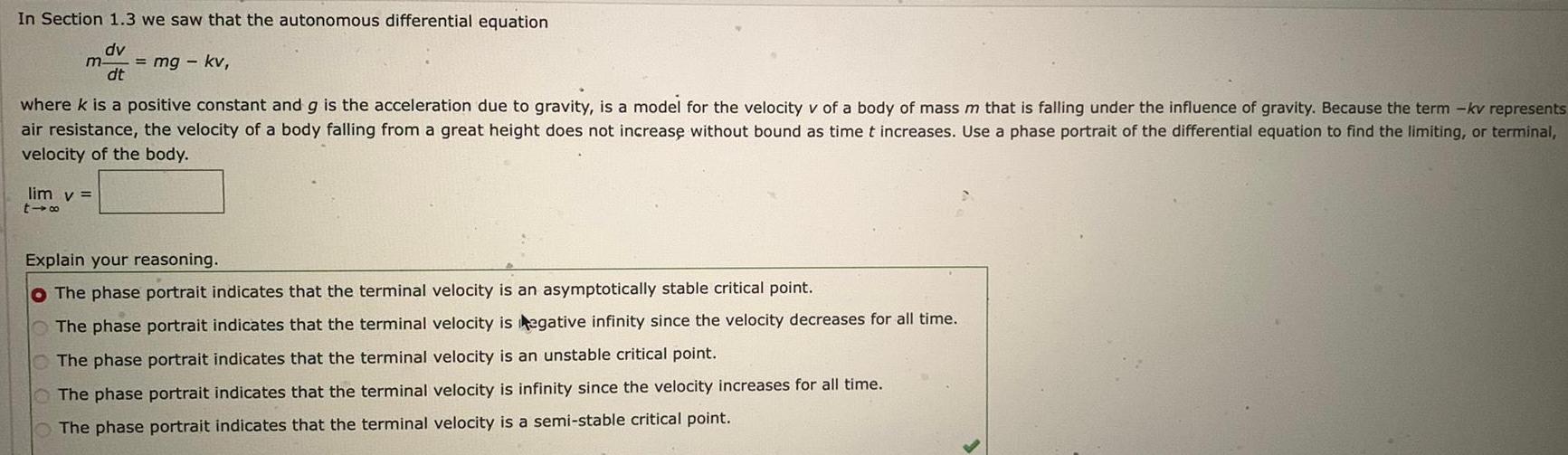
In Section 1.3 we saw that the autonomous differential equation m- dv dt = mg - kv, where k is a positive constant and g is the acceleration due to gravity, is a model for the velocity v of a body of mass m that is falling under the influence of gravity. Because the term -kv represents air resistance, the velocity of a body falling from a great height does not increase without bound as time t increases. Use a phase portrait of the differential equation to find the limiting, or terminal, velocity of the body. lim v = t Explain your reasoning. The phase portrait indicates that the terminal velocity is an asymptotically stable critical point. The phase portrait indicates that the terminal velocity is egative infinity since the velocity decreases for all time. The phase portrait indicates that the terminal velocity is an unstable critical point. The phase portrait indicates that the terminal velocity is infinity since the velocity increases for all time. The phase portrait indicates that the terminal velocity is a semi-stable critical point.
Step by Step Solution
There are 3 Steps involved in it
To find the terminal velocity we need to solve the given differential equation for the steadystat... View full answer

Get step-by-step solutions from verified subject matter experts