







Question: In SQL Server, create a new database called University. Given the ERD in this document, write the CREATE TABLE statements to construct the tables for
In SQL Server, create a new database called University.
Given the ERD in this document, write the CREATE TABLE statements to construct the tables for this database. Be sure to use reasonable data types and create all tables, attributes, primary keys, foreign keys, and not null constraints in your statements where appropriate.
To receive full credit for this assignment, your CREATE TABLE statements must be executed in SQL Server.Narrative Description of the University Database
Students take courses at the university. A student can serve as a mentor for one or more other students, but heshe is not required to do so Further, each student can have one other student as hisher mentor, but this, too, is not required. A student, however, is required to be assigned to one and only one faculty member. In turn, a faculty member advises many students but is not required to advise any students.
Courses are offered in multiple sections. A course consists of a prefix as well as a course number. For example, in this course, CSIS is the course prefix, and is the course number. CSIS is offered in multiple sections, some residentially and some online. All residential sections must be taught in a classroom on a campus; whereas online classes are not assigned to a classroom. Sections are represented by a threedigit section number such as B etc. A given section is identified by a unique SectionID field. The term of a section is Fall or Spring for residential courses and FallBFallDSpringBSpringD etc. for online courses. The year represents a digit year. All sections are taught by a faculty member, whether the section is offered online or residentially. A faculty member may not be assigned to teach any classes, however. This situation occurs when a new faculty member is hired and added to the Faculty table but is not yet assigned to individual classes.
Students can enroll in multiple sections of different classes, of course and each section can have multiple students enrolled in it Each student receives a grade in every class in which he or she is enrolled. For undergraduate students, this grade can be ABC etc. For graduate students, the grade can be AAB etc. Therefore, the grade field must be large enough to accommodate the or as needed. This grade is not entered until the end of the semester or term; however, the student is still recorded as being enrolled in the class from the minute he or she registers for it That is a start date is assigned to the enrollment record as soon as the student registers for the class. If a student withdraws from a class, the enrollment record is given an end date representing the date of withdrawal, and the grade reflects a W If the student drops the course before the official dropadd date, the record is removed from the table as if the student had never enrolled in it
Residential faculty members are assigned to offices. Online faculty members, unless they are on campus, are typically not assigned to offices. In some cases, faculty members share offices, and sometimes, offices exist but are empty until they can be assigned to faculty members. Each faculty office is associated with a Building. There are multiple Room s throughout the various campuses, and a room does not have an identity outside of its association with a Building. The same situation holds for classrooms. A classroom does not have an identity outside of its association with a building. Buildings, in turn are not dependent on any other entity. They are assigned to a particular campus, but they do not derive their identities from the campus.
ZipCodes are stored in the format Counting the dash, each zipcode can be as long as characters. Although it may seem strange now, in a later chapter, we will see why ZipCodes are often broken out into a separate table.Lab: Structured Query Language SQL Queries Data Definition Language
DDL Create Table Example
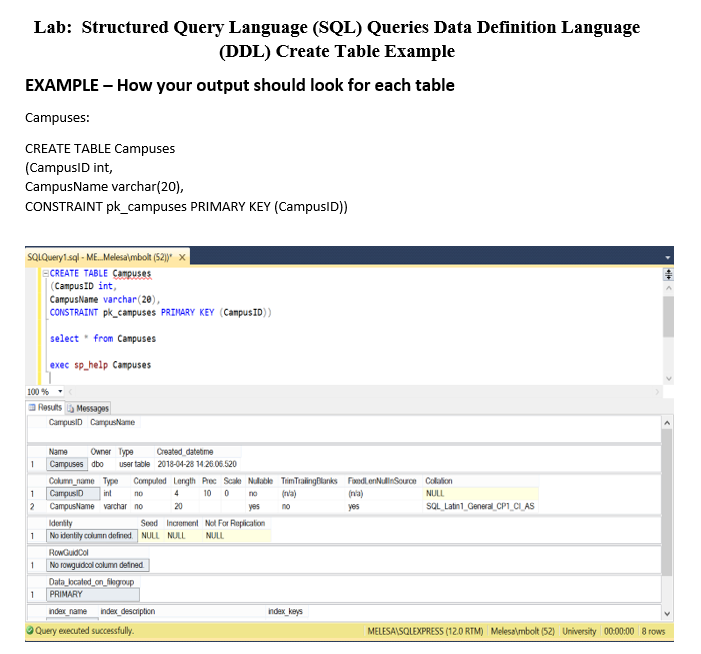
EXAMPLE How your output should look for each table
Campuses:
CREATE TABLE Campuses
CampusID int,
CampusName varchar
CONSTRAINT pkcampuses PRIMARY KEY CampusID
Step by Step Solution
There are 3 Steps involved in it
1 Expert Approved Answer
Step: 1 Unlock

Question Has Been Solved by an Expert!
Get step-by-step solutions from verified subject matter experts
Step: 2 Unlock
Step: 3 Unlock
 Study Help