





Question: In Table 6.1, why would it be problematic to calculate the mean value of the variable Religious Identification? with which it occurs (in absolute number

In Table 6.1, why would it be problematic to calculate the mean value of the variable "Religious Identification"?
In Table 6.1, why would it be problematic to
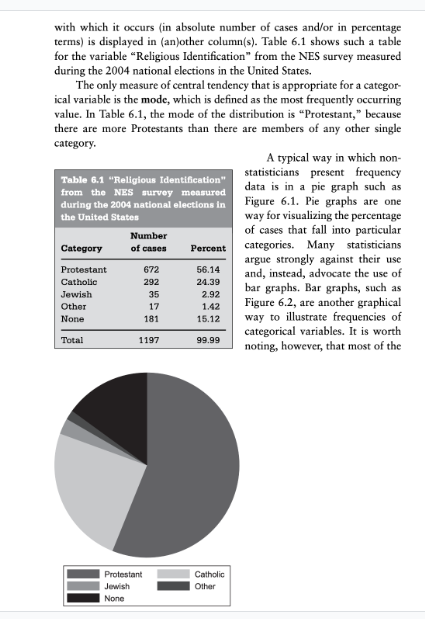
with which it occurs (in absolute number of cases and/or in percentage terms) is displayed in (an)other column(s). Table 6.1 shows such a table for the variable "Religious Identification" from the NES survey measured during the 2004 national elections in the United States. The only measure of central tendency that is appropriate for a categor- ical variable is the mode, which is defined as the most frequently occurring value. In Table 6.1, the mode of the distribution is "Protestant," because there are more Protestants than there are members of any other single category. A typical way in which non- Table 6.1 "Religious Identification" statisticians present frequency from the NES survey measured data is in a pic graph such as during the 2004 national elections in Figure 6.1. Pie graphs are one the United States way for visualizing the percentage Number of cases that fall into particular Category of cases Percent categories. Many statisticians argue strongly against their use Protestant 672 56.14 and, instead, advocate the use of Catholic 292 24.39 Jewish 35 2.92 bar graphs. Bar graphs, such as Other 17 1.42 Figure 6.2, are another graphical None 181 15.12 way to illustrate frequencies of categorical variables. It is worth Total 1197 66 66 noting, however, that most of the D Protestant Catholic Jewish Other None

Step by Step Solution

There are 3 Steps involved in it

1 Expert Approved Answer
Step: 1 Unlock blur-text-image

Question Has Been Solved by an Expert!

Get step-by-step solutions from verified subject matter experts

Step: 2 Unlock
Step: 3 Unlock

Students Have Also Explored These Related Mathematics Questions!