







Question: In terms of Java Data structures please, thank you! This question checks in for your understanding of the readings for this week (these questions will
In terms of Java Data structures please, thank you!
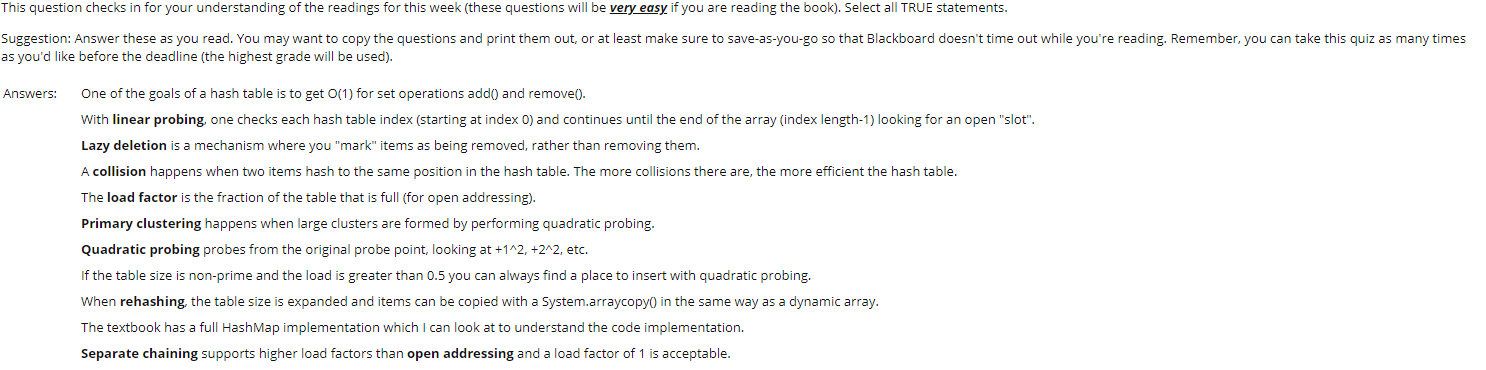
This question checks in for your understanding of the readings for this week (these questions will be very easy if you are reading the book). Select all TRUE statements. Suggestion: Answer these as you read. You may want to copy the questions and print them out, or at least make sure to save-as-you-go so that Blackboard doesn't time out while you're reading. Remember, you can take this quiz as many times as you'd like before the deadline (the highest grade will be used). Answers: One of the goals of a hash table is to get o(1) for set operations addo and remove(). With linear probing, one checks each hash table index (starting at index 0) and continues until the end of the array (index length-1) looking for an open "slot". Lazy deletion is a mechanism where you "mark" items as being removed, rather than removing them. A collision happens when two items hash to the same position in the hash table. The more collisions there are, the more efficient the hash table. The load factor is the fraction of the table that is full (for open addressing). Primary clustering happens when large clusters are formed by performing quadratic probing. Quadratic probing probes from the original probe point, looking at +142, +22, etc. If the table size is non-prime and the load is greater than 0.5 you can always find a place to insert with quadratic probing. When rehashing the table size is expanded and items can be copied with a System.arraycopy in the same way as a dynamic array. The textbook has a full HashMap implementation which I can look at to understand the code implementation. Separate chaining supports higher load factors than open addressing and a load factor of 1 is acceptable
Step by Step Solution
There are 3 Steps involved in it

Get step-by-step solutions from verified subject matter experts
 Study Help