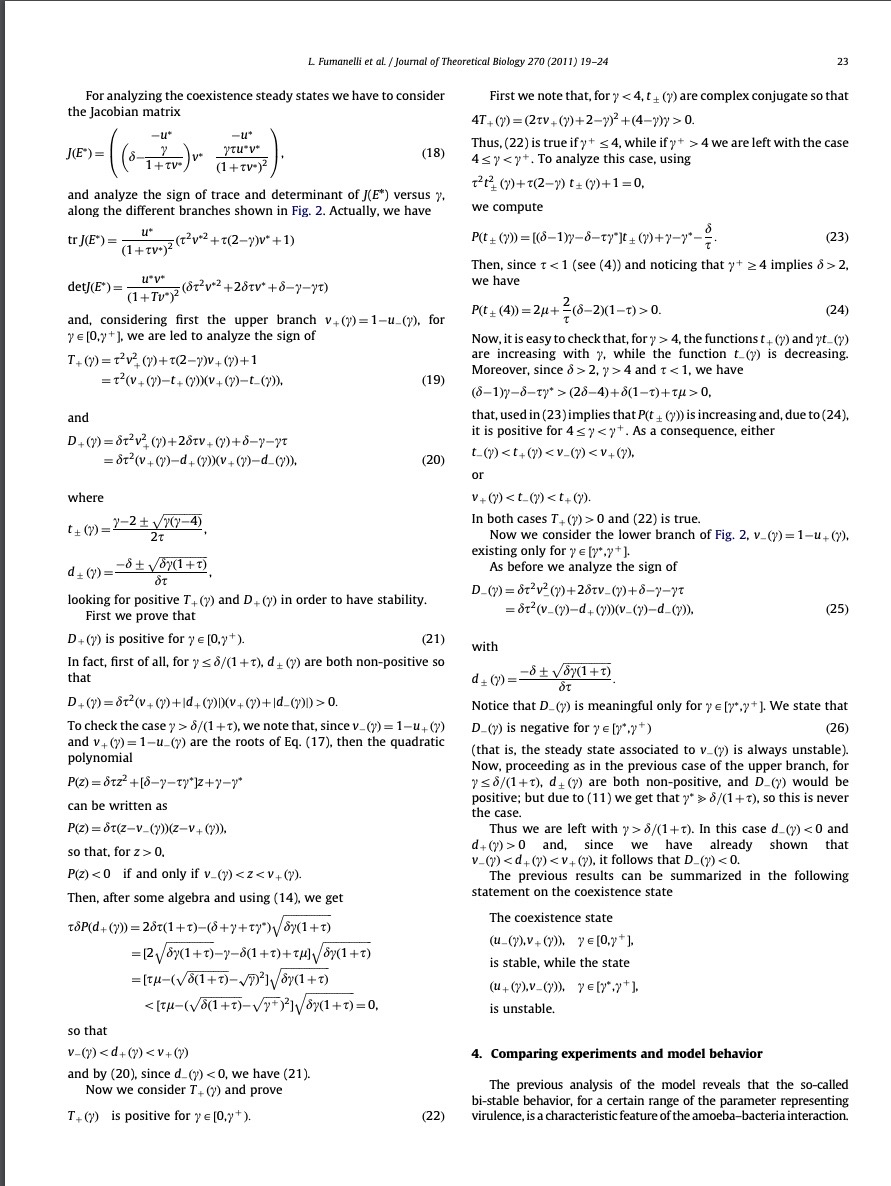
Question: In the attached, could you explain to me please how he get the values in the jacobian matrix (both jacobian matrices)? 22 L. Fumanelli et

In the attached, could you explain to me please how he get the values in the jacobian matrix (both jacobian matrices)?
In the attached, could you explain to me pleaseIn the attached, could you explain to me pleaseIn the attached, could you explain to me please
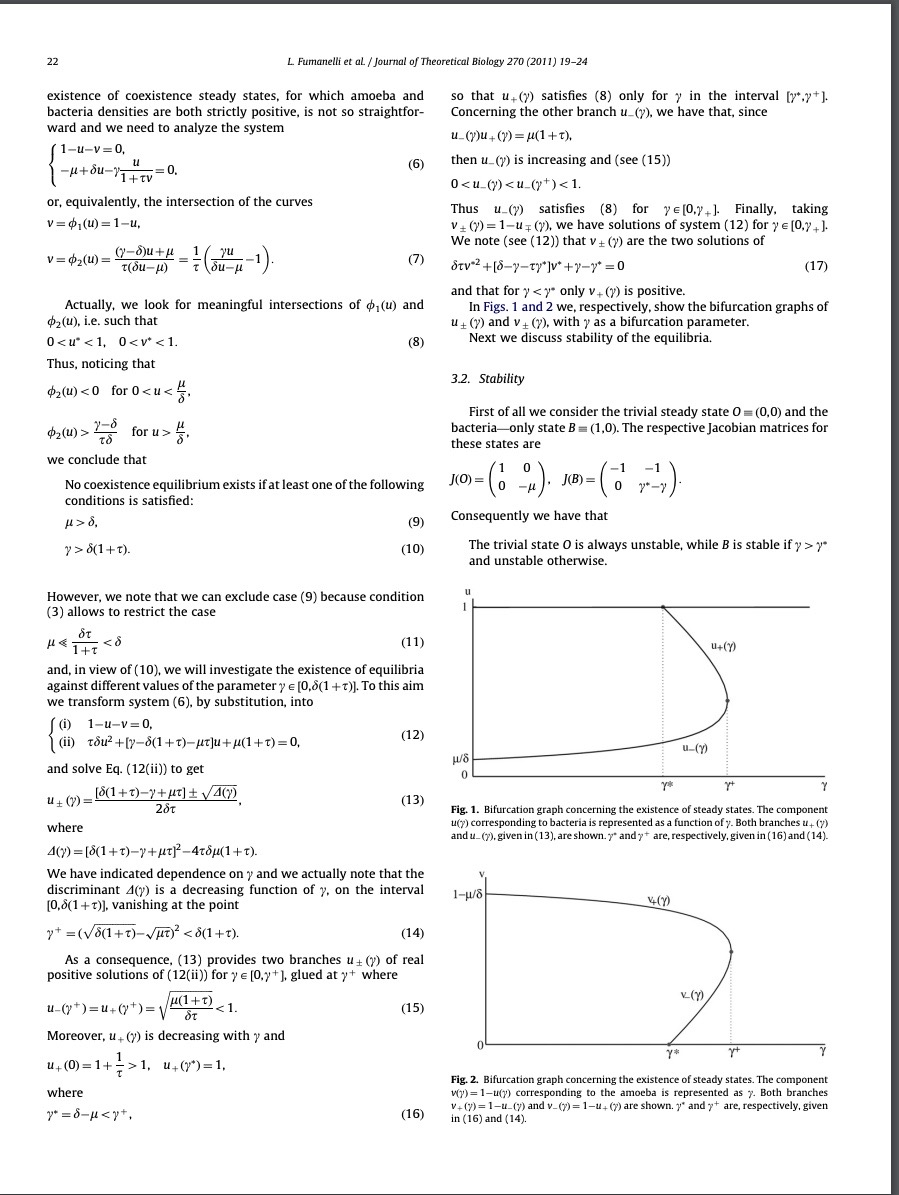
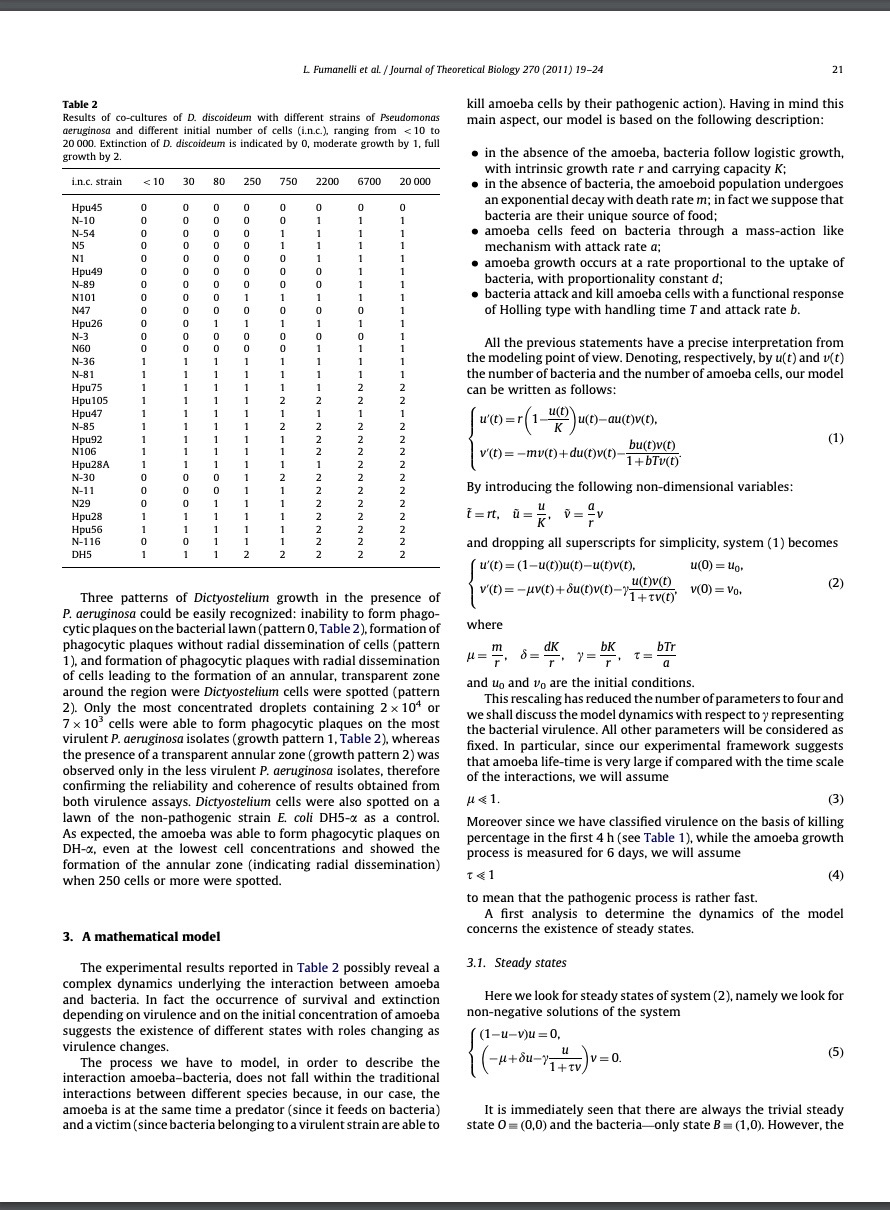
22 L. Fumanelli et al / Journal of Theoretical Biology 270 (2011) 19-24 existence of coexistence steady states, for which amoeba and so that u. (y) satisfies (8) only for y in the interval [y*,y+ ]. bacteria densities are both strictly positive, is not so straightfor- Concerning the other branch u_(y), we have that, since ward and we need to analyze the system u_()u + (?) = #(1 +t). 1-u-v=0, - 1+84-71 + TV=0. (6) then u_(y) is increasing and (see (15)) 0 2 0 for u> bacteria-only state B= (1,0). The respective Jacobian matrices for these states are we conclude that No coexistence equilibrium exists if at least one of the following conditions is satisfied: H20, (9) Consequently we have that 7 > o(1 + t). (10) The trivial state O is always unstable, while B is stable if y > >* and unstable otherwise. However, we note that we can exclude case (9) because condition (3) allows to restrict the case ST (11) and, in view of (10), we will investigate the existence of equilibria against different values of the parameter y e [0,6(1 + t)]. To this aim we transform system (6), by substitution, into (i) 1-u-v=0, (ii) tou2 +[y-6(1 +t)-utju + p(1 +t) =0, (12) U-(2) and solve Eq. (12(ii)) to get U + (y) = [o(1 + )-7+ut] + 402 (13) 20T Fig. 1. Bifurcation graph concerning the existence of steady states. The component where u(7) corresponding to bacteria is represented as a function of y. Both branches u+ (7) and u_(7), given in (13), are shown. y" and + are, respectively, given in (16) and (14). 4()) =[8(1+1)-y+ut]-4tou(1+t). We have indicated dependence on y and we actually note that the discriminant 4(7) is a decreasing function of y, on the interval 1-14/8 10,6(1 + t)], vanishing at the point y* =(V8(1+t)-vuty 1, u+(1')=1, Fig. 2. Bifurcation graph concerning the existence of steady states. The component where wy)=1-u()) corresponding to the amoeba is represented as y. Both branches (16) v+ (7)=1-u_(7) and v-() =1-u+ () are shown. y" and y+ are, respectively, given in (16) and (14).L. Fumanelli et al. / Journal of Theoretical Biology 270 (2011) 19-24 21 Table 2 kill amoeba cells by their pathogenic action). Having in mind this Results of co-cultures of D. discoideum with different strains of Pseudomonas main aspect, our model is based on the following description: aeruginosa and different initial number of cells (i.n.c.), ranging from 0. -u' -U J(E)= you"V* Thus, (22) is true if y+ $ 4, while ify+ > 4 we are left with the case (18) (1 + tv.)2 4sy 2, detJ(E*) =- u"v * (1+TV) (otzv*2+25tv* +8-7-yT) we have and, considering first the upper branch v+ (7) =1-u_(y). for P(t + (4))= 21+=(8-2)(1-T) > 0. (24) ye [O,y +], we are led to analyze the sign of Now, it is easy to check that, for y > 4, the functions t + (y) and yt-(7) T+()=12720+12-pv+()+1 are increasing with y. while the function t_(y) is decreasing. =T'(v+ ())-t+0))(v+(2)-LO)). (19) Moreover, since 6 > 2, y > 4 and t (26-4)+8(1-T)+ tu > 0, and that, used in (23) implies that P(t + ())) is increasing and, due to (24), D+ (7)=612v2 ()+28tv+()+6-9-yz it is positive for 4 s y 0 and (22) is true 27 Now we consider the lower branch of Fig. 2, v_())=1-u+()). existing only for y e [y* ,y+ ]. d + ()= 0 1 voy(1 + T) As before we analyze the sign of looking for positive T+ (y) and D+ ()) in order to have stability. D_() = 612v2(7)+28tv_(7)+8-y-yz First we prove that (25) D+ (7) is positive for y e [0,y +). (21) with In fact, first of all, for y 0. Notice that D_(y) is meaningful only for ye [y*,y+ ]. We state that To check the casey > 6/(1 + t), we note that, since v_()) =1-u+ (7) D_(y) is negative for ye [y",y*) (26) and v + (7)=1-u_(y) are the roots of Eq. (17), then the quadratic polynomial (that is, the steady state associated to v_(y) is always unstable). Now, proceeding as in the previous case of the upper branch, for P(2) = 6123+18-y-ty* ]+y-y* yo/(1+t), d+ (y) are both non-positive, and D_(y) would be can be written as positive; but due to (11) we get that y* >> 6/(1 +t), so this is never the case. P(Z) = 61(2-V_())(2-V+ (7)). Thus we are left with y > 6/(1+t). In this case d_(y) 0. d+ (7) > 0 and, since we have already shown t v_()

Step by Step Solution

There are 3 Steps involved in it

1 Expert Approved Answer
Step: 1 Unlock blur-text-image

Question Has Been Solved by an Expert!

Get step-by-step solutions from verified subject matter experts

Step: 2 Unlock
Step: 3 Unlock

Students Have Also Explored These Related Mathematics Questions!