







Question: In the case below, the original source material is given along with a sample of student work. Determine the type of plagiarism by clicking the
In the case below, the original source material is given along with a sample of student work. Determine the type of plagiarism by clicking the appropriate radio button.
Please select:
Word for Word Plagiarism
Paraphrasing Plagiarism
This is not plagiarism
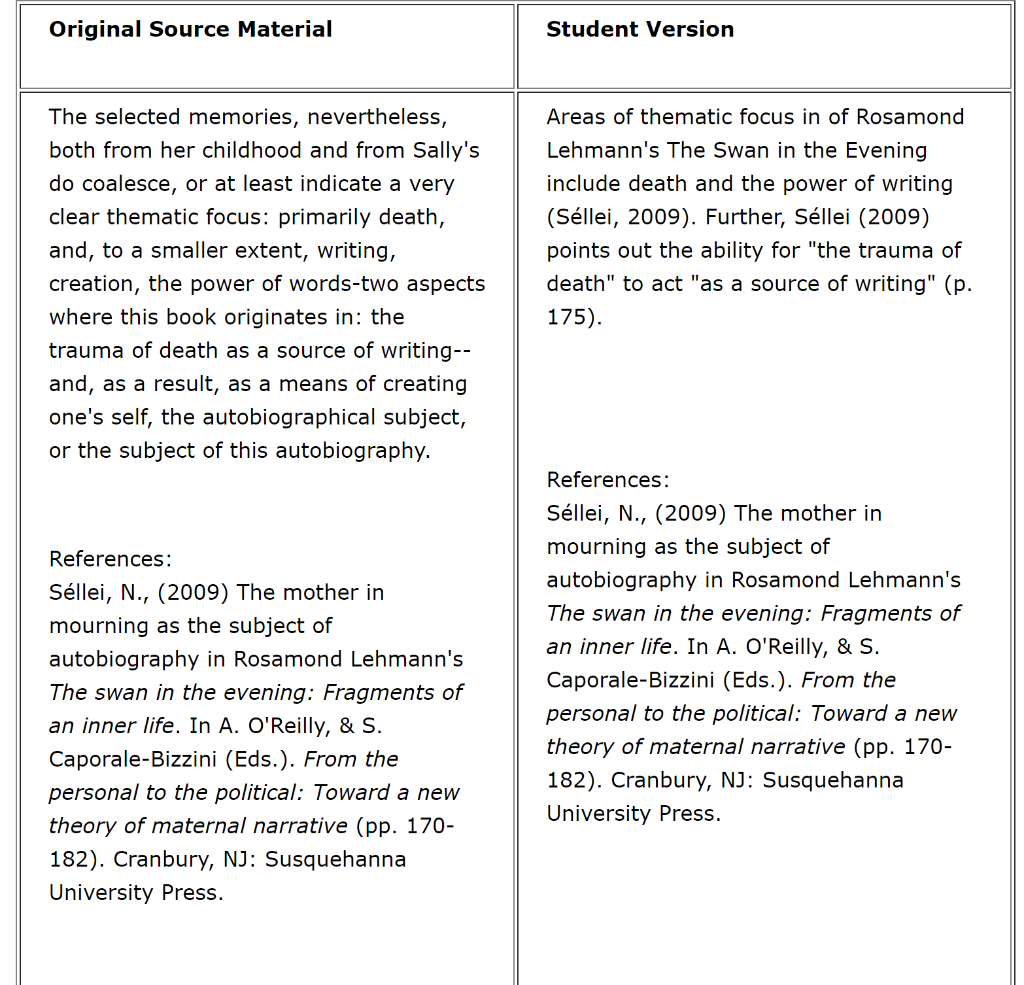
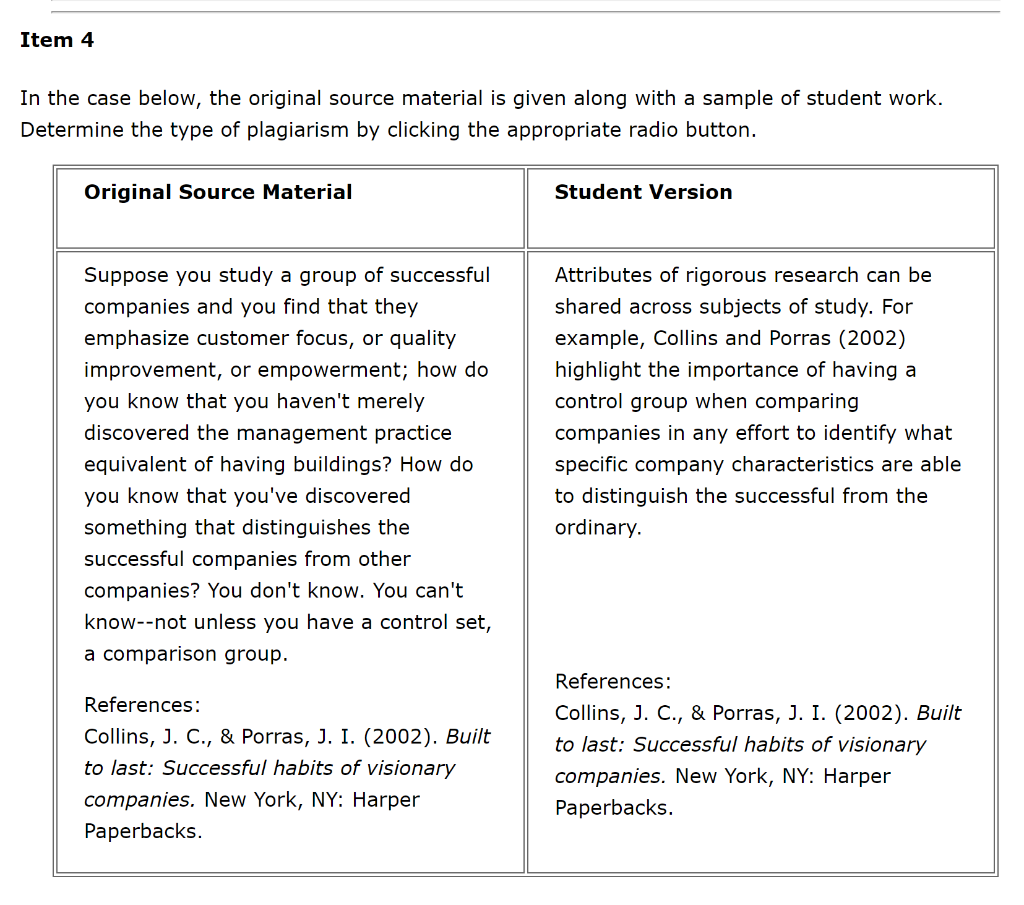
Original Source Material Student Version The selected memories, nevertheless, both from her childhood and from Sally's do coalesce, or at least indicate a very clear thematic focus: primarily death, and, to a smaller extent, writing, creation, the power of words-two aspects where this book originates in: the trauma of death as a source of writing-- and, as a result, as a means of creating one's self, the autobiographical subject, or the subject of this autobiography. Areas of thematic focus in of Rosamond Lehmann's The Swan in the Evening include death and the power of writing (Sllei, 2009). Further, Sllei (2009) points out the ability for "the trauma of death" to act "as a source of writing" (p. 175). References: Sllei, N., (2009) The mother in mourning as the subject of autobiography in Rosamond Lehmann's The swan in the evening: Fragments of an inner life. In A. O'Reilly, & S. Caporale-Bizzini (Eds.). From the personal to the political: Toward a new theory of maternal narrative (pp. 170- 182). Cranbury, NJ: Susquehanna University Press. References: Sllei, N., (2009) The mother in mourning as the subject of autobiography in Rosamond Lehmann's The swan in the evening: Fragments of an inner life. In A. O'Reilly, & S. Caporale-Bizzini (Eds.). From the personal to the political: Toward a new theory of maternal narrative (pp. 170- 182). Cranbury, NJ: Susquehanna University Press. Item 4 In the case below, the original source material is given along with a sample of student work. Determine the type of plagiarism by clicking the appropriate radio button. Original Source Material Student Version Suppose you study a group of successful companies and you find that they emphasize customer focus, or quality improvement, or empowerment; how do you know that you haven't merely discovered the management practice equivalent of having buildings? How do you know that you've discovered something that distinguishes the successful companies from other companies? You don't know. You can't know--not unless you have a control set, a comparison group. Attributes of rigorous research can be shared across subjects of study. For example, Collins and Porras (2002) highlight the importance of having a control group when comparing companies in any effort to identify what specific company characteristics are able to distinguish the successful from the ordinary. References: Collins, J. C., & Porras, J. I. (2002). Built to last: Successful habits of visionary companies. New York, NY: Harper Paperbacks. References: Collins, J. C., & Porras, J. I. (2002). Built to last: Successful habits of visionary companies. New York, NY: Harper Paperbacks
Step by Step Solution
There are 3 Steps involved in it

Get step-by-step solutions from verified subject matter experts
 Study Help