







Question: In the class, we explored the differences between CISC ( Complex Instruction Set Computing ) and RISC ( Reduced Instruction Set Computing ) architectures, where
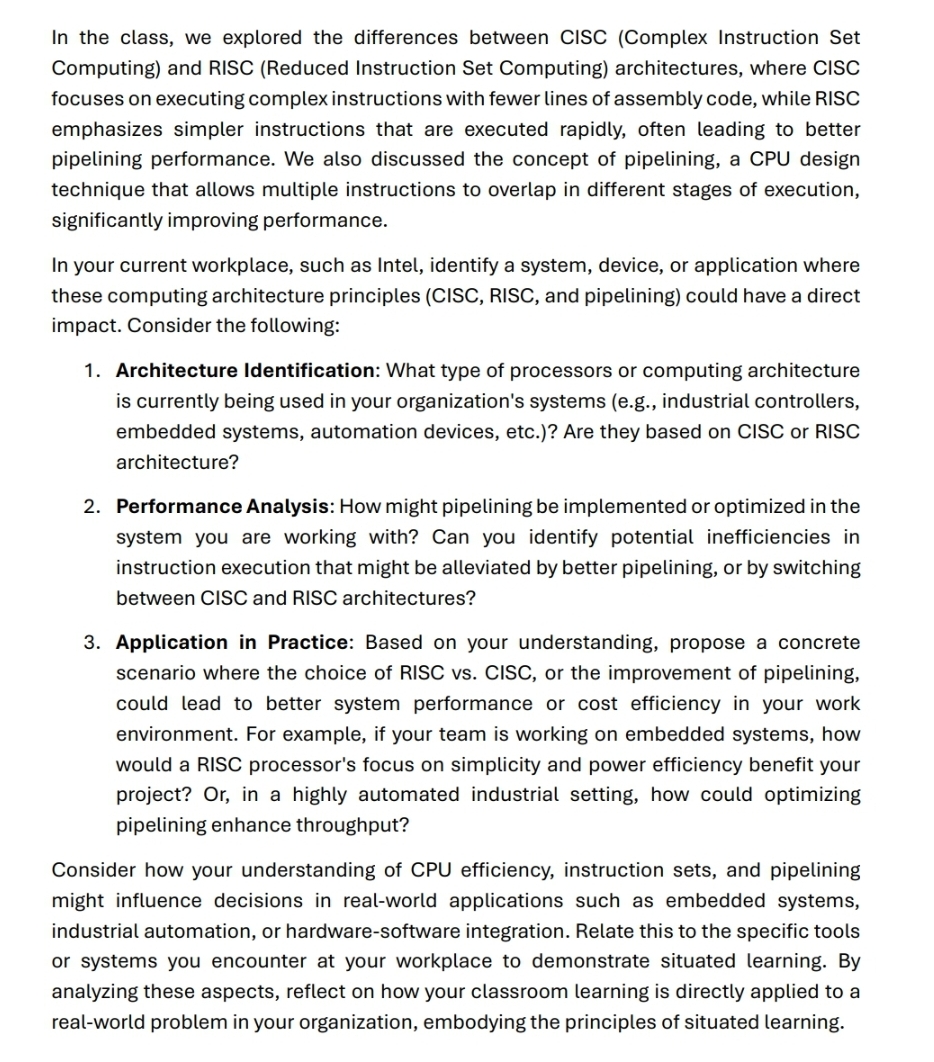
In the class, we explored the differences between CISC Complex Instruction Set Computing and RISC Reduced Instruction Set Computing architectures, where CISC focuses on executing complex instructions with fewer lines of assembly code, while RISC emphasizes simpler instructions that are executed rapidly, often leading to better pipelining performance. We also discussed the concept of pipelining, a CPU design technique that allows multiple instructions to overlap in different stages of execution, significantly improving performance.
In your current workplace, such as Intel, identify a system, device, or application where these computing architecture principles CISC RISC, and pipelining could have a direct impact. Consider the following:
Architecture Identification: What type of processors or computing architecture is currently being used in your organization's systems eg industrial controllers, embedded systems, automation devices, etc. Are they based on CISC or RISC architecture?
Performance Analysis: How might pipelining be implemented or optimized in the system you are working with? Can you identify potential inefficiencies in instruction execution that might be alleviated by better pipelining, or by switching between CISC and RISC architectures?
Application in Practice: Based on your understanding, propose a concrete scenario where the choice of RISC vs CISC, or the improvement of pipelining, could lead to better system performance or cost efficiency in your work environment. For example, if your team is working on embedded systems, how would a RISC processor's focus on simplicity and power efficiency benefit your project? Or in a highly automated industrial setting, how could optimizing pipelining enhance throughput?
Consider how your understanding of CPU efficiency, instruction sets, and pipelining might influence decisions in realworld applications such as embedded systems, industrial automation, or hardwaresoftware integration. Relate this to the specific tools or systems you encounter at your workplace to demonstrate situated learning. By analyzing these aspects, reflect on how your classroom learning is directly applied to a realworld problem in your organization, embodying the principles of situated learning.
Step by Step Solution
There are 3 Steps involved in it
1 Expert Approved Answer
Step: 1 Unlock

Question Has Been Solved by an Expert!
Get step-by-step solutions from verified subject matter experts
Step: 2 Unlock
Step: 3 Unlock
 Study Help