







Question: In the class we have seen three equivalent definitions for f(n)=O(g(n)). The first of these was: f(n)=O(g(n)) if and only if there is some constant
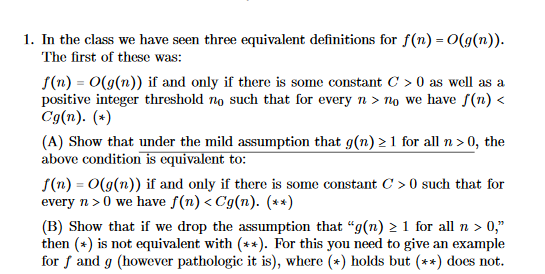
In the class we have seen three equivalent definitions for f(n)=O(g(n)). The first of these was: f(n)=O(g(n)) if and only if there is some constant C>0 as well as a positive integer threshold n0 such that for every n>n0 we have f(n)0, the above condition is equivalent to: f(n)=O(g(n)) if and only if there is some constant C>0 such that for every n>0 we have f(n)
Step by Step Solution
There are 3 Steps involved in it
1 Expert Approved Answer
Step: 1 Unlock

Question Has Been Solved by an Expert!
Get step-by-step solutions from verified subject matter experts
Step: 2 Unlock
Step: 3 Unlock
 Study Help