







Question: In the following network, frames are generated at node $mathrm{A}$ and sent to node $mathrm{C}$ through node $mathrm{B}$. Node $mathrm{A}$ is operating at a bit
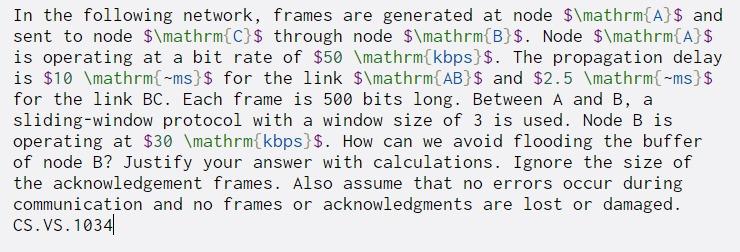
In the following network, frames are generated at node $\mathrm{A}$ and sent to node $\mathrm{C}$ through node $\mathrm{B}$. Node $\mathrm{A}$ is operating at a bit rate of $50 \mathrm{kbps} $. The propagation delay is $10 \mathrm{-ms] $ for the link $\mathrm{AB} $ and $2.5 \mathrm{-ms] $ for the link BC. Each frame is 500 bits long. Between A and B, a sliding-window protocol with a window size of 3 is used. Node B is operating at $30 \mathrm{kbps) $. How can we avoid flooding the buffer of node B? Justify your answer with calculations. Ignore the size of the acknowledgement frames. Also assume that no errors occur during communication and no frames or acknowledgments are lost or damaged. CS.VS. 1034
Step by Step Solution
There are 3 Steps involved in it

Get step-by-step solutions from verified subject matter experts
 Study Help