



Question: In the following problem, x 1 , x 2 and x 3 are respectively the number of kilograms of produced paint from Type 1, 2
In the following problem, x1, x2 and x3 are respectively the number of kilograms of produced paint from Type 1, 2 and 3. For producing each type of paint, three kinds of raw materials (M1, M2 and M3) should be mixed together. There is an availability limit on the number of kilograms of each kind of raw material, as shown in the right-hand side of each of the constraints. The objective function of this formulated problem is to maximize the profit at the end.
Max z= 10x1 + 12x2 + 8x3
s.t.
2x1 + 3x2 + 3x3 50 (Availability of M1 in kilograms)
x1 + 2x2 + x3 20 (Availability of M2 in kilograms)
4x1 + 2x2 + 2x3 40 (Availability of M3 in kilograms)
x1, x2, x3 0
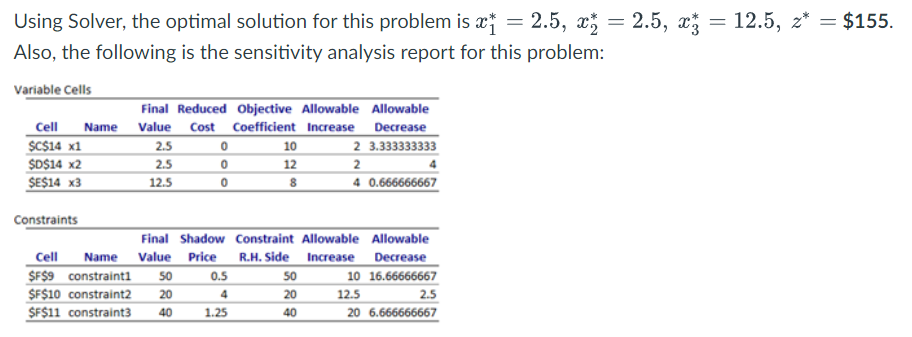
- Assume that based on new market estimates, the profit per unit of paint Type 2 has reduced to $9. How will this change impact the optimal solution for this problem? i.e., what will be the updated optimal values for decision variables and the objective function based on this change?
- If the company has the option to increase the available kilograms of M1 or M3, and each kilogram of increase costs the company $1, would you recommend an increase to any of the resources (raw materials) availability? If yes, in which one? Why?
- The producing company can increase the available kilograms of M2 from 20 to 30. If this increase costs the company $48, would you recommend such an increase? Why?
Using Solver, the optimal solution for this problem is x1=2.5,x2=2.5,x3=12.5,z=$155. Also, the following is the sensitivity analysis report for this problem: Variahle relle
Step by Step Solution
There are 3 Steps involved in it

Get step-by-step solutions from verified subject matter experts