







Question: In the IEEE 754 representation, 32 bit floating point has 1 bit to represent the sign, 8 bits to represent the exponent of 2 and
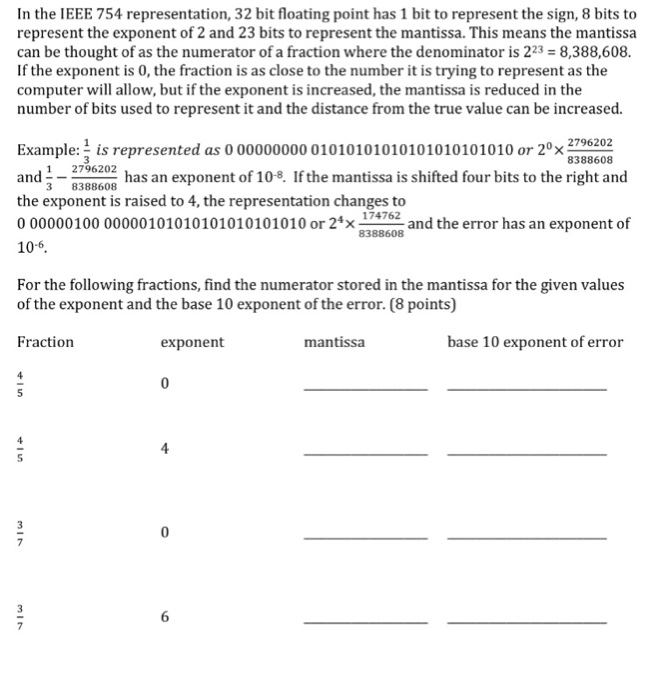
In the IEEE 754 representation, 32 bit floating point has 1 bit to represent the sign, 8 bits to represent the exponent of 2 and 23 bits to represent the mantissa. This means the mantissa can be thought of as the numerator of a fraction where the denominator is 223 8,388,608. If the exponent is 0, the fraction is as close to the number it is trying to represent as the computer will allow, but if the exponent is increased, the mantissa is reduced in the number of bits used to represent it and the distance from the true value can be increased. Example 1 is represented as 00000000001010101010101010101010 or 202796202 8388608 1 2796202 3 8388608 has an exponent of 108. If the mantissa is shifted four bits to the right and the exponent is raised to 4, the representation changes to 0 00000100 00000101010101010101010 or 24xand the error has an exponent of 10-6. 174762 8388608 For the following fractions, find the numerator stored in the mantissa for the given values of the exponent and the base 10 exponent of the error. (8 points) Fraction exponent mantissa base 10 exponent of error 6
Step by Step Solution
There are 3 Steps involved in it

Get step-by-step solutions from verified subject matter experts
 Study Help