







Question: In the last Case D , the analyzed CRM unit, made of two part - time employees, focuses on acquiring new clients through social networks
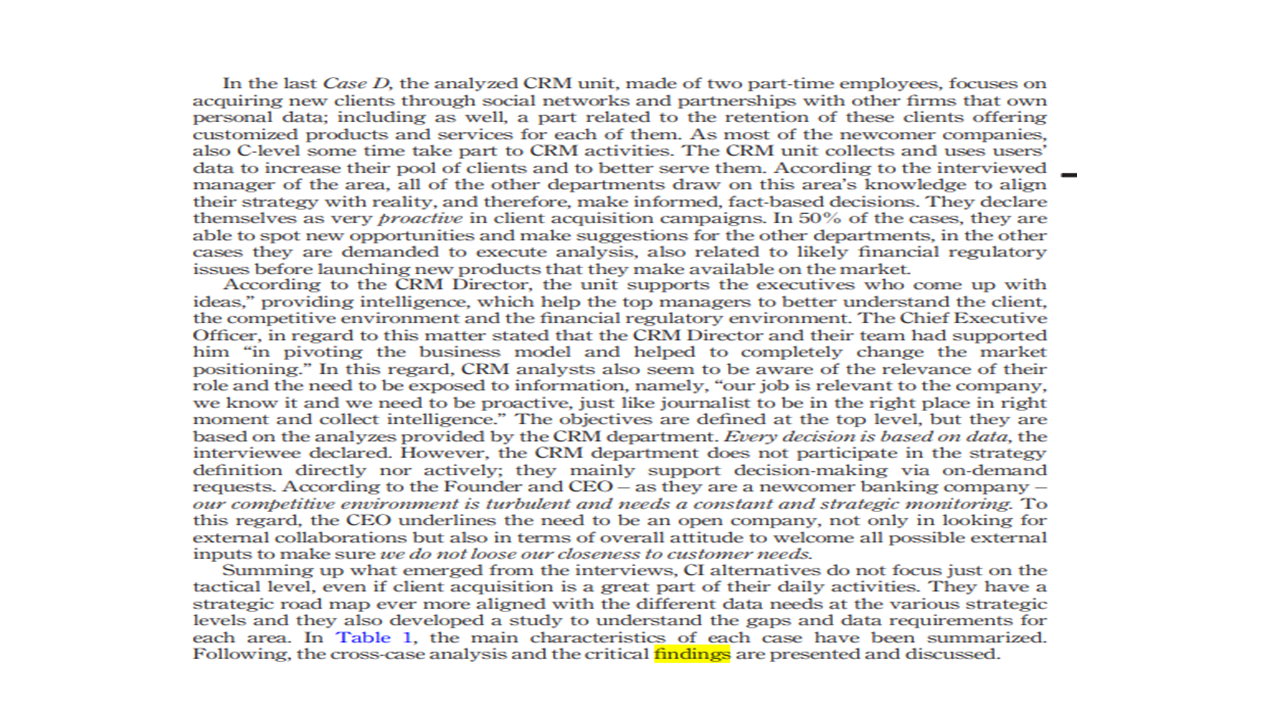
In the last Case the analyzed CRM unit, made of two parttime employees, focuses on
acquiring new clients through social networks and partnerships with other firms that own
personal data; including as well, a part related to the retention of these clients offering
customized products and services for each of them. As most of the newcomer companies,
also Clevel some time take part to CRM activities. The CRM unit collects and uses users'
data to increase their pool of clients and to better serve them. According to the interviewed
manager of the area, all of the other departments draw on this area's knowledge to align
their strategy with reality, and therefore, make informed, factbased decisions. They declare
themselves as very proactive in client acquisition campaigns. In of the cases, they are
able to spot new opportunities and make suggestions for the other departments, in the other
cases they are demanded to execute analysis, also related to likely financial regulatory
issues before launching new products that they make available on the market.
According to the CRM Director, the unit supports the executives who come up with
ideas," providing intelligence, which help the top managers to better understand the client,
the competitive environment and the financial regulatory environment. The Chief Executive
Officer, in regard to this matter stated that the CRM Director and their team had supported
him in pivoting the business model and helped to completely change the market
positioning." In this regard, CRM analysts also seem to be aware of the relevance of their
role and the need to be exposed to information, namely, "our job is relevant to the company,
we know it and we need to be proactive, just like journalist to be in the right place in right
moment and collect intelligence." The objectives are defined at the top level, but they are
based on the analyzes provided by the CRM department. Every decision is based on data, the
interviewee declared. However, the CRM department does not participate in the strategy
definition directly nor actively; they mainly support decisionmaking via ondemand
requests. According to the Founder and CEO as they are a newcomer banking company
our competitive environment is turbulent and needs a constant and strategic monitoring. To
this regard, the CEO underlines the need to be an open company, not only in looking for
external collaborations but also in terms of overall attitude to welcome all possible external
inputs to make sure we do not loose our closeness to customer needs.
Summing up what emerged from the interviews, CI alternatives do not focus just on the
tactical level, even if client acquisition is a great part of their daily activities. They have a
strategic road map ever more aligned with the different data needs at the various strategic
levels and they also developed a study to understand the gaps and data requirements for
each area. In Table the main characteristics of each case have been summarized.
Following, the crosscase analysis and the critical findings are presented and discussed. Synthesise the findings with industry practice
Step by Step Solution
There are 3 Steps involved in it
1 Expert Approved Answer
Step: 1 Unlock

Question Has Been Solved by an Expert!
Get step-by-step solutions from verified subject matter experts
Step: 2 Unlock
Step: 3 Unlock
 Study Help