







Question: In the maximum subarray problem, we are given a vector of integers vec and want to find the maximum sum of entries in a contiguous
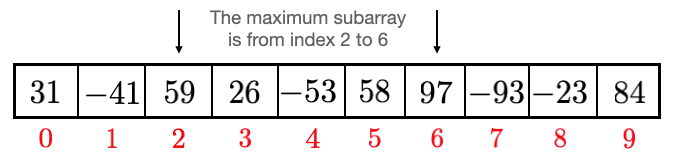
In the maximum subarray problem, we are given a vector of integers vec and want to find the maximum sum of entries in a contiguous subvector. That is we want to find indices ij so that veci veci vecj is as large as possible. Here is an example in the pictured image. In this example the maximum sum of entries in a contiguous subvector is from index to index and has sum
We can approach the maximum subarray problem using dynamic programming. Let largestSumTo be a vector where largestSumToj is the maximum over ij of veci veci vecj ie the largest sum of contiguous entries that ends at index j
We set largestSumTo vec and then successively compute largestSumTo largestSumTo largestSumTon when the input vector has size n For j how can we express largestSumToj in terms of the previous entries of largestSumTo pick an answer
a largestSumToj vecj largestSumToj
b largestSumToj maxvecj largestSumToj vecj
clargestSumToj largestSumToj largestSumToj
d largestSumToj maxvecj vecj vecj
Step by Step Solution
There are 3 Steps involved in it
1 Expert Approved Answer
Step: 1 Unlock

Question Has Been Solved by an Expert!
Get step-by-step solutions from verified subject matter experts
Step: 2 Unlock
Step: 3 Unlock
 Study Help