







Question: In the multicommodity flow problem, the input is a directed graph G = (V, E) with k source vertices $, . . ., Sk,
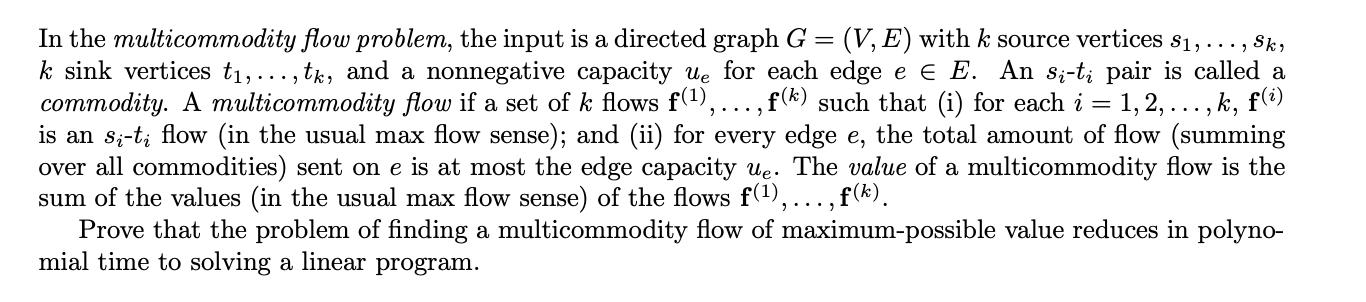
In the multicommodity flow problem, the input is a directed graph G = (V, E) with k source vertices $, . . ., Sk, k sink vertices t,..., tk, and a nonnegative capacity ue for each edge e E. An si-ti pair is called a commodity. A multicommodity flow if a set of k flows f(),...,: ,f(k) such that (i) for each i = 1, 2, ..., k, f(i) is an si-ti flow (in the usual max flow sense); and (ii) for every edge e, the total amount of flow (summing over all commodities) sent on e is at most the edge capacity ue. The value of a multicommodity flow is the sum of the values (in the usual max flow sense) of the flows f(), ,f(k). Prove that the problem of finding a multicommodity flow of maximum-possible value reduces in polyno- mial time to solving a linear program. In the multicommodity flow problem, the input is a directed graph G = (V, E) with k source vertices $, . . ., Sk, k sink vertices t, ..., tk, and a nonnegative capacity ue for each edge e E. An si-ti pair is called a commodity. A multicommodity flow if a set of k flows f(),...,: ,f(K) such that (i) for each i = 1, 2, ..., k, f(i) is an si-ti flow (in the usual max flow sense); and (ii) for every edge e, the total amount of flow (summing over all commodities) sent on e is at most the edge capacity ue. The value of a multicommodity flow is the sum of the values (in the usual max flow sense) of the flows f(), ,f(k). Prove that the problem of finding a multicommodity flow of maximum-possible value reduces in polyno- mial time to solving a linear program. In the multicommodity flow problem, the input is a directed graph G = (V, E) with k source vertices $, . . ., Sk, k sink vertices t,..., tk, and a nonnegative capacity ue for each edge e E. An si-ti pair is called a commodity. A multicommodity flow if a set of k flows f(),...,: ,f(k) such that (i) for each i = 1, 2, ..., k, f(i) is an si-ti flow (in the usual max flow sense); and (ii) for every edge e, the total amount of flow (summing over all commodities) sent on e is at most the edge capacity ue. The value of a multicommodity flow is the sum of the values (in the usual max flow sense) of the flows f(), ,f(k). Prove that the problem of finding a multicommodity flow of maximum-possible value reduces in polyno- mial time to solving a linear program.
Step by Step Solution
3.46 Rating (159 Votes )
There are 3 Steps involved in it

Get step-by-step solutions from verified subject matter experts
 Study Help