



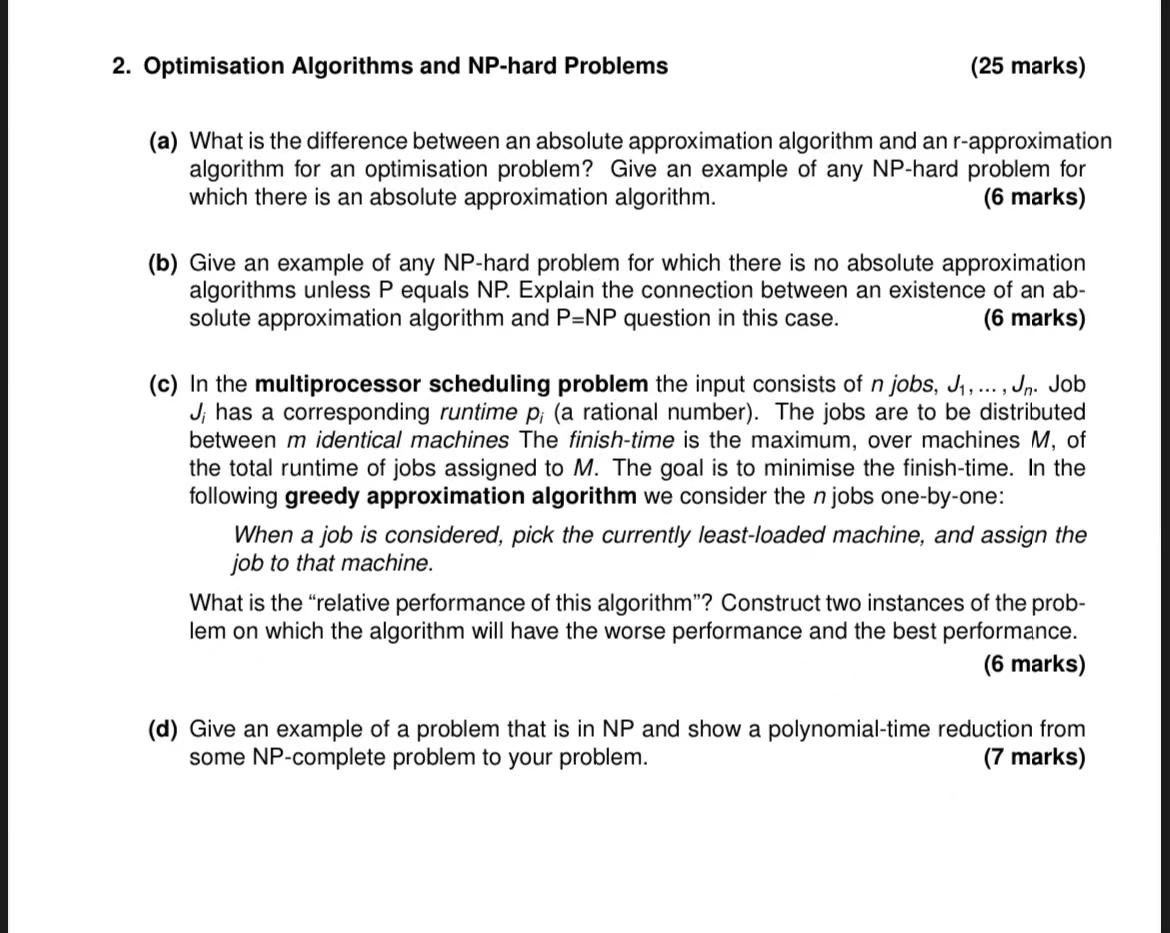
Question: In the multiprocessor scheduling problem the input consists of n jobs, J 1 , . . . , Jn . Job Ji has a corresponding
In the multiprocessor scheduling problem the input consists of n jobs, J Jn Job
Ji has a corresponding runtime pi a rational number The jobs are to be distributed
between m identical machines. The finishtime is the maximum, over machines M of
the total runtime of jobs assigned to M The goal is to minimise the finishtime. In the
following greedy approximation algorithm we consider the n jobs onebyone:
When a job is considered, pick the currently leastloaded machine, and assign the
job to that machine.
What is the relative performance of this algorithm and why? Construct two instances
of the problem on which the algorithm will have the worst performance and the best
performance
Step by Step Solution
There are 3 Steps involved in it
1 Expert Approved Answer
Step: 1 Unlock

Question Has Been Solved by an Expert!
Get step-by-step solutions from verified subject matter experts
Step: 2 Unlock
Step: 3 Unlock