


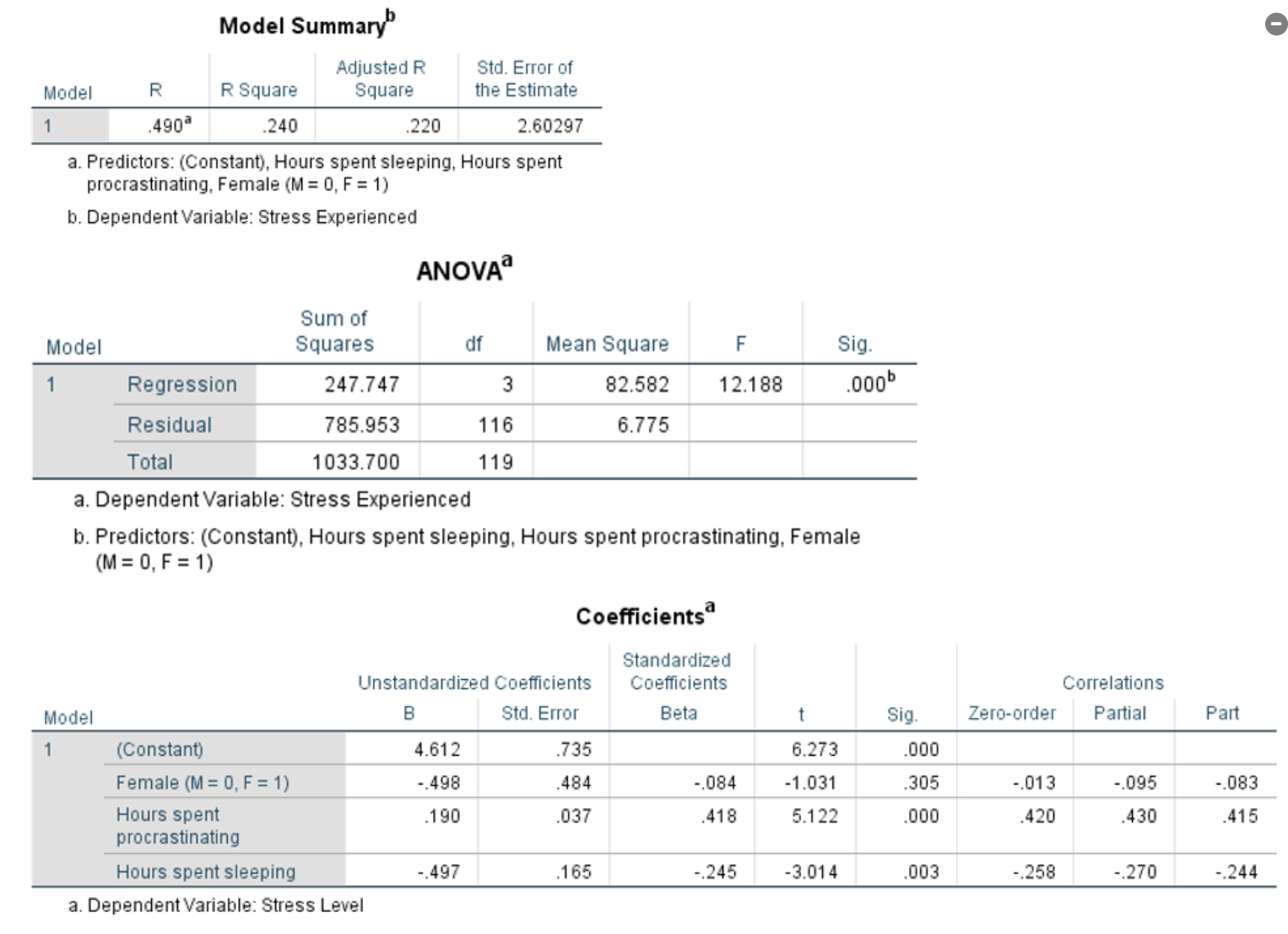
Question: In the output, the unstandardised coefficient (B-weight) for the predictor hours spent sleeping is -0.497. What does this suggest about its relationship with the criterion,

In the output, the unstandardised coefficient (B-weight) for the predictor hours spent sleeping is -0.497. What does this suggest about its relationship with the criterion, stress level?For every additional hour spent sleeping, stress level decreases by 49.7%The correlation between sleep and stress is -0.497This means that sleeping longer causes stress levels to increaseFor every additional hour spent sleeping, stress level decreases by 0.497 points
In the output, the unstandardised coefficient
Model Summary\" Adjusted R Std. Error of Model R R Square Square the Estimate 1 490? 240 .220 2.60297 a. Predictors: (Constant), Hours spent sleeping, Hours spent procrastinating, Female (M=0,F = 1) b. Dependent Variable: Stress Experienced ANOVA" Sum of Model Squares df Mean Square F Sig. 1 Regression 247.747 3 82.582 12.188 000 Residual 785.953 116 6.775 | Total 1033.700 119 a. Dependent Variable: Stress Experienced b. Predictors: (Constant), Hours spent sleeping, Hours spent procrastinating, Female (M=0,F=1) Coefficients Standardized Unstandardized Coefficients Coefficients Correlations Model B Std. Error Beta t Sig. Zero-order - Partial Part 1 (Constant) 4.612 736 6.273 000 Female (M= 0, F = 1) 498 484 084-1031 305 7.013 | -.095 -.083 Hours spent 190 037 418 .122 000 420 .430 415 procrastinating Hours spent sleeping -.497 165 -.245 -3.014 .003 -.258 -.270 -.244 a. Dependent Variable: Stress Level

Step by Step Solution

There are 3 Steps involved in it

1 Expert Approved Answer
Step: 1 Unlock blur-text-image

Question Has Been Solved by an Expert!

Get step-by-step solutions from verified subject matter experts

Step: 2 Unlock
Step: 3 Unlock

Students Have Also Explored These Related Accounting Questions!