







Question: In the previous Problem Set question, we started looking at the cost function C ( ), the cost of a firm producing & items. An
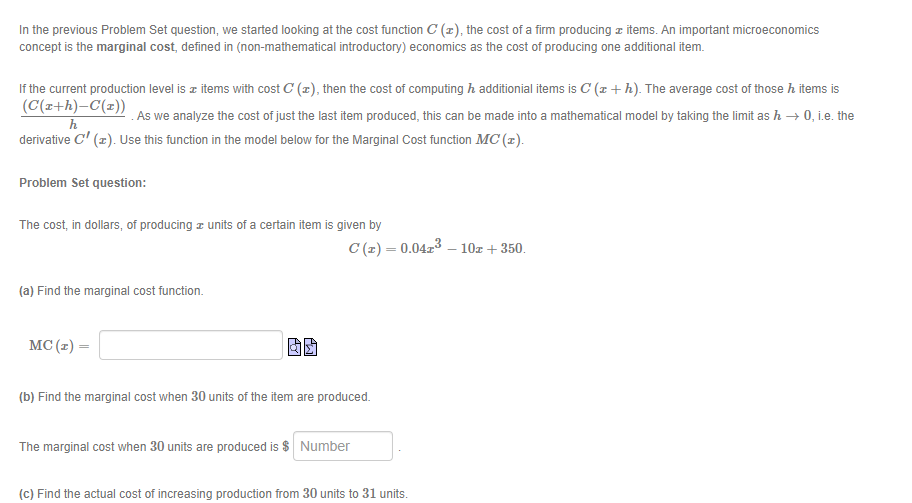
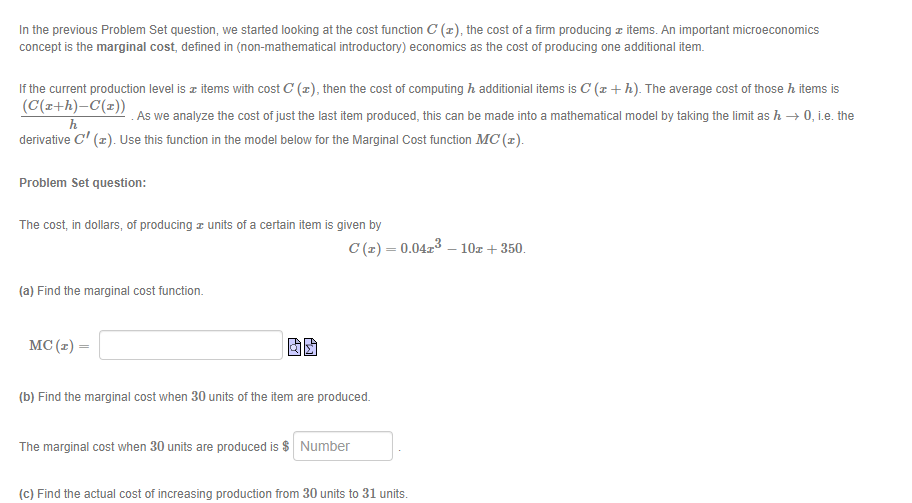
In the previous Problem Set question, we started looking at the cost function C ( ), the cost of a firm producing & items. An important microeconomics concept is the marginal cost, defined in (non-mathematical introductory) economics as the cost of producing one additional item. If the current production level is a items with cost C (x), then the cost of computing h additionial items is C (x + h). The average cost of those h items is (C(Ith)-C(I)) h As we analyze the cost of just the last item produced, this can be made into a mathematical model by taking the limit as h -+ 0, i.e. the derivative C(x). Use this function in the model below for the Marginal Cost function MC (I). Problem Set question: The cost, in dollars, of producing z units of a certain item is given by C(x) = 0.04r3 - 10r + 350. (a) Find the marginal cost function. MC(I) = (b) Find the marginal cost when 30 units of the item are produced. The marginal cost when 30 units are produced is $ Number (c) Find the actual cost of increasing production from 30 units to 31 units
Step by Step Solution
There are 3 Steps involved in it

Get step-by-step solutions from verified subject matter experts
 Study Help