







Question: In the previous programming assignment, you learned socket programming. In this assignment, you will explore reliable data transfer mechanism utilizing client-server socket communication. We have
In the previous programming assignment, you learned socket programming. In this assignment, you will explore reliable data transfer mechanism utilizing client-server socket communication. We have introduced RDT 3.0
(Chapter 3-part2.ppt, Slide No. 9) in chapter 3. RDT3.0 is a stop-and-wait protocol that uses alternative bit to
realize the reliable data transfer. In this assignment, you will implement client-server communication on two
separate processes similar to what you did in last programming assignment. Then, depending on your preference,
you may implement the RDT sender on the server side and the RDT receiver on the client side or vice versa. The
primary function for the RDT sender is to transfer data message (through socket) to the RDT receiver according to
RDT 3.0 mechanism. The RDT receiver would ACK the message based on RDT 3.0 mechanism. To simplify the
problem, we assume that the sender will always have data to transmit. The data can be defined as a set of phrases
such as the days of the week.
data=["Sunday","Monday","Tuesday","Wednesday","Thursday","Friday","Saturday"]
The sender fetches one of phrases and attaches a proper sequence number to generate a message, which would be
sent by the socket to the receiver side. The sender picks the phrases in order. When reaching the last phrase of
data set, the sender would go back to the first phrase and continue assembling the message. In this way, the sender
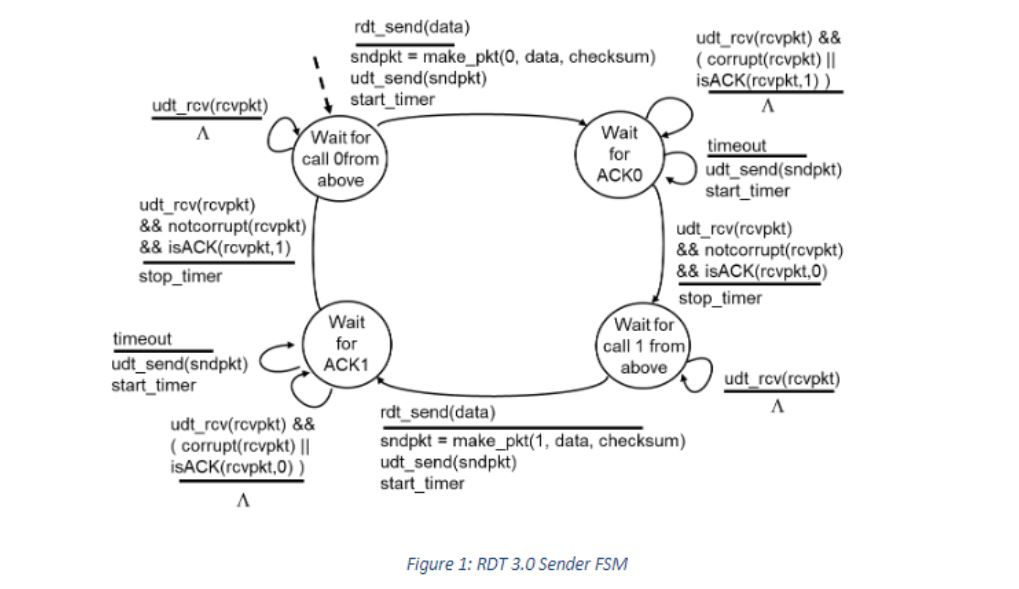
would always have data for transfer. As discussed in Chapter 3, the FSM of RDT 3.0 is shown in
Figure 1.
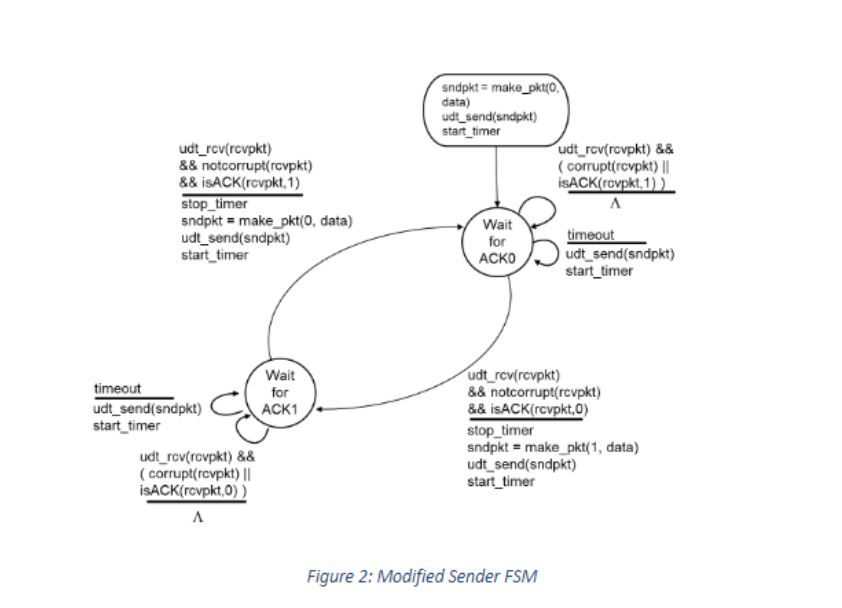
Because of our assumption of continuous data, the sender no longer needs to wait for data from above. So the
FSM can be simplified. The modified FSM is shown in
Figure 2.
As you recall, the RDT 3.0 assumes an unreliable channel between the sender and the receiver. However, the socket
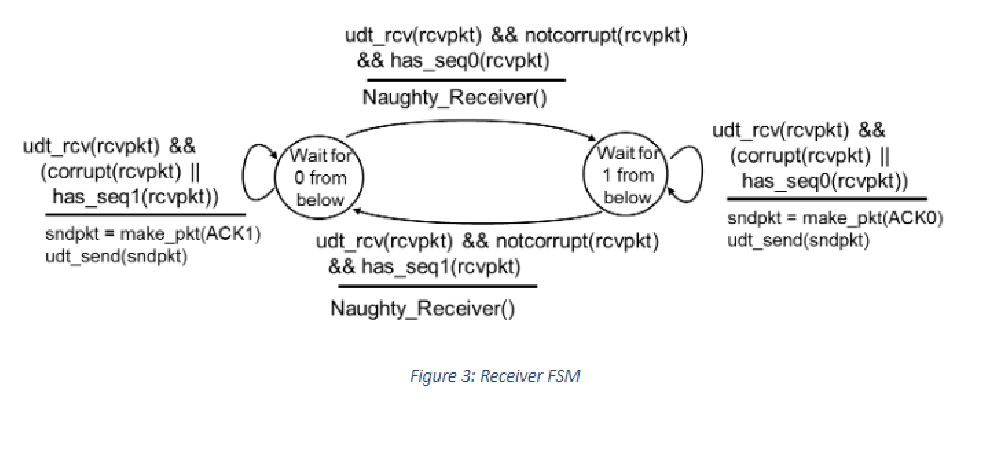
communication is reliable. To simulate the effect of unreliable packet transmission, we add a naughty receiver
function to the receiver side. The FSM of the revised receiver is shown in
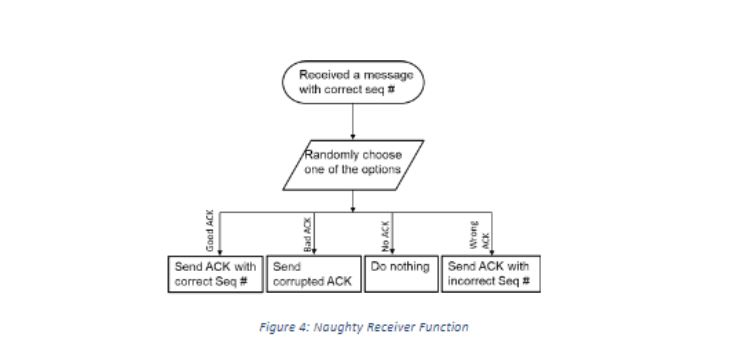
Figure 3 and the Naughty_Receiver()
function is shown in
Figure 4. As shown in
Figure 4, instead of just sending an ACK with correct sequence number,
the Naughty_Receiver function has options to send corrupted ACK, not to send ACK or to send ACK with incorrect
sequence number. This function will randomly choose one of the four options (i.e. generate a random number to
choose one of the four options with equal chance) to make the sender experience the different error conditions and
thus go through all the transitions and actions defined in the RDT 3.0. Note: the checksum is not mandatory in this
assignment. When generating the corrupted ACK, the receiver can simply generate a message of corrupted ACK
(as long as the sender understands it is a corrupted ACK).
In this assignment, you will use printout messages to indicate the actions of the sender and the receiver. The sample
printout messages are shown in the appendix. You can define your termination condition. It could be stop after
sending certain number of messages or after fixed number of iterations. Like programming assignment 1, you will
implement both client-server processes on the same server (eustis.eecs.ucf.edu). You can use C/C++, Java, and
Python to program this project. Eustis supports all these programming languages.
Submission:
1. You will submit your source codes
2. You will submit a report to describe the design of your programs, explain how to compile/run your codes
and include screenshots of the running sender and receiver screens (your screens only need to show part
of output messages since the complete set of messages may be much longer). Then, copy and paste the
complete printout messages for both sender and receiver to your report (or to text files). You printout
messages should show all four options (i.e. each option happened at least once) in the
Naughty_Receiver().
3. Since you need to submit several files, please zip all your files into one file and submit through
webcourses.
Appendix: Sample Printout Messages
RDT Sender:
Lets start
Connected by ('127.0.0.1', 57586)
Sender sent a message: Sunday 0
Continue waiting
Continue waiting
Continue waiting
Continue waiting
Continue waiting
Timeout. Send the message again
Sender sent a message: Sunday 0
Sender received a valid ACK for 0 , send next message
Sender sent a message: Monday 1
Sender received a corrupted ACK, keep waiting
Continue waiting
Continue waiting
Continue waiting
Continue waiting
Continue waiting
Timeout. Send the message again
Sender sent a message: Monday 1
Sender received a valid ACK for 1 , send next message
Sender sent a message: Tuesday 0
Sender received an ACK with wrong sequency number, keep waiting
Continue waiting
Continue waiting
Continue waiting
Continue waiting
Continue waiting
Timeout. Send the message again
Sender sent a message: Tuesday 0
Sender received a valid ACK for 0 , send next message
Sender sent a message: Wednesday 1
Sender received a valid ACK for 1 , send next message
Sender sent a message: Thursday 0
Sender received an ACK with wrong sequency number, keep waiting
Continue waiting
Continue waiting
Continue waiting
Continue waiting
Continue waiting
Timeout. Send the message again
Sender sent a message: Thursday 0
Sender received a valid ACK for 0 , send next message
Sender sent a message: Friday 1
Sender received a valid ACK for 1 , send next message
Sender sent a message: Saturday 0
Sender received a corrupted ACK, keep waiting
Continue waiting
Continue waiting
Continue waiting
Continue waiting
Continue waiting
Timeout. Send the message again
Sender sent a message: Saturday 0
Sender received a valid ACK for 0 , send next message
Sender sent a message: Sunday 1
Continue waiting
Continue waiting
Continue waiting
Continue waiting
Continue waiting
Timeout. Send the message again
Sender sent a message: Sunday 1
Sender received a valid ACK for 1 , send next message
Sender sent a message: Monday 0
Sender received an ACK with wrong sequency number, keep waiting
Continue waiting
Continue waiting
Continue waiting
Continue waiting
Continue waiting
Timeout. Send the message again
Sender sent a message: Monday 0
Sender received a valid ACK for 0 , send next message
Sender sent a message: Tuesday 1
Sender received a corrupted ACK, keep waiting
Continue waiting
Continue waiting
Continue waiting
Continue waiting
Continue waiting
Timeout. Send the message again
Sender sent a message: Tuesday 1
Sender received a valid ACK for 1 , send next message
Sender sent a message: Wednesday 0
Sender received a corrupted ACK, keep waiting
RDT Receiver:
Receiver just correctly received a message: Sunday 0
How do you respond?
(1) send a correct ACK; (2) send a corrupted ACK; (3) do not send ACK; (4) send a wrong ACK
Receiver do not send ACK
Receiver just correctly received a duplicated message: Sunday 0
Receiver responds with ACK 0
Receiver just correctly received a message: Monday 1
How do you respond?
(1) send a correct ACK; (2) send a corrupted ACK; (3) do not send ACK; (4) send a wrong ACK
A corrupted ACK is sent
Receiver just correctly received a duplicated message: Monday 1
Receiver responds with ACK 1
Receiver just correctly received a message: Tuesday 0
How do you respond?
(1) send a correct ACK; (2) send a corrupted ACK; (3) do not send ACK; (4) send a wrong ACK
Receiver incorrectly responds with ACK 1
Receiver just correctly received a duplicated message: Tuesday 0
Receiver responds with ACK 0
Receiver just correctly received a message: Wednesday 1
How do you respond?
(1) send a correct ACK; (2) send a corrupted ACK; (3) do not send ACK; (4) send a wrong ACK
Receiver correctly responds with ACK 1
Receiver just correctly received a message: Thursday 0
How do you respond?
(1) send a correct ACK; (2) send a corrupted ACK; (3) do not send ACK; (4) send a wrong ACK
Receiver incorrectly responds with ACK 1
Receiver just correctly received a duplicated message: Thursday 0
Receiver responds with ACK 0
Receiver just correctly received a message: Friday 1
How do you respond?
(1) send a correct ACK; (2) send a corrupted ACK; (3) do not send ACK; (4) send a wrong ACK
Receiver correctly responds with ACK 1
Receiver just correctly received a message: Saturday 0
How do you respond?
(1) send a correct ACK; (2) send a corrupted ACK; (3) do not send ACK; (4) send a wrong ACK
A corrupted ACK is sent
Receiver just correctly received a duplicated message: Saturday 0
Receiver responds with ACK 0
Receiver just correctly received a message: Sunday 1
How do you respond?
(1) send a correct ACK; (2) send a corrupted ACK; (3) do not send ACK; (4) send a wrong ACK
Receiver do not send ACK
Receiver just correctly received a duplicated message: Sunday 1
Receiver responds with ACK 1
Receiver just correctly received a message: Monday 0
How do you respond?
(1) send a correct ACK; (2) send a corrupted ACK; (3) do not send ACK; (4) send a wrong ACK
Receiver incorrectly responds with ACK 1
Receiver just correctly received a duplicated message: Monday 0
Receiver responds with ACK 0
Receiver just correctly received a message: Tuesday 1
How do you respond?
(1) send a correct ACK; (2) send a corrupted ACK; (3) do not send ACK; (4) send a wrong ACK
A corrupted ACK is sent
Receiver just correctly received a duplicated message: Tuesday 1
Receiver responds with ACK 1
Receiver just correctly received a message: Wednesday 0
How do you respond?
(1) send a correct ACK; (2) send a corrupted ACK; (3) do not send ACK; (4) send a wrong ACK
A corrupted ACK is sent
C language
rdt send(data) 1sndpkt make_pkt(0, data, checksum) corrupt(rcvpkt) II udt send(sndpkt) iSACK(rcvpkt,1)) udt _rcv(rcvpkt) start timer Wait for call Ofrom above Wait for ACKO timeout udt send(sndpkt) start timer udt rcv(rcvpkt) && notcorrupt(rcvpkt) && isACK(rcvpkt, 1) stop timer udt rcv(rcvpkt) && notcorrupt(rcvpkt) stop timer Wait Wait for call 1 from above timeout udt _send(sndpkt) start timer ACK1 udt rcv(rcvpkt) rdt send(data) sndpkt make_pkt(1, data, checksum) udt send(sndpkt) start timer corrupt(rcvpkt) lI iSACK(rcvpkt,0)) Figure 1: RDT 3.0 Sender FSM
Step by Step Solution
There are 3 Steps involved in it

Get step-by-step solutions from verified subject matter experts
 Study Help