







Question: In the s-t directed edge-disjoint paths problem, the input is a directed graph G = (V, E), a source vertex s, and a sink
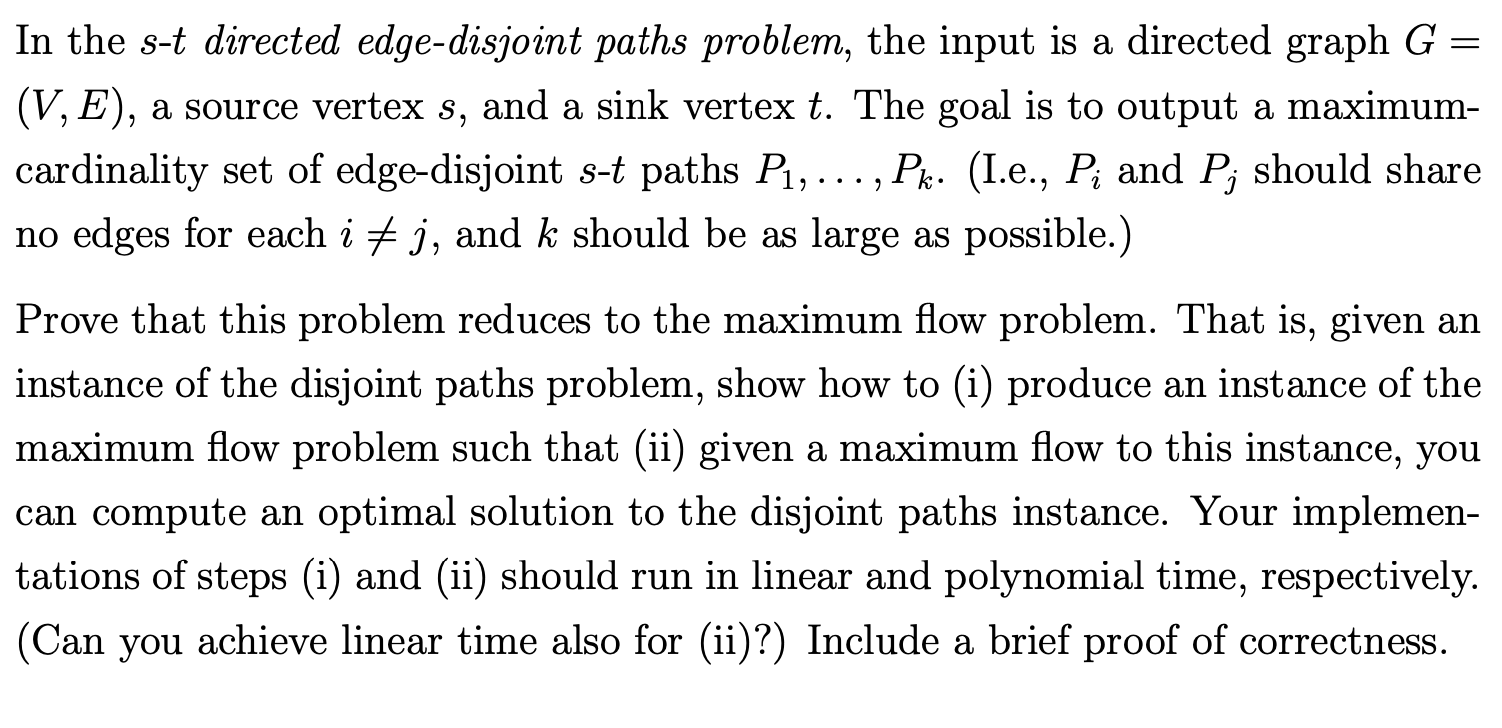
In the s-t directed edge-disjoint paths problem, the input is a directed graph G = (V, E), a source vertex s, and a sink vertex t. The goal is to output a maximum- cardinality set of edge-disjoint s-t paths P,..., Pk. (I.e., P, and Pj should share no edges for each i j, and k should be as large as possible.) Prove that this problem reduces to the maximum flow problem. That is, given an instance of the disjoint paths problem, show how to (i) produce an instance of the maximum flow problem such that (ii) given a maximum flow to this instance, you can compute an optimal solution to the disjoint paths instance. Your implemen- tations of steps (i) and (ii) should run in linear and polynomial time, respectively. (Can you achieve linear time also for (ii)?) Include a brief proof of correctness.
Step by Step Solution
3.40 Rating (150 Votes )
There are 3 Steps involved in it
Reduction to the Maximum Flow Problem The st directed edgedisjoint paths problem can be reduced to the maximum flow problem by constructing a new dire... View full answer

Get step-by-step solutions from verified subject matter experts
 Study Help