







Question: In the statement below, a physics student describes a thermodynamic cycle through which a sample of an ideal monatomic gas is taken. At the
In the statement below, a physics student describes a thermodynamic cycle through which a sample of an ideal monatomic gas is taken.
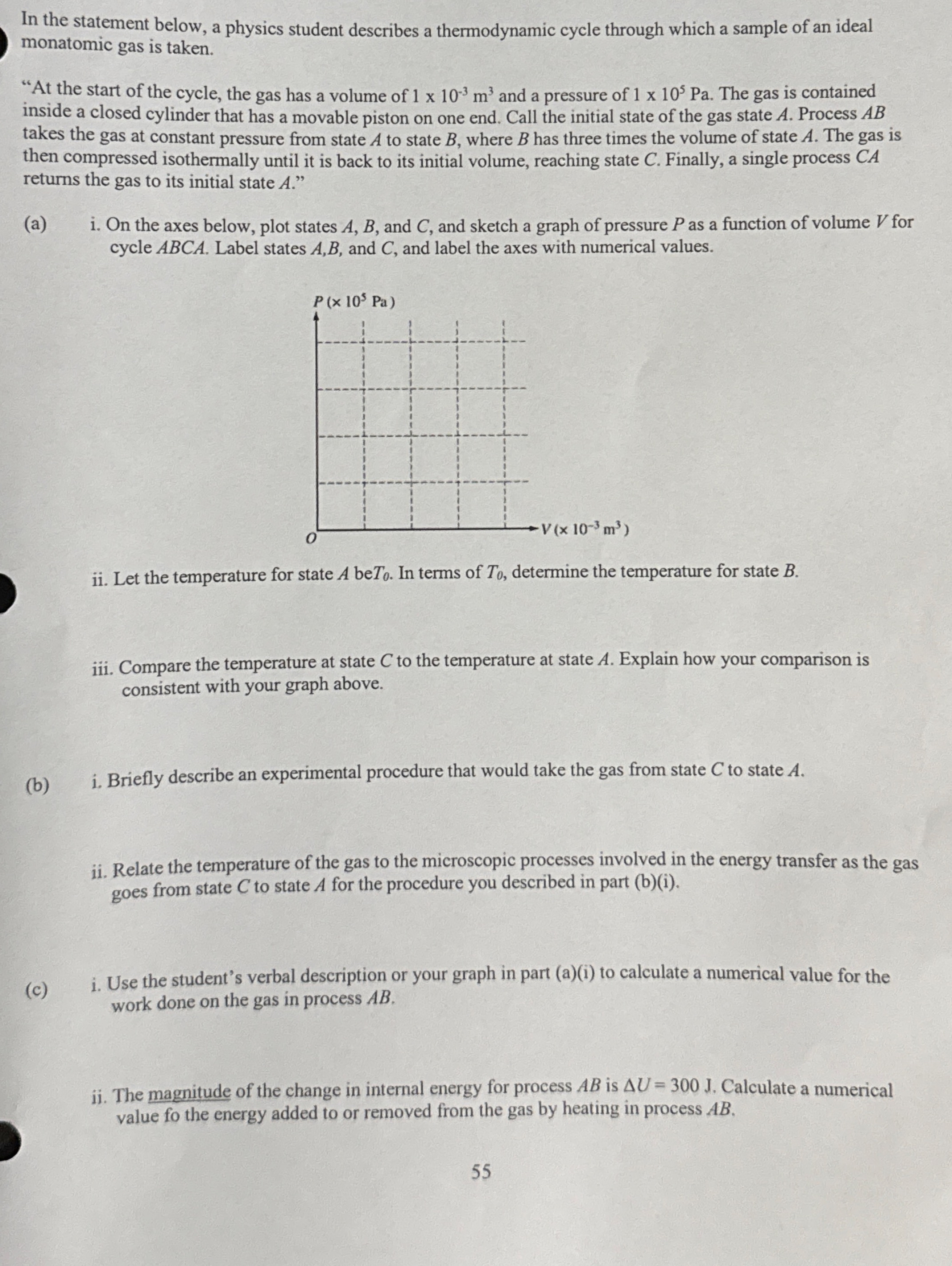
At the start of the cycle, the gas has a volume of and a pressure of The gas is contained inside a closed cylinder that has a movable piston on one end. Call the initial state of the gas state Process takes the gas at constant pressure from state to state where has three times the volume of state The gas is then compressed isothermally until it is back to its initial volume, reaching state Finally, a single process returns the gas to its initial state
a i On the axes below, plot states and and sketch a graph of pressure as a function of volume for cycle ABCA. Label states and and label the axes with numerical values.
ii Let the temperature for state be In terms of determine the temperature for state
iii. Compare the temperature at state to the temperature at state Explain how your comparison is consistent with your graph above.
b i Briefly describe an experimental procedure that would take the gas from state to state
ii Relate the temperature of the gas to the microscopic processes involved in the energy transfer as the gas goes from state to state A for the procedure you described in part bi
c i Use the student's verbal description or your graph in part ai to calculate a numerical value for the work done on the gas in process
ii The magnitude of the change in internal energy for process is Calculate a numerical value fo the energy added to or removed from the gas by heating in process
Step by Step Solution
There are 3 Steps involved in it
1 Expert Approved Answer
Step: 1 Unlock

Question Has Been Solved by an Expert!
Get step-by-step solutions from verified subject matter experts
Step: 2 Unlock
Step: 3 Unlock
 Study Help