







Question: In the supplementary notes, we give a Haskell program that takes a regular expression r, and returns a regular expression r such that L(r)rotational closure
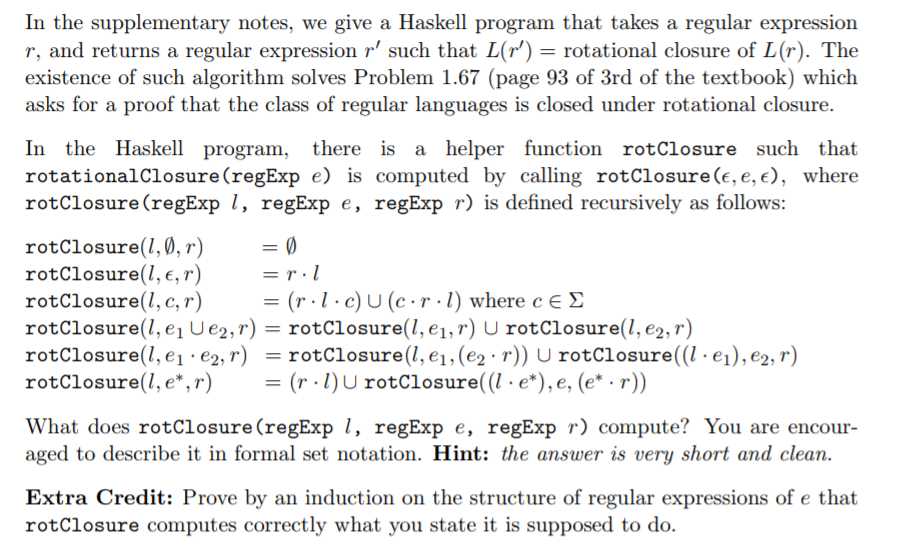
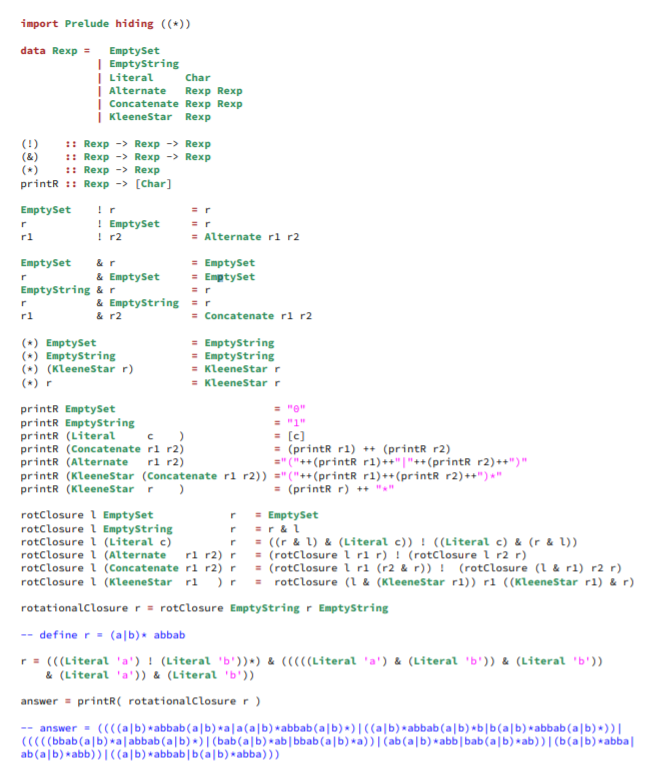
In the supplementary notes, we give a Haskell program that takes a regular expression r, and returns a regular expression r such that L(r)rotational closure of L(r). The existence of such algorithm solves Problem 1.67 (page 93 of 3rd of the textbook) which asks for a proof that the class of regular languages is closed under rotational closure In the Haskell program, there is a helper function rotClosure such that rotationalClosure(regExp e) is computed by calling rotClosure(e,e,), where rotClosure (regExp 1, regExp e, regExp r) is defined recursively as follows: rotClosure(l,0,r) rotClosure(l, ,r) rotClosure(l, c, r) (r . 1 . c) U (c . r .1) where CE rotClosure(1,e*,r) -(r. What does rotClosure(regExp 1, regExp e, regExp r) compute? You are encour- aged to describe it in formal set notation. Hint: the answer is very short and clean. Extra Credit: Prove by an induction on the structure of regular expressions of e that rotClosure computes correctly what you state it is supposed to do. In the supplementary notes, we give a Haskell program that takes a regular expression r, and returns a regular expression r such that L(r)rotational closure of L(r). The existence of such algorithm solves Problem 1.67 (page 93 of 3rd of the textbook) which asks for a proof that the class of regular languages is closed under rotational closure In the Haskell program, there is a helper function rotClosure such that rotationalClosure(regExp e) is computed by calling rotClosure(e,e,), where rotClosure (regExp 1, regExp e, regExp r) is defined recursively as follows: rotClosure(l,0,r) rotClosure(l, ,r) rotClosure(l, c, r) (r . 1 . c) U (c . r .1) where CE rotClosure(1,e*,r) -(r. What does rotClosure(regExp 1, regExp e, regExp r) compute? You are encour- aged to describe it in formal set notation. Hint: the answer is very short and clean. Extra Credit: Prove by an induction on the structure of regular expressions of e that rotClosure computes correctly what you state it is supposed to do
Step by Step Solution
There are 3 Steps involved in it

Get step-by-step solutions from verified subject matter experts
 Study Help