







Question: In this assignment, you are required to submit an individual report based upon a case study scenario. The case study identifies an organisation that has
In this assignment, you are required to submit an individual report based upon a case study scenario. The case study identifies an organisation that has suffered a significant disruption to its operations, logistics and supply chains. It can best be understood via the application of the principles of logistics and supply chain management, as introduced in the module.
Your task is to critically evaluate the case study and formulate recommendations, based on experience, lessons learned from previous crisis and relevant supply chain resilience frameworks. Consider yourself as a consultant, brought in to examine the recovery strategy of the organisation in terms of logistics and supply chain management arrangements.
See the case study images below for the article.
Suggested Structure
A recommended structure for your report follows. You can depart from these recommendations if you wish, but be sure to structure your report logically, and to cover all requested elements. Use numbered sections, with decimals for subsections.
Ideally, your report will include the following:
- A brief Introductionto the report, stating its purpose. (Do not expend too many words on descriptive writing and context-setting. Keep it clear and simple, use facts and figures to highlight the issues.)
- A critical analysis of Nissans plan to recover its supply chain operations.
- An evaluation of Nissans operational strategies for managing supply chain disruptions.
- An appraisal of Nissans recovery strategy and the potential identification of improvements for future crisis.
- A conclusionto the report with recommendations to prevent future similar disruptions.
- Add alist of Harvard references. Ideally, you will have cited 15+ sources within the text. This section does not count towards your word limit for the assignment.
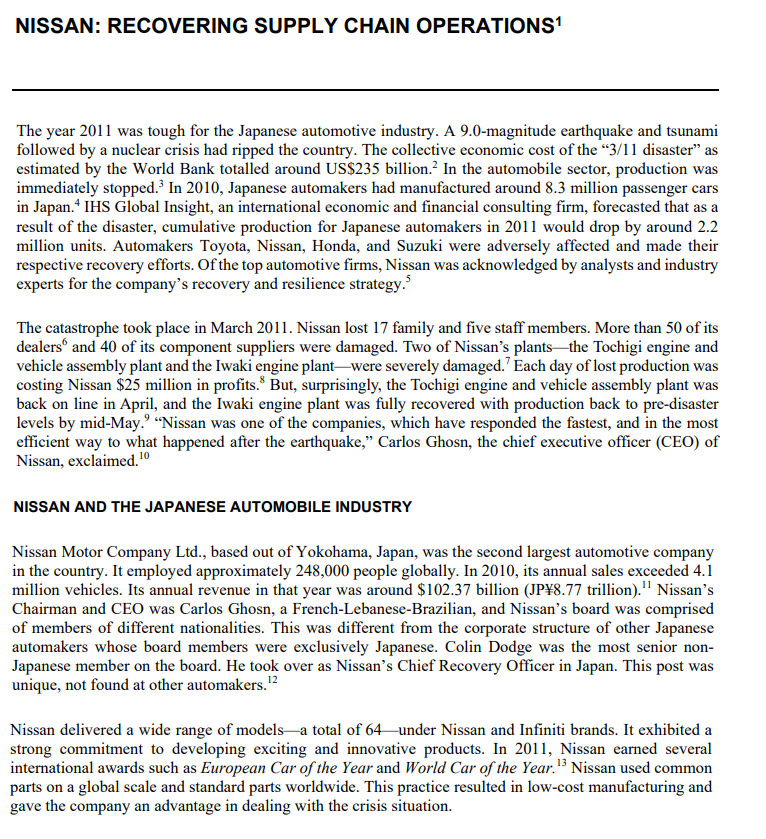
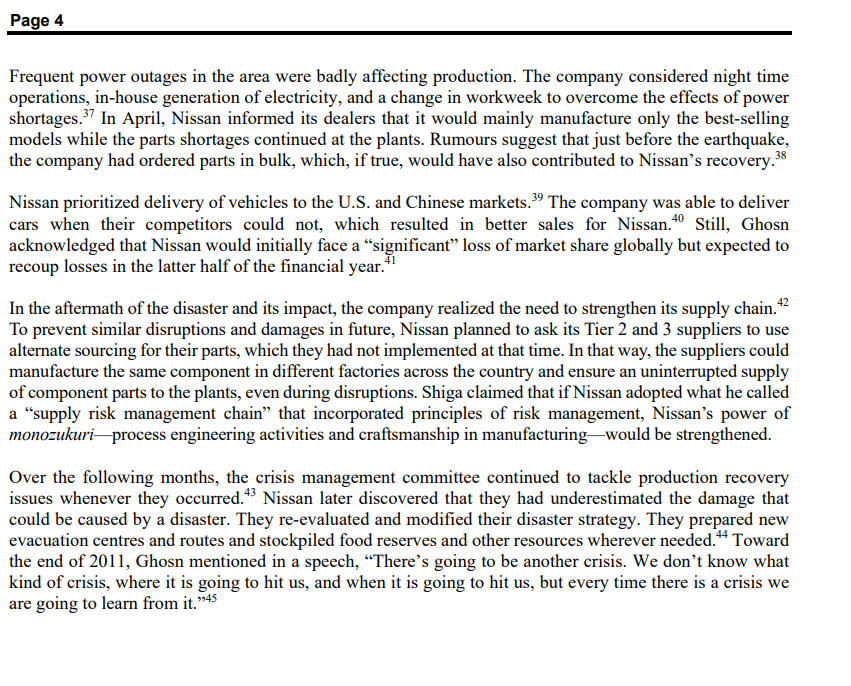
NISSAN: RECOVERING SUPPLY CHAIN OPERATIONS 1 The year 2011 was tough for the Japanese automotive industry. A 9.0-magnitude earthquake and tsunami followed by a nuclear crisis had ripped the country. The collective economic cost of the " 3/11 disaster" as estimated by the World Bank totalled around US $235 billion. 2 In the automobile sector, production was immediately stopped. 3 In 2010, Japanese automakers had manufactured around 8.3 million passenger cars in Japan. 4 IHS Global Insight, an international economic and financial consulting firm, forecasted that as a result of the disaster, cumulative production for Japanese automakers in 2011 would drop by around 2.2 million units. Automakers Toyota, Nissan, Honda, and Suzuki were adversely affected and made their respective recovery efforts. Of the top automotive firms, Nissan was acknowledged by analysts and industry experts for the company's recovery and resilience strategy. 5 The catastrophe took place in March 2011. Nissan lost 17 family and five staff members. More than 50 of its dealers 6 and 40 of its component suppliers were damaged. Two of Nissan's plants - the Tochigi engine and vehicle assembly plant and the Iwaki engine plant were severely damaged. 7 Each day of lost production was costing Nissan $25 million in profits. 8 But, surprisingly, the Tochigi engine and vehicle assembly plant was back on line in April, and the Iwaki engine plant was fully recovered with production back to pre-disaster levels by mid-May. " Nissan was one of the companies, which have responded the fastest, and in the most efficient way to what happened after the earthquake," Carlos Ghosn, the chief executive officer (CEO) of Nissan, exclaimed. 10 NISSAN AND THE JAPANESE AUTOMOBILE INDUSTRY Nissan Motor Company Ltd., based out of Yokohama, Japan, was the second largest automotive company in the country. It employed approximately 248,000 people globally. In 2010 , its annual sales exceeded 4.1 million vehicles. Its annual revenue in that year was around $102.37 billion (JP8.77 trillion). 11 Nissans Chairman and CEO was Carlos Ghosn, a French-Lebanese-Brazilian, and Nissan's board was comprised of members of different nationalities. This was different from the corporate structure of other Japanese automakers whose board members were exclusively Japanese. Colin Dodge was the most senior nonJapanese member on the board. He took over as Nissan's Chief Recovery Officer in Japan. This post was unique, not found at other automakers. 12 Nissan delivered a wide range of models - a total of 64 - under Nissan and Infiniti brands. It exhibited a strong commitment to developing exciting and innovative products. In 2011, Nissan earned several international awards such as European Car of the Year and World Car of the Year. 13 Nissan used common parts on a global scale and standard parts worldwide. This practice resulted in low-cost manufacturing and gave the company an advantage in dealing with the crisis situation. Frequent power outages in the area were badly affecting production. The company considered night time operations, in-house generation of electricity, and a change in workweek to overcome the effects of power shortages 37 In April, Nissan informed its dealers that it would mainly manufacture only the best-selling models while the parts shortages continued at the plants. Rumours suggest that just before the earthquake, the company had ordered parts in bulk, which, if true, would have also contributed to Nissan's recovery. 38 Nissan prioritized delivery of vehicles to the U.S. and Chinese markets. 39 The company was able to deliver cars when their competitors could not, which resulted in better sales for Nissan. 40 Still, Ghosn acknowledged that Nissan would initially face a "significant" loss of market share globally but expected to recoup losses in the latter half of the financial year. 41 In the aftermath of the disaster and its impact, the company realized the need to strengthen its supply chain. 42 To prevent similar disruptions and damages in future, Nissan planned to ask its Tier 2 and 3 suppliers to use alternate sourcing for their parts, which they had not implemented at that time. In that way, the suppliers could manufacture the same component in different factories across the country and ensure an uninterrupted supply of component parts to the plants, even during disruptions. Shiga claimed that if Nissan adopted what he called a "supply risk management chain" that incorporated principles of risk management, Nissan's power of monozukuri - process engineering activities and craftsmanship in manufacturing would be strengthened. Over the following months, the crisis management committee continued to tackle production recovery issues whenever they occurred. 43 Nissan later discovered that they had underestimated the damage that could be caused by a disaster. They re-evaluated and modified their disaster strategy. They prepared new evacuation centres and routes and stockpiled food reserves and other resources wherever needed. 44 Toward the end of 2011, Ghosn mentioned in a speech, "There's going to be another crisis. We don't know what kind of crisis, where it is going to hit us, and when it is going to hit us, but every time there is a crisis we are going to learn from it." 45
Step by Step Solution
There are 3 Steps involved in it

Get step-by-step solutions from verified subject matter experts
 Study Help