







Question: In this assignment, you may work in either the SI or BGS system, but you must be consistent. 1. Create the CMey versus a plot
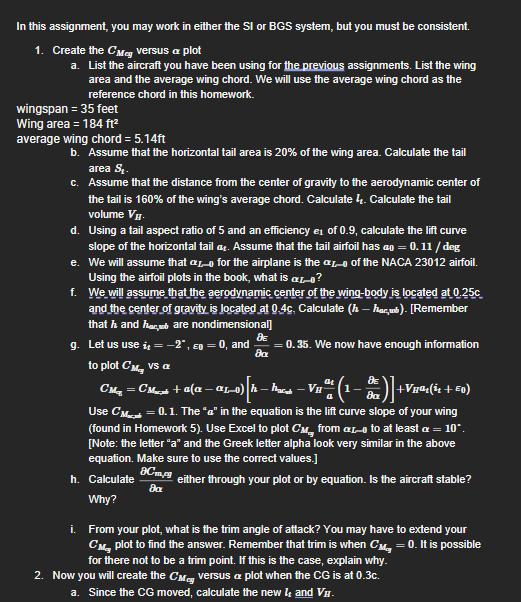
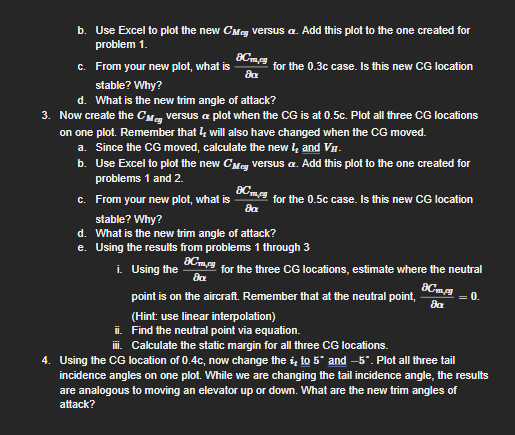
In this assignment, you may work in either the SI or BGS system, but you must be consistent. 1. Create the CMey versus a plot a. List the aircraft you have been using for the previous assignments. List the wing area and the average wing chord. We will use the average wing chord as the reference chord in this homework. wingspan = 35 feet Wing area = 184 ft2 average wing chord = 5.14ft b. Assume that the horizontal tail area is 20% of the wing area. Calculate the tail area S, c. Assume that the distance from the center of gravity to the aerodynamic center of the tail is 160% of the wing's average chord. Calculate 4. Calculate the tail volume VH- d. Using a tail aspect ratio of 5 and an efficiency en of 0.9, calculate the lift curve slope of the horizontal tail ar. Assume that the tail airfoil has ap = 0. 11 / deg . We will assume that or-o for the airplane is the or-o of the NACA 23012 airfoil. Using the airfoil plots in the book, what is or-o? f. We will assume that the aerodynamic center of the wing-body is located at 0.25c. and the center of gravity is located at 0.4c, Calculate (h - has,wb). [Remember that h and has,we are nondimensional] g. Let us use it = -2", 20 = 0, and- = 0.35. We now have enough information to plot CM VS CM - CM + a(a - 1 0) 1 - Me4 - V82 (1-82 ) +Vao(" + 50) Use CM. =0.1. The "a" in the equation is the lift curve slope of your wing (found in Homework 5). Use Excel to plot CM from or o to at least a = 10". [Note: the letter "a" and the Greek letter alpha look very similar in the above equation. Make sure to use the correct values.] h. Calculate 86,4 either through your plot or by equation. Is the aircraft stable? Why? i. From your plot, what is the trim angle of attack? You may have to extend your Cy. plot to find the answer. Remember that trim is when Cy = 0. It is possible for there not to be a trim point. If this is the case, explain why. 2. Now you will create the Cure, versus a plot when the CG is at 0.3c. a. Since the CG moved, calculate the new & and VA.b. Use Excel to plot the new Cia versus a. Add this plot to the one created for problem 1. c. From your new plot, what is for the 0.3c case. Is this new CG location stable? Why? d. What is the new trim angle of attack? 3. Now create the Cyr, versus a plot when the CG is at 0.5c. Plot all three CG locations on one plot. Remember that 4 will also have changed when the CG moved. a. Since the CG moved, calculate the new , and VA. b. Use Excel to plot the new Cia, versus a. Add this plot to the one created for problems 1 and 2. c. From your new plot, what is- 80meg for the 0.5c case. Is this new CG location stable? Why? d. What is the new trim angle of attack? e. Using the results from problems 1 through 3 i. Using the 80m,49 for the three CG locations, estimate where the neutral point is on the aircraft. Remember that at the neutral point, =0. (Hint: use linear interpolation) ii. Find the neutral point via equation. ii. Calculate the static margin for all three CG locations. 4. Using the CG location of 0.4c, now change the i, to 5" and -5". Plot all three tail incidence angles on one plot. While we are changing the tail incidence angle, the results are analogous to moving an elevator up or down. What are the new trim angles of attack
Step by Step Solution
There are 3 Steps involved in it

Get step-by-step solutions from verified subject matter experts
 Study Help