







Question: In this assignment, you will practice solving versions of the exchange economy and Ricardian models to see where the gains from trade come from. There
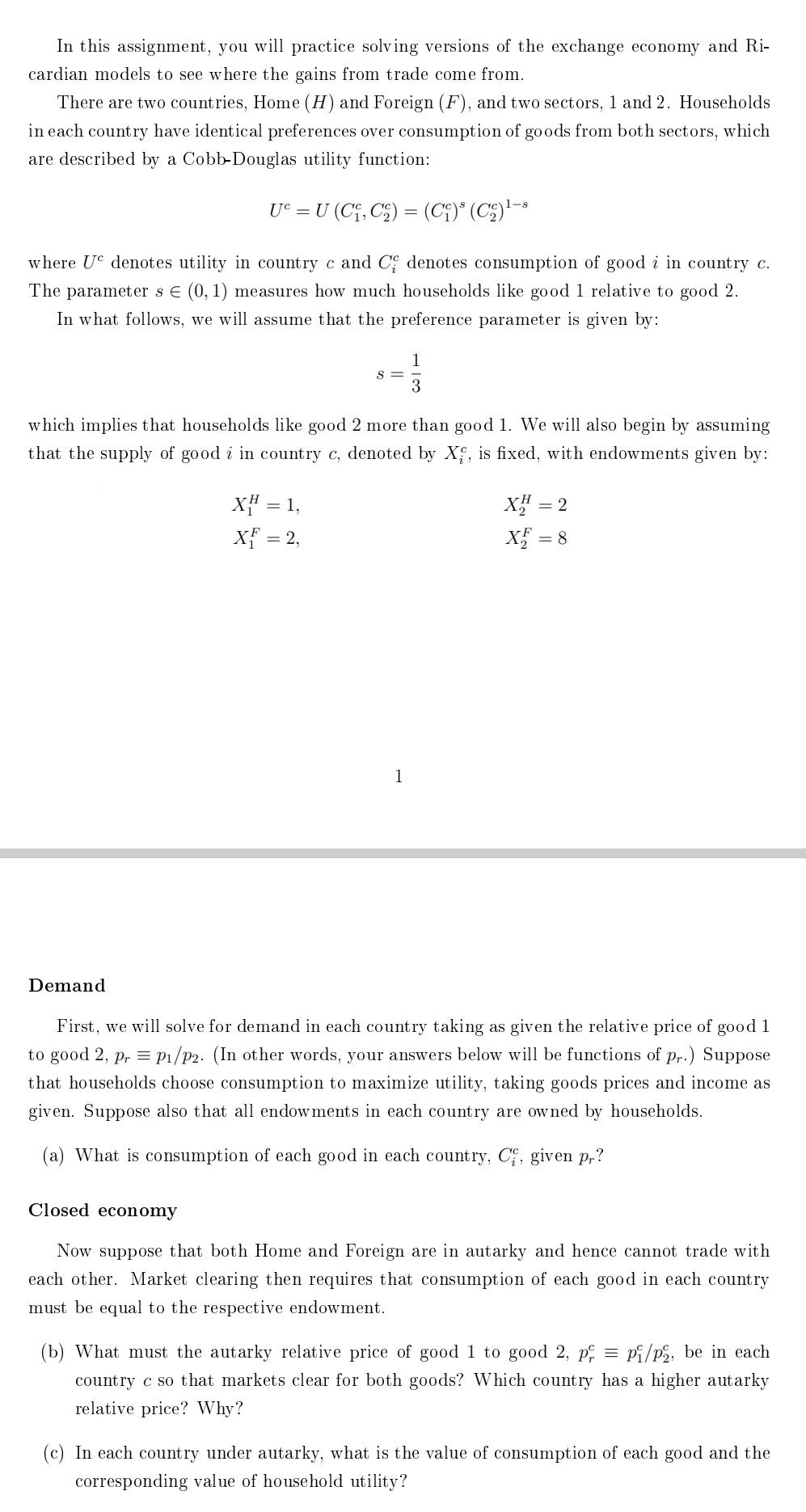
In this assignment, you will practice solving versions of the exchange economy and Ricardian models to see where the gains from trade come from. There are two countries, Home (H) and Foreign (F), and two sectors, 1 and 2 . Households in each country have identical preferences over consumption of goods from both sectors, which are described by a Cobb-Douglas utility function: Uc=U(C1c,C2c)=(C1c)s(C2c)1s where Uc denotes utility in country c and Cic denotes consumption of good i in country c. The parameter s(0,1) measures how much households like good 1 relative to good 2 . In what follows, we will assume that the preference parameter is given by: s=31 which implies that households like good 2 more than good 1 . We will also begin by assuming that the supply of good i in country c, denoted by Xic, is fixed, with endowments given by: X1H=1,X2H=2 X1F=2,X2F=8 1 Demand First, we will solve for demand in each country taking as given the relative price of good 1 to good2,prp1/p2. (In other words, your answers below will be functions of pr.) Suppose that households choose consumption to maximize utility, taking goods prices and income as given. Suppose also that all endowments in each country are owned by households. (a) What is consumption of each good in each country, Cic, given pr ? Closed economy Now suppose that both Home and Foreign are in autarky and hence cannot trade with each other. Market clearing then requires that consumption of each good in each country must be equal to the respective endowment. (b) What must the autarky relative price of good 1 to good 2,prcp1c/p2c, be in each country c so that markets clear for both goods? Which country has a higher autarky relative price? Why? (c) In each country under autarky, what is the value of consumption of each good and the corresponding value of household utility? In this assignment, you will practice solving versions of the exchange economy and Ricardian models to see where the gains from trade come from. There are two countries, Home (H) and Foreign (F), and two sectors, 1 and 2 . Households in each country have identical preferences over consumption of goods from both sectors, which are described by a Cobb-Douglas utility function: Uc=U(C1c,C2c)=(C1c)s(C2c)1s where Uc denotes utility in country c and Cic denotes consumption of good i in country c. The parameter s(0,1) measures how much households like good 1 relative to good 2 . In what follows, we will assume that the preference parameter is given by: s=31 which implies that households like good 2 more than good 1 . We will also begin by assuming that the supply of good i in country c, denoted by Xic, is fixed, with endowments given by: X1H=1,X2H=2 X1F=2,X2F=8 1 Demand First, we will solve for demand in each country taking as given the relative price of good 1 to good2,prp1/p2. (In other words, your answers below will be functions of pr.) Suppose that households choose consumption to maximize utility, taking goods prices and income as given. Suppose also that all endowments in each country are owned by households. (a) What is consumption of each good in each country, Cic, given pr ? Closed economy Now suppose that both Home and Foreign are in autarky and hence cannot trade with each other. Market clearing then requires that consumption of each good in each country must be equal to the respective endowment. (b) What must the autarky relative price of good 1 to good 2,prcp1c/p2c, be in each country c so that markets clear for both goods? Which country has a higher autarky relative price? Why? (c) In each country under autarky, what is the value of consumption of each good and the corresponding value of household utility
Step by Step Solution
There are 3 Steps involved in it

Get step-by-step solutions from verified subject matter experts
 Study Help