







Question: In this assignment, you will test three hash functions provided by the instructor and then create one of your own. Please see the starter files
In this assignment, you will test three hash functions provided by the instructor and then create one of your own.
Please see the starter files codes provided below. Do not alter the existing function definitions or driver code in any way. We will be using Standard Template Library classes for this assignment.
Comparing Hash Functions
A good hash function distributes keys uniformly across its output range. The simplest way to compare hashing algorithms is to compare the number of collisions resulting when hashing a set of keys.
For each hash function, compute the number of collisions occurring when calculating hash codes for each word in the dictionary provided by the instructor. Print out a list showing each colliding hash-key and the words that collided using the print function provided by the instructor.
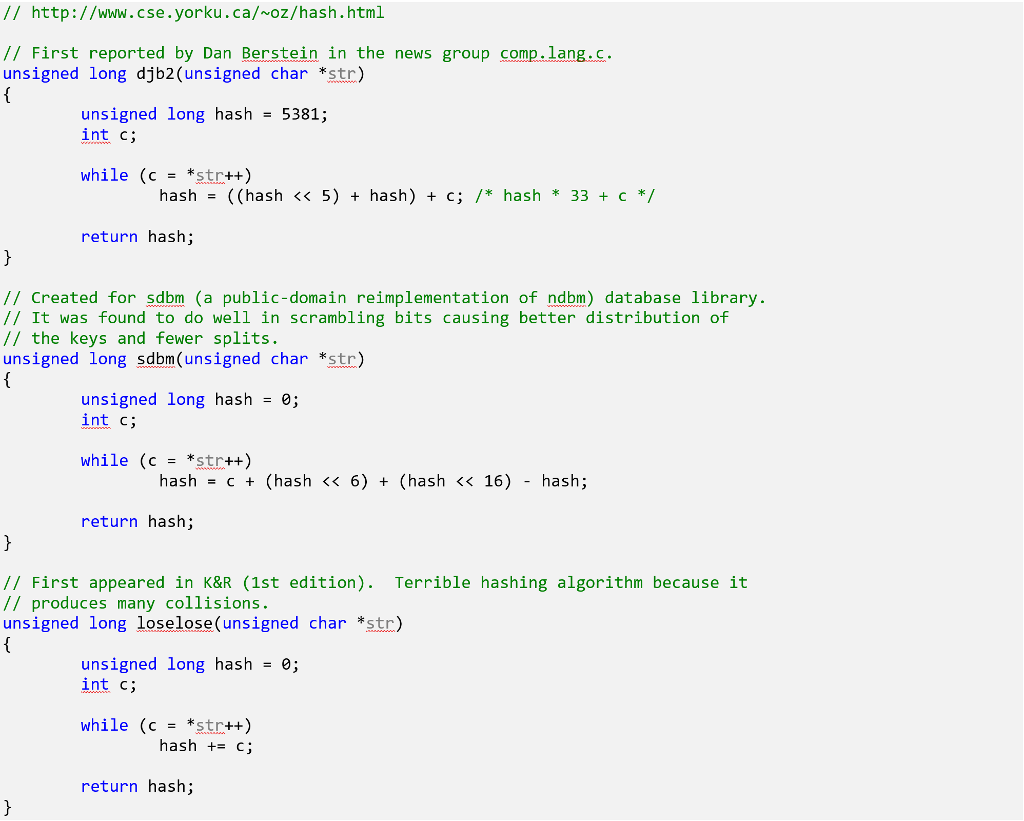
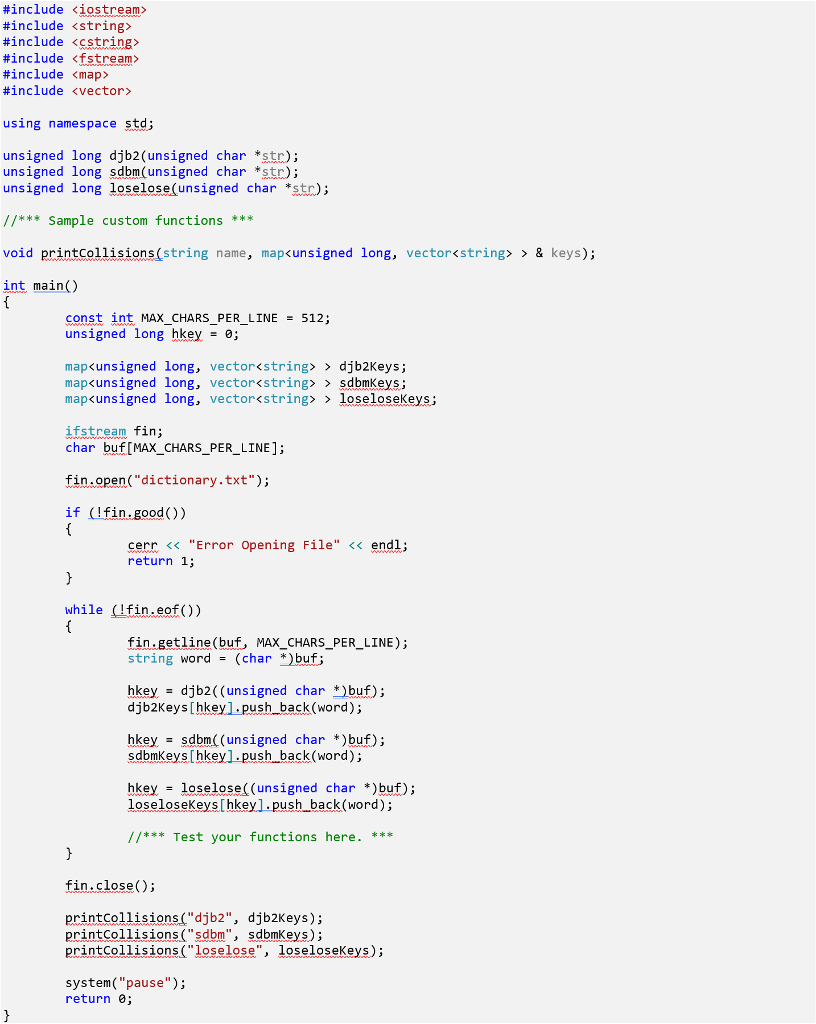
Here is some code that opens a dictionary file, reads each word, calculates a hash key, and then closes the file.
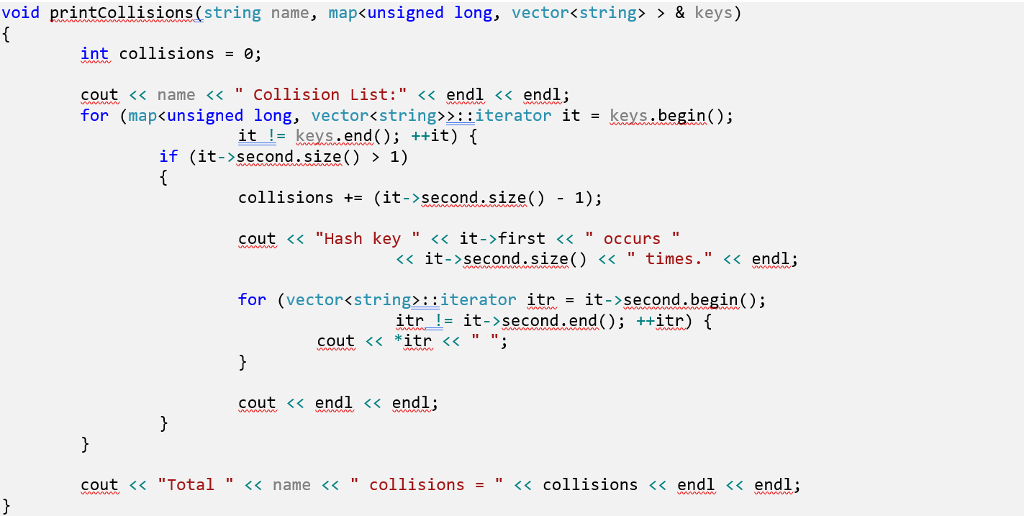
You may use the following print function if you like.
Create an original hash function.
Your hash function must have the following signature; you may assign your own function name:
unsigned long hf(unsigned char *str);
Print out the collisions for your hash function using the code provided by the instructor.
Sample output:
| djb2 - Collisions = 59 5863248: bi d' 5863413: gi i' 5863611: mi o' 121541278: joyful synaphea 153103337: broadened kilohm 193486210: ais c's 193487299: bis d's 193488388: cis e's 193489477: dis f's 193492729: gid i'd 193492738: gim i'm 193492744: gis i's 193493833: his j's 193498189: lis n's 193499278: mis o's 193500367: nis p's 193502545: pis r's 193505812: sis u's 193506901: tis v's 193509079: vis x's 193510168: wis y's 193511257: xis z's 226706708: mensis menu's 253411110: arris art's 253986102: baris bat's 256495158: delis den's 256861062: doris dot's 266348430: loris lot's 267026877: manis map's 267031233: maris mat's 267168447: melis men's 268702848: nobis nod's 270582462: palis pan's 270869958: pilis pin's 271301202: pulis pun's 272953215: rakis ram's 272956482: ranis rap's 874715923: heliotropes neurospora 919705060: animate animate 1006249872: appling bedaggle Please make sure to check for errors and compile the code before submitting an answer that is not working, thank you! Program.cpp: #include #include #include #include #include #include using namespace std; unsigned long djb2(unsigned char *str); unsigned long sdbm(unsigned char *str); unsigned long loselose(unsigned char *str); //*** Your hash function *** void printCollisions(string name, map int main() { const int MAX_CHARS_PER_LINE = 512;
unsigned long hkey = 0;
map map map
ifstream fin; char buf[MAX_CHARS_PER_LINE];
fin.open("dictionary.txt");
if (!fin.good()) { cerr return 1; }
while (!fin.eof()) { fin.getline(buf, MAX_CHARS_PER_LINE); string word = (char *)buf;
hkey = djb2((unsigned char *)buf); djb2Keys[hkey].push_back(word);
hkey = sdbm((unsigned char *)buf); sdbmKeys[hkey].push_back(word);
hkey = loselose((unsigned char *)buf); loseloseKeys[hkey].push_back(word);
//*** Test your has functions here ***
}
fin.close();
printCollisions("djb2", djb2Keys); printCollisions("sdbm", sdbmKeys); printCollisions("loselose", loseloseKeys);
system("pause"); return 0; }
// *** Hash Functions ***
// http://www.cse.yorku.ca/~oz/hash.html
// First reported by Dan Berstein in the news group comp.lang.c. unsigned long djb2(unsigned char *str) { unsigned long hash = 5381; int c;
while (c = *str++) hash = ((hash
return hash; }
// Created for sdbm (a public-domain reimplementation of ndbm) database library. // It was found to do well in scrambling bits causing better distribution of the keys and fewer splits. unsigned long sdbm(unsigned char *str) { unsigned long hash = 0; int c;
while (c = *str++) hash = c + (hash
return hash; }
// First appeared in K&R (1st edition). Terrible hashing algorithm because it produces many collisions. unsigned long loselose(unsigned char *str) { unsigned long hash = 0; int c;
while (c = *str++) hash += c;
return hash; }
void printCollisions(string name, map { int collisions = 0;
cout for (map it != keys.end(); ++it) { if (it->second.size() > 1) { collisions += (it->second.size() - 1);
cout first second.size()
for (vector itr != it->second.end(); ++itr) { cout }
cout } }
cout } |
http://www.cse.yorku.ca/~oz/hash. html First reported by Dan Berstein in the news group comp lang.c unsigned long djb2 (unsigned char str unsigned long hash 5381 int c while (c *str++) return hash; Created for sdbm (a public-domain reimplementation of ndbm) database library. It was found to do well in scrambling bits causing better distribution of the keys and fewer splits. unsigned long sdbm unsigned char str unsigned long hash 30; int c while (c str hash c (hash 6) (hash 16) hash; return hash First appeared in K&R (1st edition Terrible hashing algorithm because it produces many collisions. unsigned long loselose unsigned char str unsigned long hash e; int c while (c str hash c; return hash
Step by Step Solution
There are 3 Steps involved in it

Get step-by-step solutions from verified subject matter experts
 Study Help