







Question: In this assignment you will use MATLAB/Python to explore ideas from class. Important: please read the submission instructions posted on Canvas before you begin, as
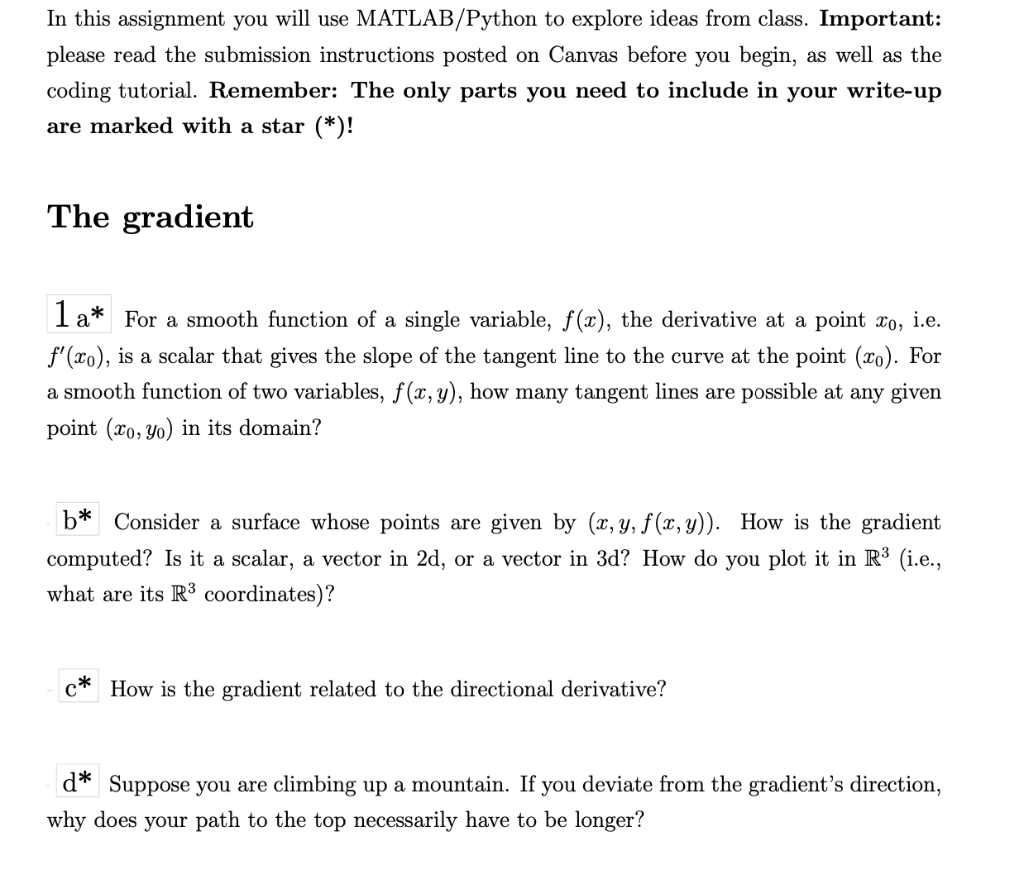
In this assignment you will use MATLAB/Python to explore ideas from class. Important: please read the submission instructions posted on Canvas before you begin, as well as the coding tutorial. Remember: The only parts you need to include in your write-up are marked with a star (*)! The gradient 1a* For a smooth function of a single variable, f(x), the derivative at a point to, i.e. f'(x0), is a scalar that gives the slope of the tangent line to the curve at the point (xo). For a smooth function of two variables, f(x, y), how many tangent lines are possible at any given point (x0, yo) in its domain? b* Consider a surface whose points are given by (x, y, f(x,y)). How is the gradient computed? Is it a scalar, a vector in 2d, or a vector in 3d? How do you plot it in R3 (i.e., what are its R3 coordinates)? c* How is the gradient related to the directional derivative? d* Suppose you are climbing up a mountain. If you deviate from the gradient's direction, why does your path to the top necessarily have to be longer? In this assignment you will use MATLAB/Python to explore ideas from class. Important: please read the submission instructions posted on Canvas before you begin, as well as the coding tutorial. Remember: The only parts you need to include in your write-up are marked with a star (*)! The gradient 1a* For a smooth function of a single variable, f(x), the derivative at a point to, i.e. f'(x0), is a scalar that gives the slope of the tangent line to the curve at the point (xo). For a smooth function of two variables, f(x, y), how many tangent lines are possible at any given point (x0, yo) in its domain? b* Consider a surface whose points are given by (x, y, f(x,y)). How is the gradient computed? Is it a scalar, a vector in 2d, or a vector in 3d? How do you plot it in R3 (i.e., what are its R3 coordinates)? c* How is the gradient related to the directional derivative? d* Suppose you are climbing up a mountain. If you deviate from the gradient's direction, why does your path to the top necessarily have to be longer
Step by Step Solution
There are 3 Steps involved in it

Get step-by-step solutions from verified subject matter experts
 Study Help