







Question: In this case, you will prepare a substantive analytical to audit Teslas 2 0 1 9 total automotive revenues. Information contained in Teslas 2 0
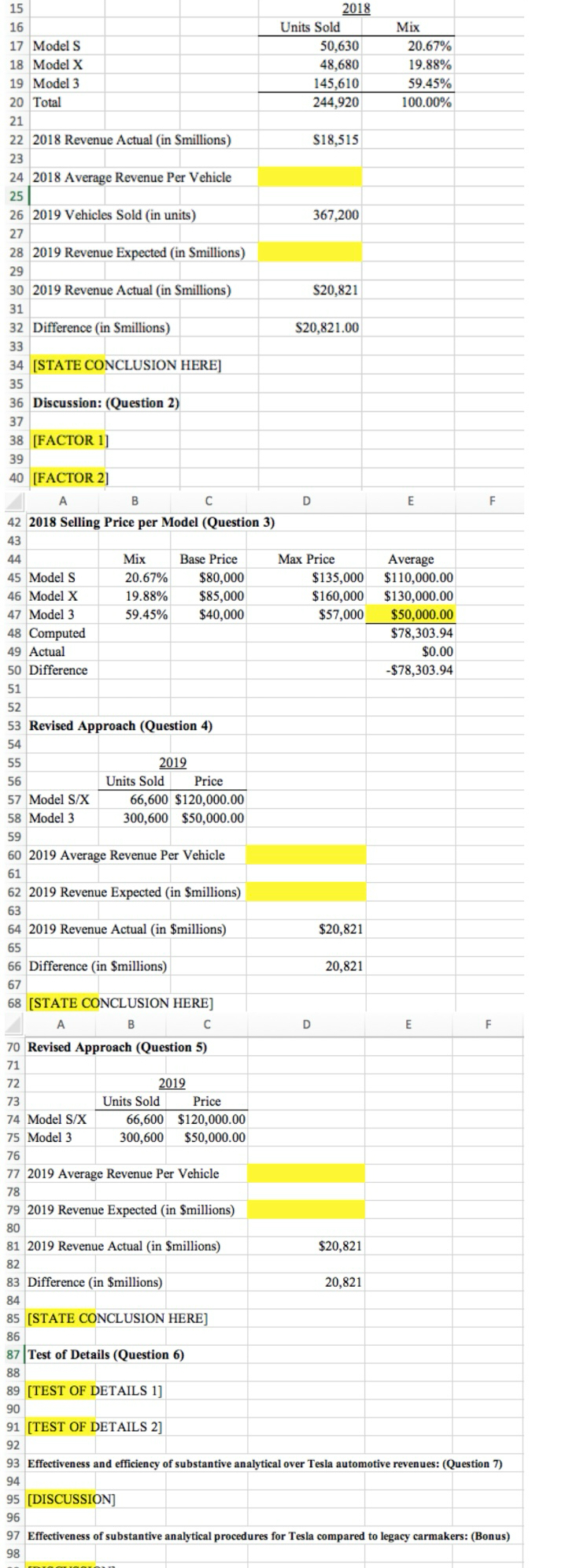
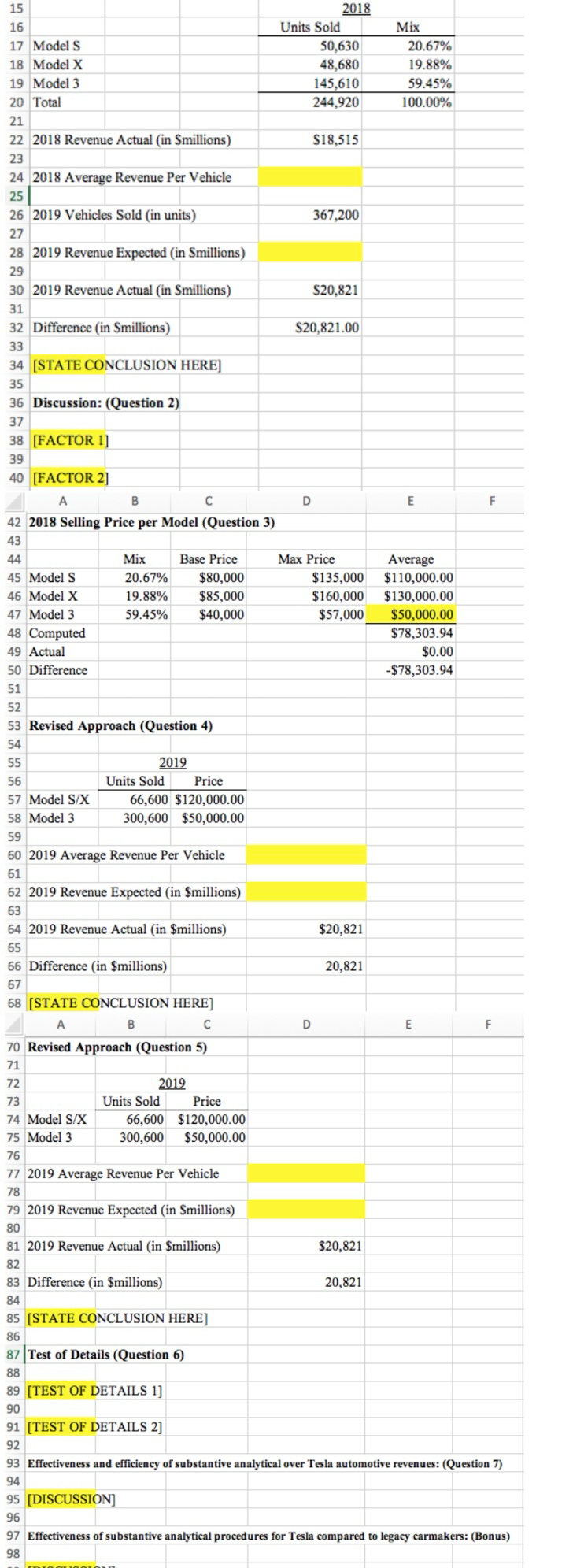
In this case, you will prepare a substantive analytical to audit Teslas total automotive revenues. Information contained in Teslas Form K filed on February will be useful to you. Use a performance materiality threshold of $ million. Submit your responses in the Excel template provided. ONLY responses in the yellow highlighted cells will be evaluated.
Develop an expectation for the total automotive revenues as a function of the simple average revenue per vehicle for and the total vehicles sold in units in What was the average selling price per vehicle in and what is your expected revenue in Based on this evidence alone, does Teslas total automotive revenues appear complete and accurate in all material respects as of and for the year ended December Explain why or why not.
The average revenue per vehicle in is a key input to your expectation of total automotive revenues in Identify and explain two factors that may explain why might average revenue per vehicle in not be consistent with that from
Using the overall average revenue per vehicle for that you computed in Question calculate the average selling price for the Model in taking the average selling prices for Model S and Model X of $ and $ respectively, as given. Round your answer to the nearest penny. Use Excels Solver feature to solve for the average price of the Model that satisfies the system of equations and related constraints.
Using your answer from Question and the average of the selling prices for Model S and Model X prepopulated in template calculate a new average selling price per vehicle as the weighted average by model. Then, calculate a new expected revenue for using this resulting average. This approach disaggregates revenue by model, which should yield a more precise expectation for total revenue. Based on the results of this revised approach, does Teslas total automotive revenues appear complete and accurate in all material respects as of and for the year ended December Explain why or why not.
Now suppose you learn that Tesla lowered the base price of all of its models by $ effective January resulting in a commensurate decrease in the average sales price per vehicle. Calculate a new average revenue per vehicle and expected revenue for incorporating this information. How do you conclude on the fair presentation of total automotive revenues as of and for the year ended December
Describe two tests of details that you could perform to ascertain the completeness, existenceoccurrence accuracy, andor cutoff of total automotive revenues as of and for the year ended December Identify the assertions tested.
Do you think substantive analytical procedures are an effective and efficient approach to gathering audit evidence over automotive revenues for a company like Tesla? Why or why not?
Bonus: Comparing Tesla to a legacy carmaker such as GM Ford, Honda, etc. what is one reason these particular analytical procedures might be more effective for Tesla at gathering evidence for automotive revenues? What is one reason they might be less effective?
PLEASE PROVIDE FORMULAS!!!!
Step by Step Solution
There are 3 Steps involved in it
1 Expert Approved Answer
Step: 1 Unlock

Question Has Been Solved by an Expert!
Get step-by-step solutions from verified subject matter experts
Step: 2 Unlock
Step: 3 Unlock
 Study Help