







Question: In this case, you will use the CAPM to compute the cost of capital for a whole company and for each of its divisions. To
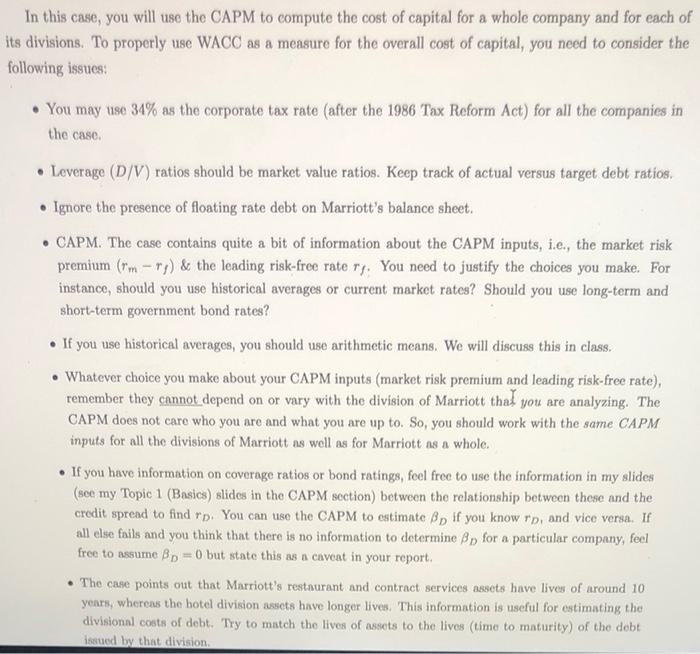

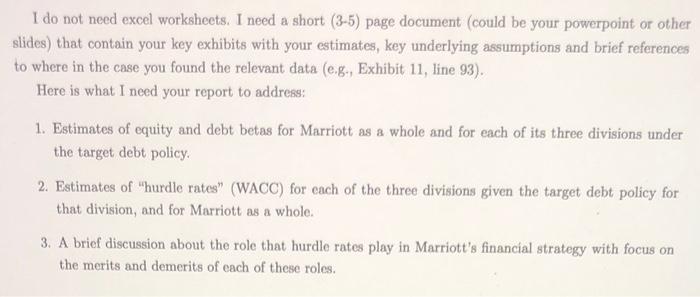
In this case, you will use the CAPM to compute the cost of capital for a whole company and for each of its divisions. To properly use WACC as a measure for the overall cost of capital, you need to consider the following issues: You may use 31% as the corporate tax rate (after the 1986 Tax Reform Act) for all the companies in the case. Leverage (D/V) ratios should be market value ratios. Keep track of actual versus target debt ratios. Ignore the presence of floating rate debt on Marriott's balance sheet CAPM. The case contains quite a bit of information about the CAPM inputs, i.e., the market risk premium (rm -ng) & the leading risk-free rate rs. You need to justify the choices you make. For instance, should you use historical averages or current market rates? Should you use long-term and short-term government bond rates? If you use historical averages, you should use arithmetic means. We will discuss this in class. Whatever choice you make about your CAPM inputs (market risk premium and leading risk-free rate), remember they cannot depend on or vary with the division of Marriott that you are analyzing. The CAPM does not care who you are and what you are up to. So, you should work with the same CAPM inputs for all the divisions of Marriott as well as for Marriott as a whole. If you have information on coverage ratios or bond ratings, feel free to use the information in my slides (soe my Topic 1 (Basics) slidos in the CAPM section) between the relationship between these and the credit spread to find rp. You can use the CAPM to estimate By If you know rp, and vice versa. If all else fails and you think that there is no information to determine By for a particular company, feel free to assume BD = 0 but state this as a caveat in your report. The case points out that Marriott's restaurant and contract services assets have lives of around 10 years, whereas the hotel division assets have longer lives. This information is useful for estimating the divisional costs of debt. Try to match the lives of assets to the lives (time to maturity) of the debt issued by that division . You will need to do a bit of unlevering and relevering for different comparable companies in order to estimate Bg for the different divisions. You will need to make assumptions about the debt policies of the comparables. Make these assumptions clear. One division of Marriott does not have comparables. What can you do for this division? The overall unlevered beta for Marriott must be a weighted average of the divisional unlevered betas. You can use this fact to back out the unlevered beta of the division that has no comparables, as long as you make 1 up your mind on what the appropriate weights are. Using weights proportional to the asset value of each division may be the simplest thing to do. I do not need excel worksheets. I need a short (3-5) page document (could be your powerpoint or other slides) that contain your key exhibits with your estimates, key underlying assumptions and brief references to where in the case you found the relevant data (e.g. Exhibit 11, line 93). Here is what I need your report to address: 1. Estimates of equity and debt betas for Marriott as a whole and for each of its three divisions under the target debt policy I do not need excel worksheets. I need a short (3-5) page document (could be your powerpoint or other slides) that contain your key exhibits with your estimates, key underlying assumptions and brief references to where in the case you found the relevant data (e.g., Exhibit 11, line 93). Here is what I need your report to address: 1. Estimates of equity and debt betas for Marriott as a whole and for each of its three divisions under the target debt policy 2. Estimates of "hurdle rates (WACC) for each of the three divisions given the target debt policy for that division, and for Marriott as a whole. 3. A brief discussion about the role that hurdle rates play in Marriott's financial strategy with focus on the merits and demerits of each of these roles. In this case, you will use the CAPM to compute the cost of capital for a whole company and for each of its divisions. To properly use WACC as a measure for the overall cost of capital, you need to consider the following issues: You may use 31% as the corporate tax rate (after the 1986 Tax Reform Act) for all the companies in the case. Leverage (D/V) ratios should be market value ratios. Keep track of actual versus target debt ratios. Ignore the presence of floating rate debt on Marriott's balance sheet CAPM. The case contains quite a bit of information about the CAPM inputs, i.e., the market risk premium (rm -ng) & the leading risk-free rate rs. You need to justify the choices you make. For instance, should you use historical averages or current market rates? Should you use long-term and short-term government bond rates? If you use historical averages, you should use arithmetic means. We will discuss this in class. Whatever choice you make about your CAPM inputs (market risk premium and leading risk-free rate), remember they cannot depend on or vary with the division of Marriott that you are analyzing. The CAPM does not care who you are and what you are up to. So, you should work with the same CAPM inputs for all the divisions of Marriott as well as for Marriott as a whole. If you have information on coverage ratios or bond ratings, feel free to use the information in my slides (soe my Topic 1 (Basics) slidos in the CAPM section) between the relationship between these and the credit spread to find rp. You can use the CAPM to estimate By If you know rp, and vice versa. If all else fails and you think that there is no information to determine By for a particular company, feel free to assume BD = 0 but state this as a caveat in your report. The case points out that Marriott's restaurant and contract services assets have lives of around 10 years, whereas the hotel division assets have longer lives. This information is useful for estimating the divisional costs of debt. Try to match the lives of assets to the lives (time to maturity) of the debt issued by that division . You will need to do a bit of unlevering and relevering for different comparable companies in order to estimate Bg for the different divisions. You will need to make assumptions about the debt policies of the comparables. Make these assumptions clear. One division of Marriott does not have comparables. What can you do for this division? The overall unlevered beta for Marriott must be a weighted average of the divisional unlevered betas. You can use this fact to back out the unlevered beta of the division that has no comparables, as long as you make 1 up your mind on what the appropriate weights are. Using weights proportional to the asset value of each division may be the simplest thing to do. I do not need excel worksheets. I need a short (3-5) page document (could be your powerpoint or other slides) that contain your key exhibits with your estimates, key underlying assumptions and brief references to where in the case you found the relevant data (e.g. Exhibit 11, line 93). Here is what I need your report to address: 1. Estimates of equity and debt betas for Marriott as a whole and for each of its three divisions under the target debt policy I do not need excel worksheets. I need a short (3-5) page document (could be your powerpoint or other slides) that contain your key exhibits with your estimates, key underlying assumptions and brief references to where in the case you found the relevant data (e.g., Exhibit 11, line 93). Here is what I need your report to address: 1. Estimates of equity and debt betas for Marriott as a whole and for each of its three divisions under the target debt policy 2. Estimates of "hurdle rates (WACC) for each of the three divisions given the target debt policy for that division, and for Marriott as a whole. 3. A brief discussion about the role that hurdle rates play in Marriott's financial strategy with focus on the merits and demerits of each of these roles
Step by Step Solution
There are 3 Steps involved in it

Get step-by-step solutions from verified subject matter experts
 Study Help