







Question: In this exercise we consider a component with a uniform ( = homogeneous ) failure distribution. We assume that the part may fail from the
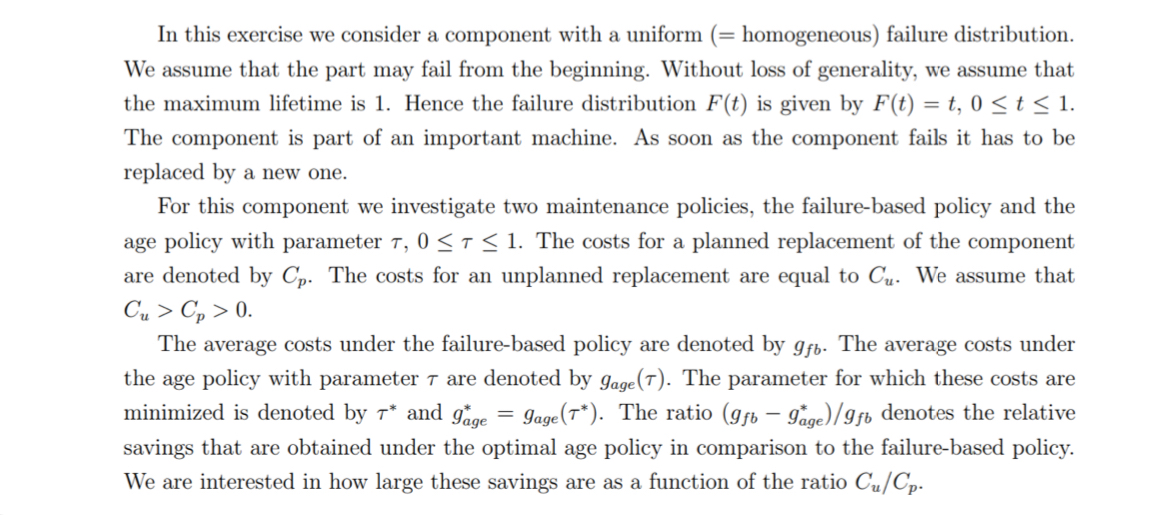
In this exercise we consider a component with a uniform homogeneous failure distribution. We assume that the part may fail from the beginning. Without loss of generality, we assume that the maximum lifetime is Hence the failure distribution is given by The component is part of an important machine. As soon as the component fails it has to be replaced by a new one.
For this component we investigate two maintenance policies, the failurebased policy and the age policy with parameter The costs for a planned replacement of the component are denoted by The costs for an unplanned replacement are equal to We assume that
The average costs under the failurebased policy are denoted by The average costs under the age policy with parameter are denoted by The parameter for which these costs are minimized is denoted by and The ratio denotes the relative savings that are obtained under the optimal age policy in comparison to the failurebased policy. We are interested in how large these savings are as a function of the ratio
Step by Step Solution
There are 3 Steps involved in it
1 Expert Approved Answer
Step: 1 Unlock

Question Has Been Solved by an Expert!
Get step-by-step solutions from verified subject matter experts
Step: 2 Unlock
Step: 3 Unlock
 Study Help