







Question: In this exercise, we will examine how the yield on municipal bonds relates to the yield on taxable bonds and also how bond ratings affect
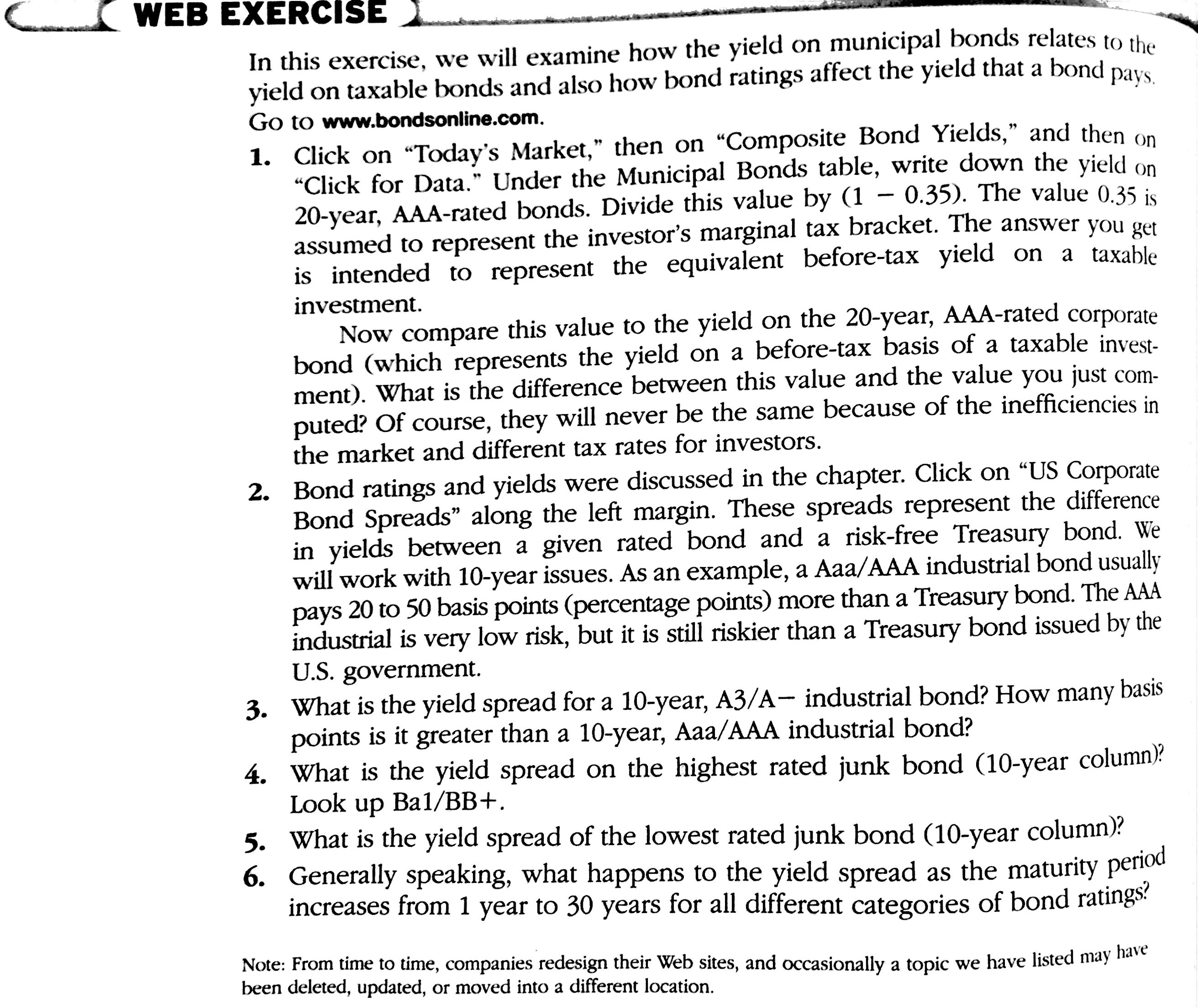
In this exercise, we will examine how the yield on municipal bonds relates to the yield on taxable bonds and also how bond ratings affect the yield that a bond pays Go to www.bondsonline.com. Click on "Today's Market," then on "Composite Bond Yields, and then on "Click for Data." Under the Municipal Bonds table, write down the yield on 20-year, AAA-rated bonds. Divide this value by (1 - 0.35). The value 0.35 is assumed to represent the investor's marginal tax bracket. The answer you get is intended to represent the equivalent before-tax yield on a taxable investment. Now compare this value to the yield on the 20-year, AAA-rated corporate bond (which represents the yield on a before-tax basis of a taxable investment). What is the difference between this value and the value you just computed? Of course, they will never be the same because of the inefficiencies in the market and different tax rates for investors. Bond ratings and yields were discussed in the chapter. Click on "US Corporate Bond Spreads" along the left margin. These spreads represent the difference in yields between a given rated bond and a risk-free Treasury bond. We will work with 10-year issues. As an example, a Aaa/AAA industrial bond usually pays 20 to 50 basis points (percentage points) more than a Treasury bond. The AAA industrial is very low risk, but it is still riskier than a Treasury bond issued by the U.S. government. What is the yield spread for a 10-year, A3/A- industrial bond? How many basis points is it greater than a 10-year, Aaa/AAA industrial bond? What is the yield spread on the highest rated junk bond (10-year column)? Look up Bal/BB+. What is the yield spread of the lowest rated junk bond (10-year column)? Generally speaking, what happens to the yield spread as the maturity period increases from 1 year to 30 years for all different categories of bond ratings? In this exercise, we will examine how the yield on municipal bonds relates to the yield on taxable bonds and also how bond ratings affect the yield that a bond pays Go to www.bondsonline.com. Click on "Today's Market," then on "Composite Bond Yields, and then on "Click for Data." Under the Municipal Bonds table, write down the yield on 20-year, AAA-rated bonds. Divide this value by (1 - 0.35). The value 0.35 is assumed to represent the investor's marginal tax bracket. The answer you get is intended to represent the equivalent before-tax yield on a taxable investment. Now compare this value to the yield on the 20-year, AAA-rated corporate bond (which represents the yield on a before-tax basis of a taxable investment). What is the difference between this value and the value you just computed? Of course, they will never be the same because of the inefficiencies in the market and different tax rates for investors. Bond ratings and yields were discussed in the chapter. Click on "US Corporate Bond Spreads" along the left margin. These spreads represent the difference in yields between a given rated bond and a risk-free Treasury bond. We will work with 10-year issues. As an example, a Aaa/AAA industrial bond usually pays 20 to 50 basis points (percentage points) more than a Treasury bond. The AAA industrial is very low risk, but it is still riskier than a Treasury bond issued by the U.S. government. What is the yield spread for a 10-year, A3/A- industrial bond? How many basis points is it greater than a 10-year, Aaa/AAA industrial bond? What is the yield spread on the highest rated junk bond (10-year column)? Look up Bal/BB+. What is the yield spread of the lowest rated junk bond (10-year column)? Generally speaking, what happens to the yield spread as the maturity period increases from 1 year to 30 years for all different categories of bond ratings
Step by Step Solution
There are 3 Steps involved in it

Get step-by-step solutions from verified subject matter experts
 Study Help