







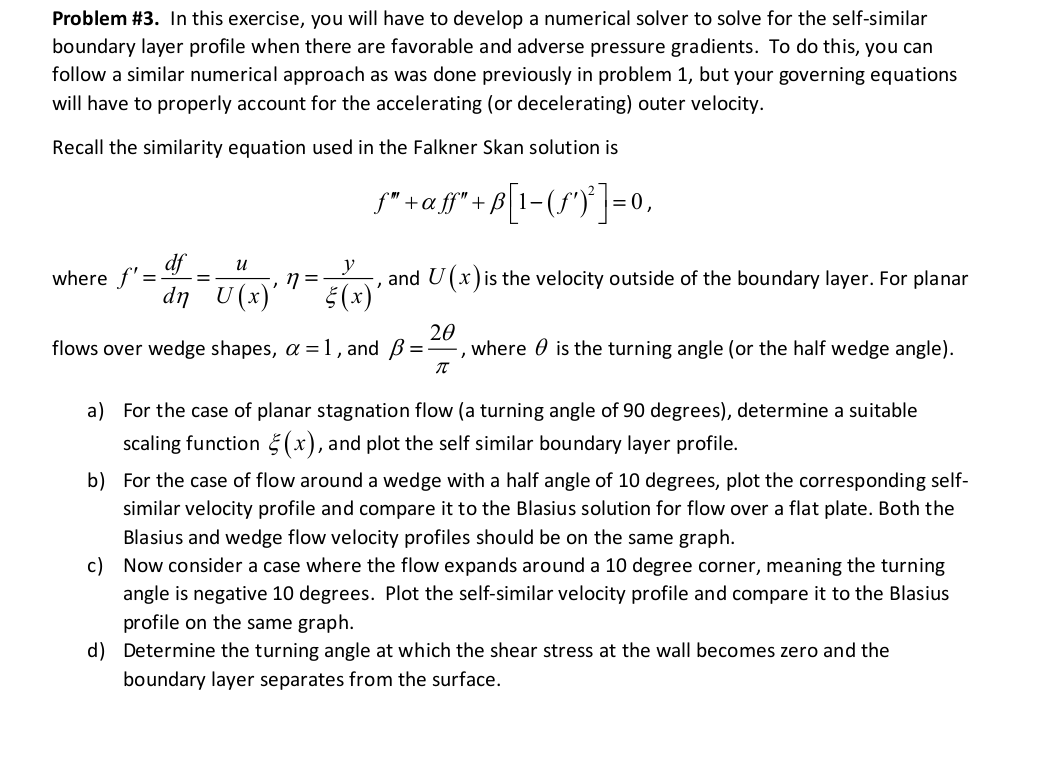
Question: In this exercise, you will have to develop a numerical solver to solve for the self - similar boundary layer profile when there are favorable
In this exercise, you will have to develop a numerical solver to solve for the selfsimilar
boundary layer profile when there are favorable and adverse pressure gradients. To do this, you can
follow a similar numerical approach as was done previously in problem but your governing equations
will have to properly account for the accelerating or decelerating outer velocity.
Recall the similarity equation used in the Falkner Skan solution is
f ff f
alpha beta
where
df u
f d Ux
eta
y
x
eta xi
and U x is the velocity outside of the boundary layer. For planar
flows over wedge shapes, alpha and beta
pi
theta where theta is the turning angle or the half wedge angle
a For the case of planar stagnation flow a turning angle of degrees determine a suitable
scaling function
x
xi
and plot the self similar boundary layer profile.
b For the case of flow around a wedge with a half angle of degrees, plot the corresponding selfsimilar velocity profile and compare it to the Blasius solution for flow over a flat plate. Both the
Blasius and wedge flow velocity profiles should be on the same graph.
c Now consider a case where the flow expands around a degree corner, meaning the turning
angle is negative degrees. Plot the selfsimilar velocity profile and compare it to the Blasius
profile on the same graph.
d Determine the turning angle at which the shear stress at the wall becomes zero and the
boundary layer separates from the surface.
Problem # In this exercise, you will have to develop a numerical solver to solve for the selfsimilar boundary layer profile when there are favorable and adverse pressure gradients. To do this, you can follow a similar numerical approach as was done previously in problem but your governing equations will have to properly account for the accelerating or decelerating outer velocity.
Recall the similarity equation used in the Falkner Skan solution is
where and is the velocity outside of the boundary layer. For planar flows over wedge shapes, and where is the turning angle or the half wedge angle
a For the case of planar stagnation flow a turning angle of degrees determine a suitable scaling function and plot the self similar boundary layer profile.
b For the case of flow around a wedge with a half angle of degrees, plot the corresponding selfsimilar velocity profile and compare it to the Blasius solution for flow over a flat plate. Both the Blasius and wedge flow velocity profiles should be on the same graph.
c Now consider a case where the flow expands around a degree corner, meaning the turning angle is negative degrees. Plot the selfsimilar velocity profile and compare it to the Blasius profile on the same graph.
d Determine the turning angle at which the shear stress at the wall becomes zero and the boundary layer separates from the surface.
Step by Step Solution
There are 3 Steps involved in it
1 Expert Approved Answer
Step: 1 Unlock

Question Has Been Solved by an Expert!
Get step-by-step solutions from verified subject matter experts
Step: 2 Unlock
Step: 3 Unlock
 Study Help