







Question: In this exercise you will test a hypothesis that electoral systems affect turnout: In a comparison of 100 countries, countries with proportional representation electoral systems
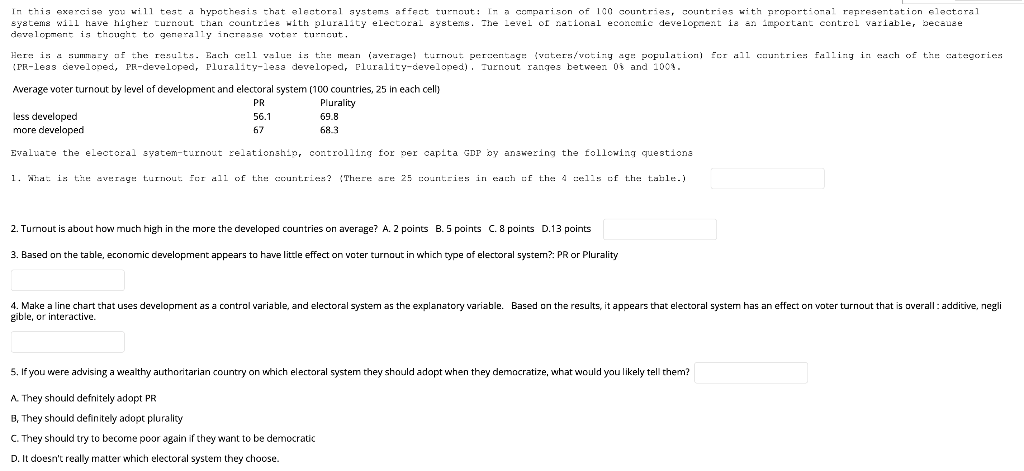
In this exercise you will test a hypothesis that electoral systems affect turnout: In a comparison of 100 countries, countries with proportional representation electoral systems will have higher curnout than countries with plurality electoral eystems. The level of nacional economic development is an important control variable, because development is thought to generally increase voter turnout, Here is a summary at the results. Each cell value is the mean averagel turnout percentage veters/vetiy age population for all countries falling in each of the categories (PR-less developed, PR-developed, Plurality-less developed, plurality-developed). Jurnout ranges between 01 and 1001. Average voter turnout by level of development and electoral system (100 countries, 25 in each cell) PR Plurality less developed 56.1 69.8 more developed 68.3 62 Evaluate the electoral svatem-turnout relationsho, controlling for per capita GDP by answering the following questions 1. What is the average turnout. For all of the countriex? There are 25 countries in each of the sells of the table.) 2. Turnout is about how much high in the more the developed countries on average? A. 2 points B.5 points C. 8 points D.13 points 3. Based on the table, economic development appears to have little effect on voter turnout in which type of electoral system?: PR or Plurality 4. Make a line chart that uses development as a control variable, and electoral system as the explanatory variable. Based on the results, it appears that electoral system has an effect on voter turnout that is overall: additive, negli gible, or interactive. 5. If you were advising a wealthy authoritarian country on which electoral system they should adopt when they democratize, what would you likely tell them? A. They should defnitely adopt PR B. They should definitely adopt plurality C. They should try to become poor again if they want to be democratic D. It doesn't really matter which electoral system they choose. In this exercise you will test a hypothesis that electoral systems affect turnout: In a comparison of 100 countries, countries with proportional representation electoral systems will have higher curnout than countries with plurality electoral eystems. The level of nacional economic development is an important control variable, because development is thought to generally increase voter turnout, Here is a summary at the results. Each cell value is the mean averagel turnout percentage veters/vetiy age population for all countries falling in each of the categories (PR-less developed, PR-developed, Plurality-less developed, plurality-developed). Jurnout ranges between 01 and 1001. Average voter turnout by level of development and electoral system (100 countries, 25 in each cell) PR Plurality less developed 56.1 69.8 more developed 68.3 62 Evaluate the electoral svatem-turnout relationsho, controlling for per capita GDP by answering the following questions 1. What is the average turnout. For all of the countriex? There are 25 countries in each of the sells of the table.) 2. Turnout is about how much high in the more the developed countries on average? A. 2 points B.5 points C. 8 points D.13 points 3. Based on the table, economic development appears to have little effect on voter turnout in which type of electoral system?: PR or Plurality 4. Make a line chart that uses development as a control variable, and electoral system as the explanatory variable. Based on the results, it appears that electoral system has an effect on voter turnout that is overall: additive, negli gible, or interactive. 5. If you were advising a wealthy authoritarian country on which electoral system they should adopt when they democratize, what would you likely tell them? A. They should defnitely adopt PR B. They should definitely adopt plurality C. They should try to become poor again if they want to be democratic D. It doesn't really matter which electoral system they choose
Step by Step Solution
There are 3 Steps involved in it

Get step-by-step solutions from verified subject matter experts
 Study Help