







Question: In this homework, you will be comparing the performances empirically for Insertion sort, Quick sort, Merge sort and Radix sort. You may find starting code
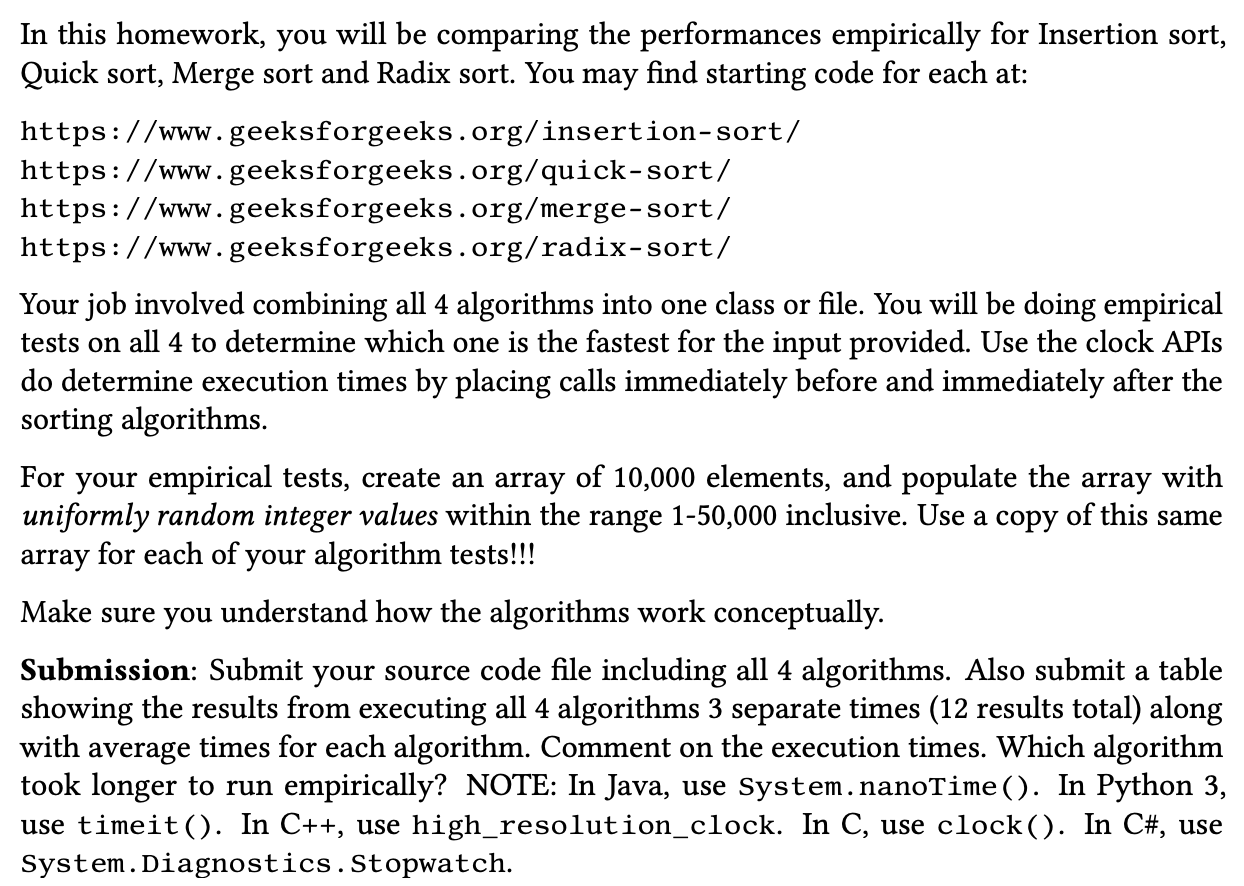
In this homework, you will be comparing the performances empirically for Insertion sort, Quick sort, Merge sort and Radix sort. You may find starting code for each at: https://www.geeksforgeeks .org/insertion-sort/ https://www. geeksforgeeks . org/quick-sort/ https: //www. geeksforgeeks . org/merge-sort/ https: //www. geeksforgeeks . org/radix-sort/ Your job involved combining all 4 algorithms into one class or file. You will be doing empirical tests on all 4 to determine which one is the fastest for the input provided. Use the clock APIs do determine execution times by placing calls immediately before and immediately after the sorting algorithms. For your empirical tests, create an array of 10,000 elements, and populate the array with uniformly random integer values within the range 1-50,000 inclusive. Use a copy of this same array for each of your algorithm tests!!! Make sure you understand how the algorithms work conceptually. Submission: Submit your source code file including all 4 algorithms. Also submit a table showing the results from executing all 4 algorithms 3 separate times (12 results total) along with average times for each algorithm. Comment on the execution times. Which algorithm took longer to run empirically? NOTE: In Java, use System. nanoTime( ). In Python 3 , use timeit(). In C++, use high_resolution_clock. In C, use clock(). In C\#, use System.Diagnostics.Stopwatch
Step by Step Solution
There are 3 Steps involved in it

Get step-by-step solutions from verified subject matter experts
 Study Help