







Question: In this lab, we will develop the digital signal code for a very basic, notional codec. A specialized application has been developed which needs to
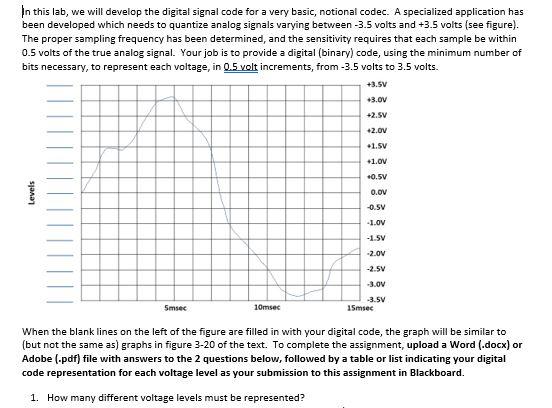
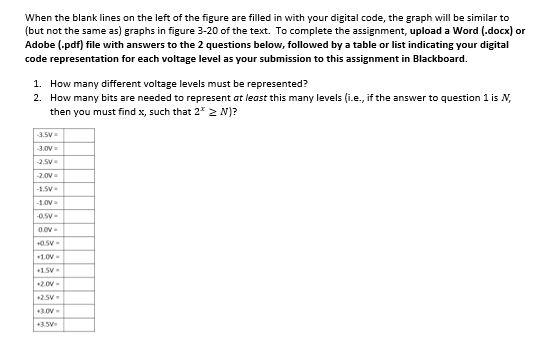
In this lab, we will develop the digital signal code for a very basic, notional codec. A specialized application has been developed which needs to quantize analog signals varying between -3.5 volts and +3.5 volts (see figure). The proper sampling frequency has been determined, and the sensitivity requires that each sample be within 0.5 volts of the true analog signal. Your job is to provide a digital (binary) code, using the minimum number of bits necessary, to represent each voltage, in 0.5 volt increments, from -3.5 volts to 3.5 volts. +3.5V *3.0V +2.5V +2.0V 1.5V +1.0v Levels +0.5V O.OV -0.5V -1.0V -1.5V -2.0v -2.5V -3.0V Smsec 10msec -3.5V 15msec When the blank lines on the left of the figure are filled in with your digital code, the graph will be similar to (but not the same as) graphs in figure 3-20 of the text. To complete the assignment, upload a Word (.docx) or Adobe (.pdf) file with answers to the 2 questions below, followed by a table or list indicating your digital code representation for each voltage level as your submission to this assignment in Blackboard. 1. How many different voltage levels must be represented? When the blank lines on the left of the figure are filled in with your digital code, the graph will be similar to (but not the same as) graphs in figure 3-20 of the text. To complete the assignment, upload a Word (.docx) or Adobe (.pdf) file with answers to the 2 questions below, followed by a table or list indicating your digital code representation for each voltage level as your submission to this assignment in Blackboard. 1. How many different voltage levels must be represented? 2. How many bits are needed to represent at least this many levels (ie., if the answer to question 1 is N, then you must find , such that 2* 2 N)? -3.5V 3.0V -2.5V -2.0 -1.5V -1.0 -0.5 0.- 05V- -1.0V +15V 2.0 - +25V 3.0V +35V
Step by Step Solution
There are 3 Steps involved in it

Get step-by-step solutions from verified subject matter experts
 Study Help