







Question: In this lab, you will write a program that computes the following physics motion equations vo at vi 2- zf zo vo t 3. vf
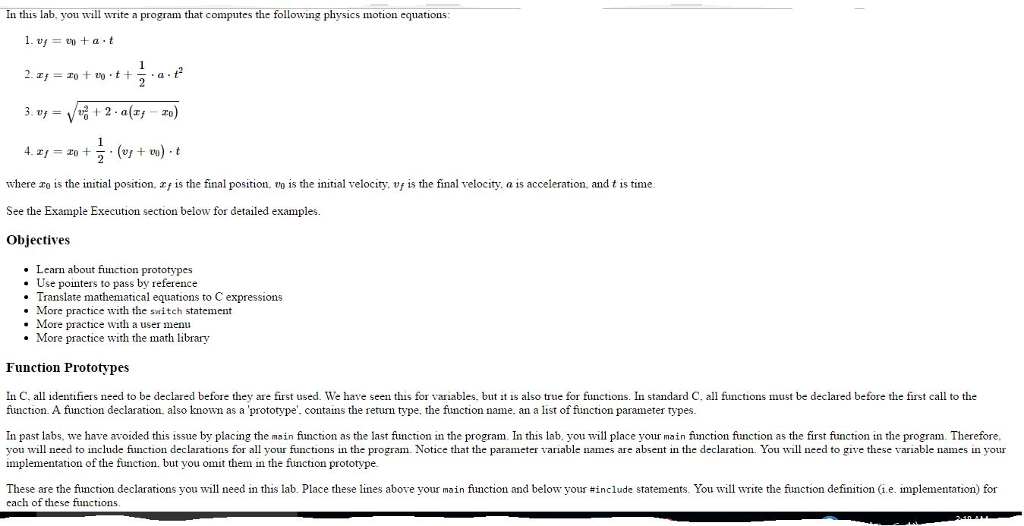
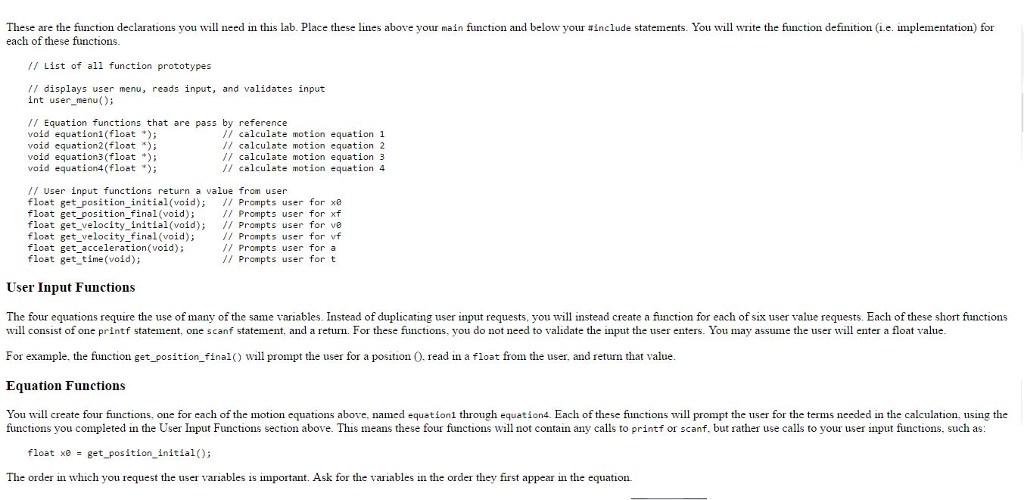
In this lab, you will write a program that computes the following physics motion equations vo at vi 2- zf zo vo t 3. vf (vs vo) t where zo is the initial position. zf is the final position. vo is the initial velocity vf is the final velocity a is acceleration. and t is time. See the Example Execution section below for detailed examples. Objectives Learn about function prototypes Use pointers to pass by reference Translate mathematical equations to C expressions More practice with the switch statement More practice with a user menu More practice with the math library Function Prototypes In C. all identifiers need to be declared before they are first used. We have seen this for variables. but it is also true for functions. In standard C, all functions must be declared before the first call to the function. A function declaration. also known as a prototype contains the return type. the function name. an a list of function parameter types. In past labs, we have avoided this issue by placing the main function as the last function in the program. In this lab, you will place your main finction function as the first function in the program. Therefore you will need to include function declarations for all your functions in the program. Notice that the parameter v names are absent in the declaration. You will need to give these variable name in your s implementation of the function, but you omit them in the function prototype. These are the function declarations you will need in this lab. Place these lines above your main function and below your #include statements. You will write the function definition e. implementation) for each of these functions
Step by Step Solution
There are 3 Steps involved in it

Get step-by-step solutions from verified subject matter experts
 Study Help